Capital Gains Tax on Property in Kenya: Rates, Exemptions, and How to Calculate (2026)
Capital gains tax on property in Kenya is 15% of the net gain. Learn how to calculate CGT, which exemptions apply, how to file on iTax, and 2026 updates.
Capital Gains Tax on Property in Kenya: Rates, Exemptions, and How to Calculate (2026)
If you sell land, a house, or an apartment in Kenya for more than you paid for it, you owe capital gains tax on the profit. The current rate is 15% of the net gain, and it is a final tax — meaning it cannot be offset against other income and the gain is not added to your taxable income for the year. Capital gains tax (CGT) applies to every transfer of property situated in Kenya, regardless of when the property was acquired and regardless of whether the seller is a Kenyan citizen, a diaspora investor, or a foreign national. This guide explains how CGT works in 2026, how to calculate it, which exemptions may apply to your transaction, and the filing process through iTax.
CGT is the seller's responsibility, not the buyer's. But buyers need to understand it too: the KRA now "twins" CGT and stamp duty in the iTax system, meaning the buyer's stamp duty payment cannot be completed until the seller has either declared and paid CGT or provided proof of a valid exemption. If the seller has not handled CGT, your transfer stalls at the registry.
CGT in Kenya: History and Current Rate
Capital gains tax was first introduced in Kenya in 1975, then suspended in 1985 to encourage real estate investment. It was reintroduced on 1 January 2015 at a rate of 5% of the net gain. The Finance Act 2022 tripled the rate to 15%, effective 1 January 2023. This is the rate that applies to all property transfers in 2026.
Period | CGT rate | Notes |
|---|---|---|
1975–1985 | Varied | Original CGT regime |
1985–2014 | Suspended | No CGT on property transfers |
1 Jan 2015 – 31 Dec 2022 | 5% | Reintroduced by Finance Act 2014 |
1 Jan 2023 – present | 15% | Finance Act 2022. Final tax. |
May 2026 update: President Ruto signed the Income Tax (Amendment) Act on 11 May 2026. Key change for property: CGT is now exempt on transfers of property into registered Real Estate Investment Trusts (REITs), along with exemption on internal corporate reorganisations where no third-party transaction occurs. The standard 15% rate for individual property sales remains unchanged. The Finance Bill 2026 (separately under public participation as of mid-May) proposes expanding CGT on non-resident share transfers linked to Kenyan assets, but the 15% rate on direct property sales is not being altered.
What Property Is Subject to CGT?
CGT applies to any transfer of property situated in Kenya. Under the Eighth Schedule of the Income Tax Act, "transfer" includes sale, exchange, conveyance, gift, or disposal in any manner. "Property" includes:
Land (freehold or leasehold, agricultural or urban)
Buildings and houses
Apartments and sectional titles
Shares not listed on the Nairobi Securities Exchange (private equity)
Since July 2023: shares in foreign entities that derive more than 20% of their value from immovable property in Kenya
CGT is triggered at the point of transfer — specifically, upon registration of the transfer instrument at the Lands Registry or upon receipt of the full purchase price, whichever comes first.
How to Calculate Capital Gains Tax
The formula is straightforward, but the details matter:
Component | Definition |
|---|---|
Transfer value | The sale price (or market value if the transaction is between related parties) |
Less: Incidental costs of transfer | Advocate fees, valuation fees, agent commissions directly related to the sale |
= Net transfer value | |
Less: Adjusted cost | Original purchase price + stamp duty paid on acquisition + legal fees on acquisition + cost of improvements (with receipts) + cost of defending title |
= Capital gain (or loss) | |
× 15% | CGT payable |
Worked Examples
Example 1: Simple plot sale in Ruiru
Item | Amount (KES) |
|---|---|
Sale price (2026) | 5,000,000 |
Less: Agent commission (3%) | -150,000 |
Less: Advocate fees on sale | -80,000 |
Net transfer value | 4,770,000 |
Purchase price (2019) | 2,000,000 |
Plus: Stamp duty paid on acquisition (4%) | 80,000 |
Plus: Legal fees on acquisition | 50,000 |
Plus: Fencing and borehole (with receipts) | 300,000 |
Adjusted cost | 2,430,000 |
Capital gain | 2,340,000 |
CGT at 15% | 351,000 |
Example 2: Apartment in Kilimani
Item | Amount (KES) |
|---|---|
Sale price (2026) | 15,000,000 |
Less: Incidental costs of sale | -500,000 |
Net transfer value | 14,500,000 |
Purchase price (2020) | 12,000,000 |
Plus: Acquisition costs | 600,000 |
Plus: Renovations (kitchen, bathroom — with receipts) | 800,000 |
Adjusted cost | 13,400,000 |
Capital gain | 1,100,000 |
CGT at 15% | 165,000 |
Example 3: Agricultural land sold at a loss
If the adjusted cost exceeds the net transfer value, you have a capital loss. No CGT is payable. However, you cannot carry forward the loss to offset future capital gains — each transaction is assessed independently under Kenyan law.
The Exemptions: When CGT Does Not Apply
Several property transfers are exempt from CGT under the Eighth Schedule of the Income Tax Act. These exemptions do not apply automatically — the seller must apply to the Kenya Revenue Authority and provide documentation to obtain approval.
Exemption | Conditions |
|---|---|
Low-value transfers (≤ KES 3 million) | Transfer value must not exceed KES 3 million. Applies to land only (not shares). |
Primary residence (3-year rule) | Individual owner must have occupied the property continuously for at least 3 years immediately before the sale. Only one exemption per person at a time. |
Agricultural land < 50 acres outside municipalities | Property must be agricultural, less than 50 acres, and situated outside any municipality, gazetted township, or area declared urban by the Minister. |
Estate administration | Transfer by a personal representative to a beneficiary during estate administration. Must be completed within 2 years of death (or 2 years from finalisation of any court case regarding the estate). |
Transfer to family trust | Transfer of immovable property to a registered family trust under the Trustees (Perpetual Succession) Act. Introduced by Finance Act 2021. |
Spousal transfers | Transfer between spouses or former spouses as part of a divorce settlement or bona fide separation agreement. |
Security for debt | Transfer for the purpose only of securing a debt or loan, and the re-transfer by the creditor returning the security. |
Internal corporate reorganisation | Transfer within a group that has existed for at least 24 months, involving no third-party transfer. Strengthened by the Income Tax (Amendment) Act signed May 2026. |
Transfer to REITs (new, 2026) | Transfer of property into a registered Real Estate Investment Trust under Section 20(1) of the Capital Markets Act. Exempt from both CGT and stamp duty. Effective from the 2026/27 financial year. |
Common Exemption Mistakes
Assuming the 3-year residence rule applies to investment properties. It does not. The exemption is for your primary residence only — the one you actually lived in for 3 continuous years. A rental property you owned for 10 years still attracts CGT when sold.
Assuming agricultural land < 50 acres is automatically exempt. The land must also be outside a municipality or gazetted township. A 10-acre plot in Nairobi is not exempt even though it is under 50 acres.
Forgetting that exemptions require a KRA application. You must proactively file for the exemption through iTax. If you just skip the CGT declaration and proceed to stamp duty, the system will block the stamp duty payment.
How to File and Pay CGT Through iTax
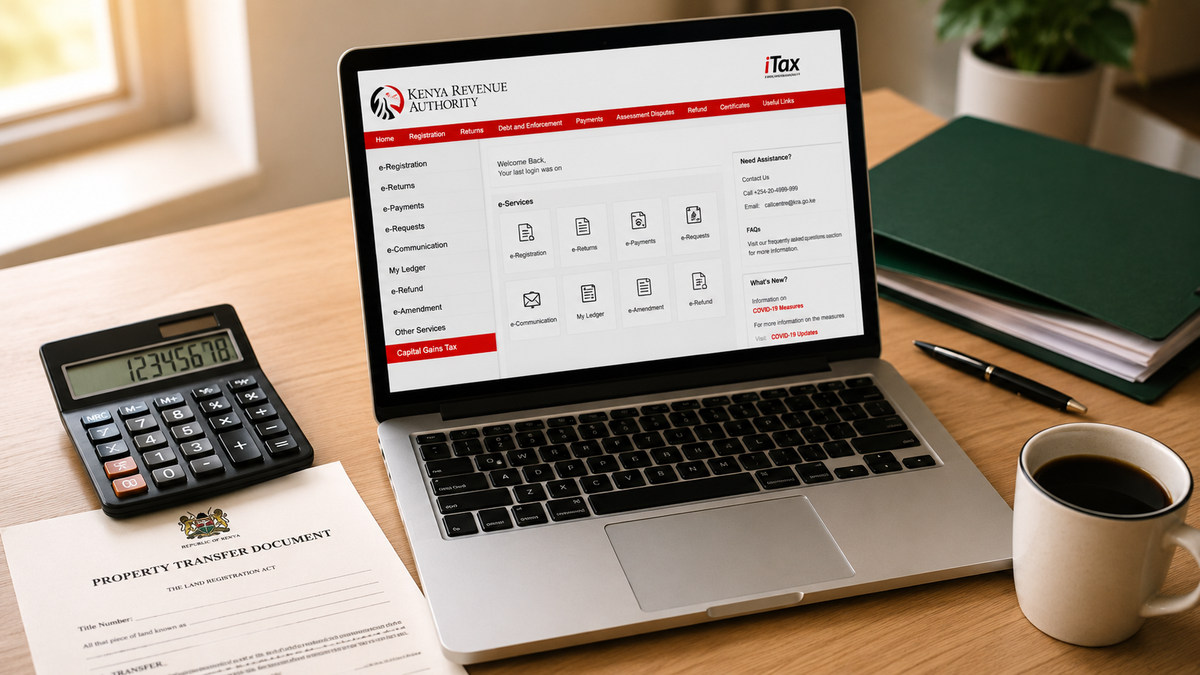
CGT is filed and paid through the KRA's iTax portal. The process is linked to the stamp duty workflow — the system requires CGT to be resolved before stamp duty can be finalised.
Step | Action |
|---|---|
1 | Log in to iTax (itax.kra.go.ke) using your KRA PIN and password. |
2 | Navigate to Payments → Payment Registration → Tax Head: Income Tax → Sub Head: Capital Gains Tax. |
3 | Enter transaction details: property description, transfer value, adjusted cost, and the computed gain. |
4 | If claiming an exemption, select the applicable exemption category and upload supporting documents. |
5 | The system calculates CGT payable (or confirms exemption). Generate a payment slip. |
6 | Pay via M-Pesa Paybill, bank transfer, or over the counter. Retain the e-receipt. |
7 | The CGT receipt is linked to the stamp duty application on Ardhipay. Without it, stamp duty cannot be processed. |
Tax point (due date): CGT is payable upon the earlier of receipt of the full purchase price by the seller or registration of the transfer. In practice, your advocate should ensure CGT is declared and paid before lodging the transfer documents at the registry.
CGT and Your Overall Transfer Cost
CGT is the seller's cost, but it affects buyers indirectly. Sellers who have not budgeted for CGT may delay the transfer while they find the money, or they may try to pass the cost on by inflating the price. Understanding CGT helps buyers negotiate fairly and set realistic completion timelines.
For a complete breakdown of all buyer-side costs, see our guide on total costs of buying property in Kenya. For sellers, CGT sits alongside these other potential costs:
Seller's cost | Typical amount |
|---|---|
Capital Gains Tax | 15% of net gain |
Advocate fees | 1–2% of value + 16% VAT (min KES 28,000) |
Land Rates Clearance Certificate | KES 5,000–10,000 (plus any outstanding rates) |
Land Rent Clearance Certificate | Usually free (if rent is current) |
Agent commission | Typically 3–5% of sale price |
For Diaspora Sellers: CGT on Kenya Property Sold from Abroad
If you are a Kenyan citizen in the USA, UK, UAE, or Canada and you sell property in Kenya, you owe Kenyan CGT on the gain — regardless of where you reside. Kenya taxes based on where the property is situated, not where the seller lives.
Additionally, you may owe tax in your country of residence on the same gain. Most countries tax their residents on worldwide income — meaning you could face double taxation on the same property sale. However:
Kenya has Double Tax Agreements (DTAs) with the UK, Canada, India, Germany, France, and several other countries. These treaties typically give the country where the property is located (Kenya) the primary right to tax, and the resident country gives a credit for tax paid in Kenya.
The USA does not have a DTA with Kenya, but US taxpayers can claim a Foreign Tax Credit on their US return for CGT paid in Kenya, avoiding full double taxation.
The UAE has no personal income tax, so Kenyan CGT is the only tax on the gain for UAE-based sellers.
Consult a tax professional in both Kenya and your country of residence before selling. The interaction between Kenyan CGT and foreign tax obligations is specific to your situation, and getting it wrong can be expensive.
Strategies to Legally Reduce CGT
These are legitimate approaches under the current law — not loopholes, and not avoidance schemes:
Keep all improvement receipts. Every shilling you spent on fencing, boreholes, renovations, landscaping, or structural additions is deductible from the gain — but only with documented proof. No receipts means no deduction.
Include all acquisition costs. Stamp duty paid when you bought the property, legal fees, valuation fees, and survey costs all form part of the adjusted cost.
Occupy the property for 3+ years. If you live in the property as your primary residence for at least 3 continuous years before selling, the entire gain is exempt. This requires genuine occupancy, not just ownership.
Transfer to a family trust. If your goal is intergenerational wealth planning rather than a sale, transferring property to a registered family trust is exempt from both CGT and stamp duty.
Time the sale relative to improvements. Completing improvements (and documenting them) before selling increases your adjusted cost and reduces the taxable gain.
What does NOT work: Underdeclaring the sale price on the agreement. KRA valuers will assess on the higher of the declared price or government valuation. Under-reporting triggers scrutiny and potential penalties. If the sale is between related parties, KRA will adjust to market value.
The Finance Bill 2026: What May Change
As of mid-May 2026, the Finance Bill 2026 is under public participation. For property owners, the key proposed changes are:
CGT on non-resident share transfers — gains from disposing of shares in foreign entities that derive value from Kenyan property would be brought within the CGT net. This primarily affects offshore holding structures used in commercial real estate.
REIT incentive — already signed into law (Income Tax Amendment Act, May 2026): transfers of property into registered REITs are exempt from both CGT and stamp duty, encouraging investment in the formal REIT market.
Residential rental income tax increase — proposed increase from 7.5% to 10% for resident landlords (separate from CGT, but affects the overall tax burden on property investment).
These proposals may change during the parliamentary process. The standard 15% CGT rate on direct property sales by individuals is not proposed for change in the current Finance Bill.
Frequently Asked Questions
Who pays capital gains tax in Kenya — the buyer or the seller?
The seller (transferor) pays CGT. It is calculated on the gain the seller makes from the sale. However, buyers are affected indirectly: KRA's iTax system twins CGT and stamp duty, meaning the buyer's stamp duty payment cannot proceed until the seller has declared and paid (or been exempted from) CGT.
Is inherited property subject to capital gains tax?
The transfer of property from a deceased person's estate to a beneficiary is exempt from CGT, provided the transfer is completed within 2 years of the death (or 2 years from the finalisation of any related court case). However, if the beneficiary later sells the inherited property at a profit, that sale is subject to CGT. The base cost is typically the fair market value of the property at the time of inheritance.
Can I carry forward a capital loss to offset future gains?
No. Under Kenyan law, capital losses cannot be carried forward to offset future capital gains. Each transaction is assessed independently. If you sell at a loss, no CGT is payable on that transaction, but you cannot use the loss to reduce tax on a profitable sale in the future.
What happens if I do not pay CGT before transferring property?
The transfer will stall. KRA's twinning of CGT and stamp duty means the Lands Registry will not register the transfer unless stamp duty has been paid, and stamp duty cannot be finalised until CGT is resolved. If you proceed without declaring CGT, you risk penalties, interest, and potential prosecution for tax evasion.
Does selling my home attract capital gains tax?
Only if you have not lived in it continuously for at least 3 years immediately before the sale. If you have occupied the property as your primary residence for 3+ continuous years, the sale is exempt from CGT. Rental properties and second homes do not qualify for this exemption, regardless of how long you have owned them.
Has the CGT rate changed in 2026?
The standard CGT rate remains 15% of the net gain as of May 2026. The Income Tax (Amendment) Act signed on 11 May 2026 introduced new exemptions (notably for REIT transfers and internal corporate reorganisations) but did not change the rate. The Finance Bill 2026, currently under public participation, does not propose changing the 15% rate for direct property sales.
Explore Further
How to Transfer Land in Kenya: Complete Step-by-Step Guide (2026) — the full transfer process including stamp duty
Sale Agreement for Land in Kenya — get the legal foundation right
Consent to Transfer Land in Kenya — LCB and NLC consent requirements
Total Cost of Buying Property in Kenya — all 12 costs in one guide
Kenya Land Prices 2026 — current market context
Other Guides

Living in Juja, Kiambu: The University Town That Became a Satellite City — Prices, Estates & Honest Guide (2026)
Juja houses from KSh 1.2M, rent from KSh 2.5K. JKUAT area, Kenyatta Road estates, Kalimoni, Witeithie. Student yields 9-15%.

Westlands Property Guide: Prices, Lifestyle & Investment (2026)
Complete guide to Westlands real estate. Apartments from KES 8M, rental yields 6-8%, plus lifestyle amenities. Browse verified Westlands listings today.

Houses for Sale in Karen: Price Guide 2026
Karen house prices from KES 35M–250M+. 4-bedroom, 5-bedroom, villas. Karen Hardy, Ndege Road, budget breakdown. Updated March 2026.