Property Tax in Kenya: Every Tax You Pay as an Owner, Landlord, or Seller (2026)
All 5 property taxes in Kenya explained: land rates, land rent, rental income tax, CGT, and stamp duty. Rates, deadlines, penalties, and how to pay.
Property Tax in Kenya: Every Tax You Pay as an Owner, Landlord, or Seller (2026)
There is no single "property tax" in Kenya. Instead, property owners face a web of five separate taxes and levies, each governed by different legislation, collected by different authorities, and due on different dates. Confusing them — or forgetting one entirely — leads to penalties that compound monthly, transfers that stall at the registry, and in extreme cases, county governments that can clamp or auction your property for unpaid rates. This guide maps every property-related tax in Kenya as of 2026: what it is, who collects it, how much you owe, when to pay, and what happens if you do not.
Whether you own a single plot in Ruiru, rent out apartments in Kilimani, or manage a diaspora investment from the USA or UK, these taxes apply to you. Understanding the full picture is what separates property owners who build wealth from those who bleed it in penalties and compliance costs.
The 5 Property Taxes in Kenya at a Glance
Tax | Paid to | Applies to | Rate | When due |
|---|---|---|---|---|
Land rates | County government | All rateable property in rated areas | Varies by county (typically 0.1% of site value or flat rate by zone) | Annually, by 30 June |
Land rent | National government (Ministry of Lands) | Leasehold property only | KES 1,000–10,000+ per acre/year | Annually, by 31 January |
Rental income tax | KRA | Landlords earning rental income | 7.5% MRI (residential, ≤KES 15M/yr) or graduated rates | Monthly by 20th of following month |
Capital gains tax | KRA | Sellers transferring property | 15% of net gain | Upon transfer registration |
Stamp duty | KRA (via Ardhipay) | Buyers on transfer | 4% urban / 2% rural | Before registration |
The first two — land rates and land rent — are ongoing ownership costs that you pay every year for as long as you hold the property. The last three — rental income tax, CGT, and stamp duty — are event-triggered and only apply when you rent out the property, sell it, or buy a new one. This article focuses primarily on the ongoing costs, since the event-triggered taxes are covered in depth in our dedicated guides: capital gains tax, stamp duty and the transfer process, and total buying costs.
Land Rates: The County Property Tax
Land rates are the closest thing Kenya has to a traditional property tax. They are annual levies charged by county governments on all rateable property within their jurisdiction, governed by the Rating Act (Cap 267), now supplemented by the National Rating Act, 2024, and authorised under Article 209(3) of the Constitution. The revenue funds county services: roads, waste collection, street lighting, drainage, and general infrastructure.
How Land Rates Are Calculated
Counties use one of two main methods:
Method | How it works | Where used |
|---|---|---|
Unimproved Site Value (USV) | The land is valued as if it were vacant — buildings and improvements are ignored. The county applies a rate (typically around 0.1%) to this unimproved value. | Nairobi and most major urban centres |
Area rating (flat rate by zone) | Properties are grouped into zones based on location and size. Each zone has a fixed annual charge regardless of the specific site value. | Smaller counties and some sub-counties within larger counties |
Under USV, a plot in Westlands valued at KES 50,000,000 (unimproved site value) at a rate of 0.1% would pay KES 50,000 per year. A plot in Ruiru valued at KES 5,000,000 would pay KES 5,000. The key point: development on the land does not increase land rates under USV, because only the unimproved site value is used.
Nairobi County: 2026 Rate Changes
Nairobi City County issued Gazette Notice No. 15899 under the National Rating Act 2024, effective 1 January 2026. The new structure introduced flat annual charges for properties in flat-rate zones, starting from KES 2,560 for plots not exceeding 0.1 hectares. Key transitional rules apply: property owners whose new rates are lower than the 2022 rates continue paying the 2022 rate; those whose new rates are more than double the 2022 rate pay only double the 2022 rate (a cap on sudden increases). The county also completed a digital mapping of all 256,000 parcels in Nairobi to enable real-time compliance tracking.
When and How to Pay
Land rates are due annually by 30 June (the end of the county fiscal year). Payment methods vary by county but typically include M-Pesa Paybill, bank transfer, and eCitizen. For Nairobi, check your balance online at the Nairobi County revenue portal using your plot/LR number.
Penalties for Non-Payment
Late payment attracts interest of up to 3% per month (36% per year) in most counties. Beyond interest, counties can:
Issue demand notices and publish defaulter lists
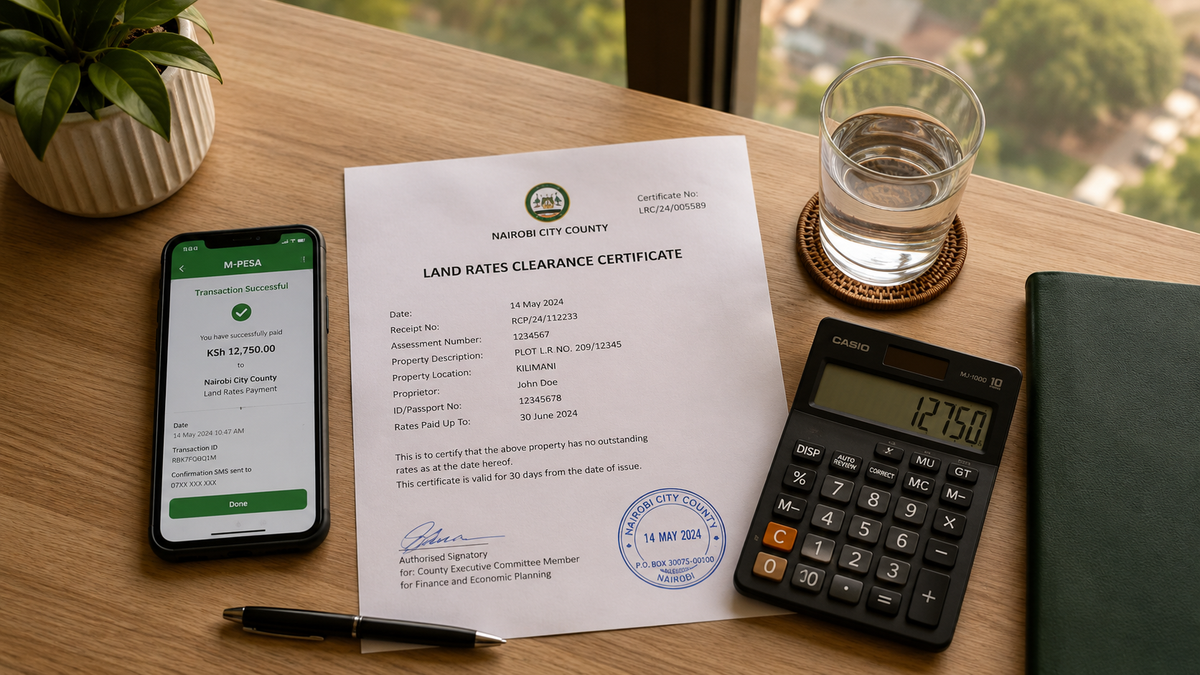
Refuse to issue a Land Rates Clearance Certificate — without which no property transfer can be registered at the Lands Registry
Clamp or restrict use of the property
In extreme cases, auction the property to recover unpaid arrears
The practical impact is immediate: if you try to sell and owe years of back rates, the buyer's advocate will discover this during due diligence, and the transfer cannot proceed until the arrears (including compound interest) are cleared.
Land Rent: The National Government Levy
Land rent is a separate charge, paid to the national government through the Ministry of Lands and Physical Planning. It applies only to leasehold property — land where the government retains the reversionary interest and has granted a lease (typically 99 years). Freehold landowners do not pay land rent.
How It Works
The land rent amount is set when the lease is originally granted and is stated in the lease document. Rates vary widely: KES 1,000 to 10,000+ per acre per year, depending on the location, land use classification, and the terms of the original grant. The government can revise land rent when the lessee seeks a development approval or a lease renewal.
Payment is made through the Ardhisasa platform (ardhisasa.lands.go.ke). You need your title number and KRA PIN to access your account and view the outstanding balance.
When Due and Penalties
Land rent is due annually by 31 January. Late payment attracts interest of 1% per month (12% per year). As with land rates, unpaid land rent blocks the issuance of a Land Rent Clearance Certificate, which is required for any transfer of leasehold property.
Why This Matters for Buyers
Unpaid land rent arrears transfer to the new owner. If the seller has not paid land rent for five years, and you buy the property without verifying, you inherit the debt plus accumulated interest. Your advocate should verify land rent status and ensure the seller clears all arrears before completion. This is standard in the sale agreement — the seller's obligation to deliver clearance certificates.
Rental Income Tax: For Landlords
If you earn rental income from property in Kenya, you owe tax on that income. The regime depends on how much you earn and whether you are a resident or non-resident.
For Resident Landlords (Residential Property)
Annual gross rental income | Tax regime | Rate |
|---|---|---|
Below KES 288,000 | Exempt | 0% |
KES 288,000 – KES 15,000,000 | Monthly Rental Income (MRI) tax | 7.5% of gross rent (final tax, no deductions) |
Above KES 15,000,000 | Normal income tax | Graduated rates up to 35% (with expense deductions) |
MRI tax is filed and paid monthly by the 20th of the month following the rental period. It is a final tax — meaning no further income tax is payable on that rental income, but equally no deductions for expenses are allowed.
2026 Finance Bill proposal: The Finance Bill 2026 (under public participation as of mid-May 2026) proposes increasing the residential rental income tax rate from 7.5% to 10%. This is not yet law — it requires parliamentary approval. Budget accordingly if you are a landlord: the effective rate may increase from 1 July 2026.
For Non-Resident Landlords
If you are a non-resident (including diaspora Kenyans living abroad), the tenant is required to withhold 30% of the gross rent and remit it to KRA. This withholding is a final tax — the non-resident landlord does not need to file a Kenyan tax return for the rental income. See our diaspora guides for country-specific tax implications: USA, UK, UAE, Canada.
The eRITS System
KRA launched the Electronic Rental Income Tax System (eRITS) in April 2025, requiring landlords to register their properties, file monthly returns, and pay MRI tax online. Full compliance was mandated by September 2025. The system has significantly improved KRA's ability to track rental income and enforce compliance — if you are not yet registered, you should be.
Capital Gains Tax and Stamp Duty: Transaction Taxes
These two taxes are triggered by property transactions, not ongoing ownership. A brief summary here, with links to the full guides:
Tax | Who pays | Rate | Full guide |
|---|---|---|---|
Capital Gains Tax (CGT) | Seller | 15% of net gain | |
Stamp duty | Buyer | 4% urban / 2% rural |
Since February 2026, stamp duty is processed exclusively through Ardhipay on the Ardhisasa platform. Physical submissions are no longer accepted. CGT and stamp duty are "twinned" in the iTax system — the buyer's stamp duty cannot proceed until the seller's CGT is resolved.
Total Annual Tax Cost: What Ownership Really Costs
Many buyers focus exclusively on the purchase price and transfer costs, and then are surprised by the ongoing tax burden. Here is a realistic example:
Scenario: KES 15M apartment in Kilimani (leasehold), rented at KES 80,000/month | Annual cost |
|---|---|
Land rates (0.1% of USV ~KES 8M) | ~KES 8,000 |
Land rent (leasehold, Nairobi) | ~KES 3,000–8,000 |
Rental income tax (7.5% MRI on KES 960,000/yr) | KES 72,000 |
Service charge (management company) | ~KES 60,000–120,000 |
Total annual ownership cost | KES 143,000–208,000 |
That is roughly 15–22% of gross rental income going to taxes and management before maintenance, insurance, or void periods. Factor these costs into your investment analysis before buying — we break down every cost in the total cost of buying property guide.
For Diaspora Owners: Managing Tax Compliance from Abroad
Owning property in Kenya while living abroad adds a layer of complexity. Key points:
Land rates and land rent can be paid online via eCitizen and Ardhisasa — you do not need to be in Kenya to stay compliant. Set annual reminders for 31 January (land rent) and 30 June (land rates).
Rental income at the 30% non-resident withholding rate is handled by your tenant or property manager. Ensure they are registered with KRA and actually remitting the tax — you are liable if they do not.
When selling, CGT is owed in Kenya at 15% regardless of where you live. You may also owe tax in your country of residence. See our CGT guide for DTA and foreign tax credit details.
Appoint a local representative — either a property manager or your advocate — who can handle compliance matters, receive government notices, and pay on time. A missed notice from the county government does not pause the penalty clock.
Common Mistakes That Cost Property Owners Money
Confusing land rates with land rent. They are different taxes, paid to different authorities, on different deadlines. Paying one does not satisfy the other.
Assuming freehold means no tax. Freehold owners do not pay land rent, but they do pay land rates if the property is in a rated area (which most urban and peri-urban land is).
Not checking for arrears before buying. Unpaid land rates and land rent arrears transfer to the new owner. Always require clearance certificates as part of the sale agreement.
Ignoring the MRI tax. Even small-scale landlords earning above KES 288,000 per year (KES 24,000 per month) are required to file and pay. KRA's eRITS system is designed to catch non-compliance.
Not objecting to the valuation roll. Counties periodically publish draft valuation rolls that determine your land rates for the next 5+ years. If you do not object to an overvalued assessment within the objection window, you overpay for years.
How to Check Your Property Tax Status
Tax | Where to check | What you need |
|---|---|---|
Land rates | County revenue portal (e.g., Nairobi: payments.nairobi.go.ke) or visit county offices | Plot/LR number, owner name |
Land rent | Ardhisasa (ardhisasa.lands.go.ke) | Title number, KRA PIN |
Rental income tax | iTax (itax.kra.go.ke) | KRA PIN, password |
CGT status | iTax | KRA PIN |
How Afriqahome Helps Property Owners Start Right
Tax problems in property often begin with bad information at the buying stage. An unverified agent who does not mention outstanding rates, a seller who hides land rent arrears, or a listing that omits the leasehold status (and therefore the land rent obligation) — these are the starting points of tax surprises that cost new owners thousands.
Every agent on Afriqahome has been identity-verified: National ID and licence uploaded, KES 10,000 verification fee paid, and approval reviewed by our team. Verified agents carry a visible badge on their profile and listings. This does not replace your advocate's due diligence on tax clearances, but it means your first point of contact is a real, accountable professional — not an anonymous listing with a burner number.
Browse verified listings on Afriqahome — start your property search with agents you can hold accountable.
Frequently Asked Questions
What is the difference between land rates and land rent in Kenya?
Land rates are an annual property tax paid to the county government, applicable to all rateable property (both freehold and leasehold) within rated areas. Land rent is an annual fee paid to the national government (Ministry of Lands) that applies only to leasehold property. They are governed by different laws, collected by different authorities, and due on different dates (30 June for rates, 31 January for rent).
Do freehold property owners pay any property tax in Kenya?
Yes. Freehold owners do not pay land rent (which is a leasehold obligation), but they do pay land rates if the property is within a rated area — which includes most urban and peri-urban land. They also owe rental income tax if they earn rent, and capital gains tax if they sell at a profit.
What happens if I do not pay land rates in Kenya?
Late payment attracts interest of up to 3% per month (36% annually) in most counties. The county can refuse to issue a Land Rates Clearance Certificate, blocking any transfer of the property. In extreme cases, the county can clamp, restrict, or auction the property to recover arrears.
How much is rental income tax in Kenya in 2026?
For resident landlords earning between KES 288,000 and KES 15 million per year, the Monthly Rental Income (MRI) tax rate is 7.5% of gross rent — a final tax with no expense deductions. Above KES 15 million, graduated income tax rates apply (up to 35%). The Finance Bill 2026 proposes increasing the MRI rate to 10%, but this is not yet law as of May 2026.
Do property tax arrears transfer to the new owner when I buy?
Yes. Unpaid land rates and land rent arrears are attached to the property, not the person. If you buy without verifying clearance, you inherit the debt plus accumulated interest. Always require Land Rates and Land Rent Clearance Certificates as conditions in your sale agreement.
How do I pay property taxes online in Kenya?
Land rates are paid through county revenue portals or eCitizen using your plot/LR number. Land rent is paid through the Ardhisasa platform. Rental income tax and CGT are filed and paid through KRA's iTax portal. All accept M-Pesa Paybill and bank transfers.
Explore Further
Other Guides

Living in Juja, Kiambu: The University Town That Became a Satellite City — Prices, Estates & Honest Guide (2026)
Juja houses from KSh 1.2M, rent from KSh 2.5K. JKUAT area, Kenyatta Road estates, Kalimoni, Witeithie. Student yields 9-15%.

Westlands Property Guide: Prices, Lifestyle & Investment (2026)
Complete guide to Westlands real estate. Apartments from KES 8M, rental yields 6-8%, plus lifestyle amenities. Browse verified Westlands listings today.

Houses for Sale in Karen: Price Guide 2026
Karen house prices from KES 35M–250M+. 4-bedroom, 5-bedroom, villas. Karen Hardy, Ndege Road, budget breakdown. Updated March 2026.