How to Buy Land in Kenya: Complete Step-by-Step Guide 2026
Learn exactly how to buy land in Kenya safely Step-by-step process land search, title deed verification, stamp duty, transfer with fraud warnings at every stage
How to Buy Land in Kenya: Step-by-Step Guide
Land is one of Kenya's most treasured assets — and one of the most common targets for fraud. In 2024, the Ministry of Lands reported that over 10,000 land fraud cases were under active investigation, with losses running into billions of shillings. The United States Trade Representative has formally named fake and double-issued title deeds as a barrier to investment in Kenya. Banks, companies, and thousands of ordinary buyers have lost everything on land that, on paper, looked legitimate.
But here is the important counterpoint: the land buying process in Kenya, when followed correctly, is clear, documented, and legally sound. The same government systems that have struggled with fraud are also being rapidly digitised — as of early 2026, stamp duty payments are now fully online through Ardhisasa, and title deed verification is available in real time through the same platform. Every step in this guide is designed to make the process manageable and to flag exactly where the risks sit.
Whether you are a Kenyan professional buying your first plot in Kitengela, a family planning to build in Ruaka or Juja, or a member of the diaspora coordinating a purchase from abroad — this guide walks you through every step, every document, every cost, and every red flag.
Related Articles
→ Article #17: Understanding 50x100 Plots in Kenya — if you are still deciding what size to buy
→ Article #70: Land Buying Checklist — download the PDF version of every step in this guide
→ Article #3: How to Avoid Property Scams in Kenya 2026 — broader fraud prevention context
Before You Start: Know What You Are Buying
Land in Kenya is not all the same. Before you begin searching for plots, you need to understand a few foundational distinctions — because they affect which documents apply, what rights you actually hold, and what risks you face.
Freehold vs Leasehold Land
Freehold land is owned outright, with no ground rent payable to anyone. Freehold title deeds are common in rural areas and older private residential developments. Leasehold land is owned for a fixed term — typically 33, 50, or 99 years — with an annual ground rent payable to the county government. Most urban and peri-urban land in Nairobi and other major towns is leasehold. The type of land determines what your title deed will look like: an Absolute Title Deed for freehold, or a Certificate of Lease for leasehold.
Before you make an offer, confirm whether the land is freehold or leasehold — and for leasehold, check how many years remain on the lease and what the ground rent obligations are.
Public Land vs Private Land
Private land is owned by an individual or company. Public land is owned by the county or national government. Some fraudsters attempt to sell road reserves, riparian land (the buffer zone alongside rivers), forest land, or other government property as if it were private. A licensed surveyor and a lawyer's due diligence will confirm the land's status — do not skip either.
Agricultural vs Residential Zoning
Land zoning determines what you can legally build. Agricultural land classified as agricultural zone requires a change of user application before you can develop it residentially. Building without this approval risks demolition and loss of your investment. In satellite towns like Kitengela, Juja, and parts of Ruaka, many plots are still classified as agricultural even though they are sold for residential development. Your lawyer must confirm the zoning — and the process for changing it if required.
A Critical Warning on Verbal Agreements
In Kenya, many land transactions begin with a handshake, a verbal agreement, or an informal letter of intent. None of these offer you legal protection. Any payment made before a signed, lawyer-drafted sale agreement is a payment at your own risk. The moment you hand over money without legal documentation, you have significantly reduced your options if the transaction goes wrong.
The Complete Step-by-Step Process
The following eight steps cover the full land purchase process — from finding the land to holding a new title deed in your name. At each step, we flag the specific fraud risks that buyers commonly encounter and explain how the step itself protects you.
Step 1: Find the Land and Confirm the Seller's Identity
The search process matters. Where you find the land — and through whom — significantly affects your fraud exposure.
Where to source land listings: Use verified platforms like Afriqahome, PropertyPro, or BuyRentKenya. When working with agents, confirm they are registered with the Estate Agents Registration Board (EARB) — Kenya's regulatory body for real estate agents. An EARB-registered agent has a registration number you can verify.
How to verify the seller's identity: Ask for their national ID and confirm the name matches what appears on the title deed exactly. If the seller is a company, ask for the Certificate of Incorporation and confirm the company is still active via the Business Registration Service portal.
Confirm any Power of Attorney is legitimate: If the seller is not the registered owner but is acting as an agent, they must produce a notarised Power of Attorney. Verify it was signed by the actual registered owner — contact the registered owner directly if at all possible. A Power of Attorney that cannot be verified is one of the most common instruments of fraud in Kenya.
⚠ Red Flag: A seller who is 'just handling the transaction' for the owner, cannot provide the owner's contact details, or becomes evasive when you ask to speak directly with the registered owner should be treated with extreme caution.
→ See Article #5: How to Verify a Real Estate Agent (EARB Guide)
Learn how to check an agent's EARB registration number and what it means for your protection.
Step 2: Conduct an Official Land Search via Ardhisasa
A land search is not optional — it is the single most important verification step in a land transaction. It tells you who is legally registered as the owner of the land, whether there are any encumbrances (mortgages, loans charged against the land), any caveats or court orders restricting transfer, and the official subdivision status of the parcel.
How to do the search (as of early 2026):
Visit ardhisasa.lands.go.ke and create an account using your national ID and mobile number
Navigate to 'Land Search' under the Ministry of Lands services
Enter the title deed number and county — you will receive the registered owner's details, encumbrances, and subdivision status in real time
Cost: approximately KES 500 – 1,000 depending on the type of search
Ardhisasa currently covers Nairobi and a growing number of counties, with national expansion ongoing. If the land is in a county not yet on Ardhisasa, your lawyer can conduct a manual search at the relevant county land registry — but the online route is faster and leaves a verifiable digital trail.
Cross-check the results: The registered owner's name must exactly match the seller's name as it appears on their national ID. If there is a discrepancy — even a minor one — do not proceed until it is resolved through your lawyer.
⚠ Red Flag: A seller who discourages you from conducting a land search, offers to 'do it for you,' or asks you to proceed to payment before the search is complete is a serious red flag. No legitimate seller objects to a buyer verifying ownership.
→ See Article #4: Complete Ardhisasa Tutorial
A step-by-step walkthrough of every function on the Ardhisasa platform, including land search, title deed verification, and the new Ardhipay stamp duty module.
Step 3: Engage a Licensed Property Lawyer
A conveyancing lawyer is not optional in a Kenyan land transaction. This is not a technicality — it is a structural protection. A good property lawyer will draft or review the sale agreement, conduct additional due diligence beyond the land search (including checking for court cases involving the property and verifying zoning), prepare the transfer documents, and coordinate the stamp duty and registration process.
Typical lawyer fees for land transactions in Kenya:
Scale fee: 1% – 2% of the purchase price (Kenya Law Society recommended scale)
Minimum fees for smaller transactions typically start around KES 30,000 – 50,000
Agree fees in writing before engagement
Ask for a lawyer recommended by someone whose judgment you trust, or search the Law Society of Kenya directory to confirm a lawyer is an active member in good standing. Do not use a lawyer recommended solely by the seller.
⚠ Red Flag: A seller who suggests you 'save money' by skipping a lawyer or offers to use 'their lawyer' for both sides of the transaction is a red flag. Both parties should ideally have independent legal representation.
Step 4: Conduct a Physical Survey
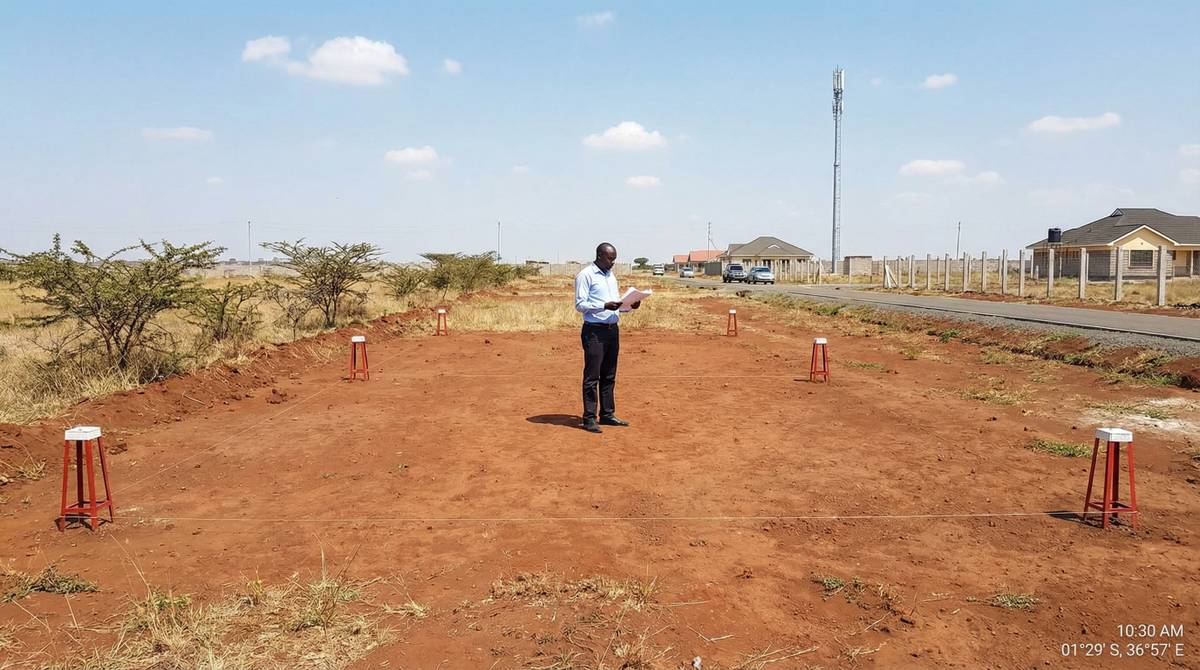
A licensed surveyor physically visits the land, confirms that the plot boundaries match what is described in the title deed, locates or re-establishes the survey beacons at each corner of the plot, and produces a beacon certificate. This step is essential because boundary manipulation — where the seller shows a buyer a larger plot than what the title deed actually covers — is a documented fraud method in Kenya.
Finding a licensed surveyor: Contact the Institution of Surveyors of Kenya (ISK) to confirm a surveyor is registered. Ask your lawyer for a recommendation, or find licensed surveyors listed on the Survey of Kenya website.
What you receive: A beacon certificate (also called a survey report) showing the confirmed plot dimensions, area, and beacon positions. Your lawyer will need this for the transfer process.
⚠ Red Flag: If the beacons on the ground do not match the measurements described in the title deed, do not proceed until the discrepancy is formally resolved. What you see on the ground and what the title deed says must match exactly.
Step 5: Sign the Sale Agreement
The sale agreement is a legally binding contract between buyer and seller. It is not the same as the final title deed transfer — it is a commitment to complete the transaction under agreed terms. Your lawyer should draft or review this document before you sign anything or pay any money.
What a sale agreement typically includes:
Full details of the property (parcel number, area, location)
Purchase price and deposit amount
Completion period — the date by which the full purchase price must be paid and transfer completed
Conditions precedent — any conditions that must be met before the sale proceeds
What happens if either party defaults
Deposit amount: In Kenya, a 10% deposit is standard at the point of signing the sale agreement. This is negotiable. The deposit is typically held in a lawyer's client account — not paid directly to the seller — until transfer is complete.
Completion period: 60 – 90 days is typical. This gives time for the survey, stamp duty valuation, and registry transfer. Be realistic about the timeline based on the county you are buying in.
⚠ Red Flag: Never pay the full purchase price before the title deed is transferred to your name. Paying in full before transfer is complete — regardless of how trustworthy the seller seems — leaves you with no legal leverage if something goes wrong.
Step 6: Pay Stamp Duty and Obtain a Valuation
Stamp duty is a government tax on property transfers. In Kenya, the standard rate is 4% of the property's market value for urban land and 2% for rural land. It must be paid before the title deed can be transferred into your name.
Important update for early 2026: As of February 16, 2026, the Ministry of Lands has made stamp duty processing fully digital. Physical submissions at land registries are no longer accepted. All stamp duty applications — including valuation, assessment, and payment — must now be processed online through the Ardhipay module on the Ardhisasa platform. This applies to all stakeholders, including lawyers and financial institutions.
How the process works now:
Your lawyer logs into Ardhisasa and initiates the land transaction
A government valuer assesses the market value of the land (this is the value stamp duty is calculated on — not necessarily the agreed sale price)
The stamp duty invoice is generated through Ardhipay
Payment is made digitally through approved government payment channels
You receive digital confirmation of payment
Timeline: The valuation and payment process currently takes approximately 1 – 3 weeks, depending on the queue at the relevant county office and how quickly the online system processes the application. Budget for 2 – 4 weeks to be safe.
→ See Article #107: Stamp Duty & Closing Costs Kenya 2026
A complete breakdown of all closing costs in a Kenyan land transaction, with worked examples for different purchase price bands.
Step 7: Transfer the Title Deed
With the sale agreement signed, the survey complete, and stamp duty paid, your lawyer will prepare the transfer documents and submit them to the relevant county land registry. This is the step that formally moves legal ownership from the seller to you.
Documents required for transfer:
Original title deed (in the seller's name)
Signed transfer form (Land Registration Act Form LRA 16)
National ID copies for both buyer and seller
Stamp duty payment receipt (from Ardhipay)
Official land search certificate
Beacon certificate (survey report)
Sale agreement
Where to submit: The county land registry for the area where the land is located. In Nairobi, this is the Nairobi Land Registry at Ardhi House on Upperhill Road. For satellite towns, check the relevant sub-county land office.
Processing time: This varies more than any other step. In Nairobi, the real-world timeline is currently 4 – 12 weeks. In satellite towns with less congested registries (Thika, Kitengela, Ruaka), you may see transfers completed in 3 – 6 weeks. Budget for the longer end.
What you receive: A new title deed — either an Absolute Title Deed or a Certificate of Lease — issued in your name by the land registry. This is your proof of legal ownership.
⚠ Red Flag: A title deed issued very quickly — within days of submission, without any apparent processing — should be treated with extreme suspicion. Fraudulent title deeds have been produced through insider connections at land registries. If the timeline seems implausibly fast, verify independently.
Step 8: Verify Your New Title Deed
The process does not end when you receive the title deed. The final step — which most buyers skip — is independently verifying that the title deed issued in your name is genuine and correctly registered in the official system.
How to verify your new title deed:
Log into Ardhisasa and search for your parcel number — you should now appear as the registered owner
Confirm the parcel number, land area, and owner name on the physical title deed exactly match the Ardhisasa records
Check the physical title deed for security features: government watermarks, official stamps, the land registrar's signature, and a unique serial number
Where to store the original: Your title deed should be stored in a bank safety deposit box — not at home. In the event of fire, flooding, or theft, a lost original title deed requires a formal application to the registry for replacement, which can take months. Keep a certified copy for your own reference.
→ See Article #1: How to Verify a Title Deed in Kenya
A detailed guide to checking the security features of a genuine Kenyan title deed and using Ardhisasa to confirm registration status.
Summary: All Costs in a Kenya Land Transaction
Many buyers focus entirely on the purchase price and are surprised by the additional costs at closing. Budget for transaction costs of approximately 6% – 10% of the purchase price on top of what you pay the seller.
Cost Item | Typical Fee | Notes |
|---|---|---|
Land Search (Ardhisasa) | KES 500 – 1,000 | Online via Ardhisasa / eCitizen portal |
Lawyer Fees | 1% – 2% of purchase price | Negotiable; minimum ~KES 30,000 for small transactions |
Licensed Surveyor | KES 15,000 – 50,000+ | Depends on plot size and location |
Stamp Duty | 4% (urban) / 2% (rural) | Paid via Ardhipay on Ardhisasa — mandatory as of Feb 2026 |
Land Registry Transfer Fee | ~KES 5,000 – 15,000 | County land registry; varies by county |
Agent Commission | 1% – 3% of purchase price | Negotiable; paid by buyer or seller depending on agreement |
Approximate Total (excl. purchase price) | 6% – 10% of purchase price | Plan for this in your budget before making an offer |
Example: If you buy a plot for KES 1,500,000 (a typical 50x100 plot in a satellite town like Kitengela), your total additional transaction costs could range from approximately KES 90,000 to KES 150,000. For a KES 5,000,000 plot in a closer-in area, budget KES 300,000 – 500,000 in transaction costs.
How Long Does It Really Take?
The official processes are faster than they used to be — the move to digital stamp duty through Ardhipay and the expansion of online land searches have genuinely reduced some waiting times. But the real-world experience still involves queues, surveyor availability, lawyer schedules, and registry backlogs.
Stage | Official Timeline | Real-World Timeline |
|---|---|---|
Land search (Ardhisasa) | Instant – same day | Instant – same day (if covered county) |
Lawyer engagement & sale agreement | 3 – 7 days | 1 – 3 weeks (negotiation time) |
Physical survey & beacon certificate | 1 – 2 weeks | 2 – 6 weeks (surveyor availability) |
Stamp duty valuation & payment | 3 – 5 days | 1 – 3 weeks (Ardhipay queue, 2026) |
Land Registry title transfer | 2 – 4 weeks | 4 – 12 weeks (Nairobi); 2 – 6 weeks (satellite towns) |
Total: Find to Title Deed | 6 – 10 weeks | 3 – 6 months (budget for 6 months) |
The honest answer: plan for three to six months from the point of agreeing on a price to holding a title deed. If it goes faster, consider yourself fortunate. If you are working with a tight timeline — a loan draw-down date, a construction schedule — communicate this to your lawyer at the outset.
Special Considerations for Diaspora Buyers
Kenyans buying land from abroad are among the most frequently targeted by land fraud. The combination of distance, limited ground-level knowledge, and often higher available funds makes diaspora buyers attractive targets. But remote land purchases are absolutely possible when done correctly.
Remote Verification Steps
Most of the verification process can now be conducted remotely:
Ardhisasa land search: Fully online — you can conduct this from anywhere in the world with an internet connection and a registered account
Video land visit: Ask your agent or a trusted local contact to conduct a video walk of the land via WhatsApp or Zoom. Confirm the beacons are visible, the access road is real, and the surrounding development matches what has been described
Lawyer engagement: Kenyan lawyers routinely work with diaspora clients remotely. Signing authority for documents can be arranged via notarised email or by signing in person at a Kenyan embassy
Power of Attorney for Diaspora Buyers
If you cannot be present in Kenya during the transaction, you can grant someone a Power of Attorney to act on your behalf. This must be notarised at a Kenyan embassy or by an internationally recognised notary in your country of residence and then apostilled. Your Kenyan lawyer will advise on the specific requirements.
Be extremely careful about who you grant PoA to. There have been cases where a PoA granted for a specific purpose has been misused to carry out additional transactions. Limit the scope of any PoA to the specific transaction, with a defined expiry date.
Extra Precautions for Diaspora
Never wire funds directly to a seller or an agent — always to a lawyer's escrow/client account
Do not rely solely on WhatsApp photos or PDF documents as verification — always conduct an Ardhisasa search yourself
If a deal is being presented as urgent or time-sensitive ('another buyer is waiting'), take that as a reason to slow down, not speed up
Consider using a buyer's agent — a verified Afriqahome agent who works for your interests, not the seller's
The 5 Most Common Land Fraud Schemes in Kenya
Understanding how fraud is perpetrated is the most practical way to avoid it. Each of the following schemes has cost Kenyan buyers — and diaspora buyers specifically — significant amounts of money. Knowing the pattern means you can spot it before it is too late.
Scheme | How It Works | Which Step Catches It |
|---|---|---|
Double Selling | The same plot is sold to multiple buyers simultaneously. Each gets 'convincing' documents. The fraud surfaces only when buyers arrive to develop the land. | Step 2: Land search reveals only one registered owner. If two buyers search the same plot on the same day, both will see the same name — but the fraudster may already have cashed out. |
Fake Title Deeds | Forged title deeds are printed using stolen government paper or digital forgeries. The fakes can pass a casual visual inspection. Some have even passed manual registry checks via insider collusion. | Step 2: Ardhisasa cross-check against the live registry. Step 8: Independent post-transfer verification. |
Selling Government or Road Reserve Land | Fraudsters sell plots that are actually government land, road reserves, riparian corridors, or forest buffers. The buyer gets a title — which is later revoked. | Step 4: Physical survey and overlay on official county maps. Step 3: Lawyer's due diligence on land use zoning. |
Forged Power of Attorney | A fraudster claims to be selling on behalf of the owner and presents a forged Power of Attorney. The real owner has no idea the land is being sold. | Step 1: Verify the seller's identity and confirm any PoA is notarised and current. Contact the principal owner directly if possible. |
Boundary Manipulation | The seller shows the buyer a larger plot than what the title deed covers. The buyer pays for, say, a quarter-acre, but receives title to a plot 20% smaller. | Step 4: Licensed surveyor physically measures and beacons the plot. Never pay full price before the survey is complete. |
Find Verified Land Listings on Afriqahome
Afriqahome is Kenya's verified property marketplace, built specifically to address the trust and verification challenges in the Kenyan property market. Every agent on the platform is verified — we check EARB registration, confirm identity, and review track record before an agent can list properties.
This does not make any individual transaction risk-free — no platform can guarantee the behaviour of every seller or the status of every plot. But working through a verified platform with a verified agent significantly reduces the risk of encountering unregistered brokers or fraudulent listings.
Browse land listings across Nairobi and satellite towns: afriqahome.com
Filter by location, price, and plot size
Contact a verified agent directly through the platform
Whether you are buying your first plot in Kitengela or a larger parcel for development in Ruaka, start with verified listings and a verified agent. The extra hour you spend on due diligence at the beginning of this process is the insurance policy for the entire tr
Other Guides

Living in Juja, Kiambu: The University Town That Became a Satellite City — Prices, Estates & Honest Guide (2026)
Juja houses from KSh 1.2M, rent from KSh 2.5K. JKUAT area, Kenyatta Road estates, Kalimoni, Witeithie. Student yields 9-15%.

Westlands Property Guide: Prices, Lifestyle & Investment (2026)
Complete guide to Westlands real estate. Apartments from KES 8M, rental yields 6-8%, plus lifestyle amenities. Browse verified Westlands listings today.

Houses for Sale in Karen: Price Guide 2026
Karen house prices from KES 35M–250M+. 4-bedroom, 5-bedroom, villas. Karen Hardy, Ndege Road, budget breakdown. Updated March 2026.