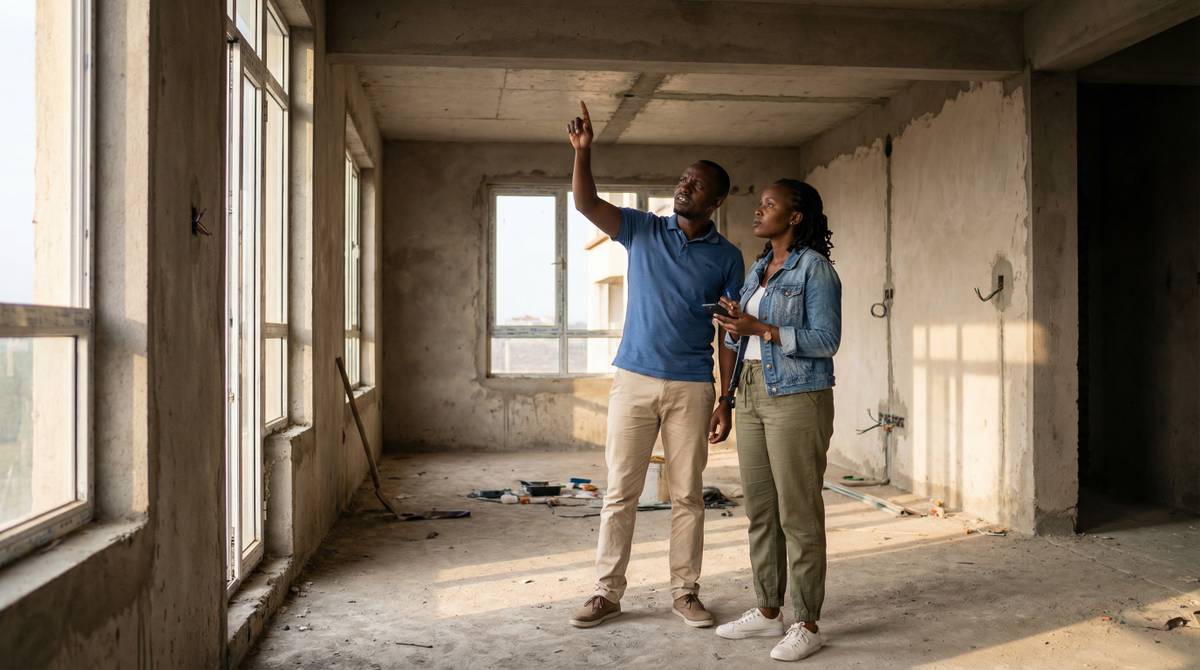
10 Red Flags When Viewing Property in Kenya
Spot the 10 red flags experienced buyers check at every property viewing in Kenya. Protect yourself from scams, structural risks, and pressure tactics.
10 Red Flags When Viewing Property in Kenya
You found a property that looks perfect. The photos are stunning, the price seems right, and the agent is keen to show you around. Here’s what nobody tells you: the viewing itself is where most fraud in Kenya becomes real. A well-staged site visit is designed to bypass your critical thinking — to make you feel so good about the property that you skip the checks that would have protected you.
This guide is about what to look for with your own eyes when you’re standing inside a property in Kenya. Not documents. Not online systems. The physical, environmental, and behavioural property red flags in Kenya that experienced buyers catch and first-time buyers miss. Think of it as a cheat sheet from someone who’s been to 100 viewings — the things I wish someone had told me before my first one.
Send this to anyone you know who’s about to view a property. It might be the most useful thing they read before signing anything.
Why this matters right now: In January 2026 alone, two buildings collapsed in Nairobi — one in South C (16 storeys, built without approved structural plans) and one in Karen (using timber supports instead of steel). The National Building Inspectorate found only about 15% of assessed Nairobi buildings are structurally safe. What you observe at a viewing could save your investment — and your life. |
Before you go: This article covers what to check at the viewing. For document verification, title deed checks, and agent verification, start with our Property Due Diligence Checklist. → /blog/property-due-diligence-checklist-kenya |
The 10 Red Flags
RED FLAG #1: The Show House Doesn’t Match the Actual Units |
Why it matters
Developers invest millions in staging show houses with premium finishes, imported furniture, and professional landscaping. The actual delivered units often have inferior materials, smaller rooms, and missing amenities. In Kenya’s off-plan market, this gap between promise and reality is one of the most common sources of buyer disappointment — and outright fraud.
In a February 2026 investigation, buyers of developments along the Kenyatta Road corridor in Kiambu discovered the homes they received bore no resemblance to the artistic impressions and YouTube videos they were shown. One developer marketed estates using AI-enhanced images of homes against picturesque mountain backdrops. The actual sites: bare, abandoned plots with zero construction.
What to look for
• Ask to see an actual completed unit, not just the show house. If the developer can’t show you one, that tells you something.
• Compare the finishes in the show house against the sale agreement specifications. Are the tiles, fittings, and countertops named in the contract the same ones in the model?
• Photograph everything — the show house, the actual construction site, and any discrepancies between them.
✔ What to do: If you’re buying off-plan, insist on seeing completed units from previous phases. If this is Phase 1, ask for the developer’s track record on other projects. A developer who has never completed a project is a significant risk. |
RED FLAG #2: Fresh Paint or New Finishes Hiding Structural Problems |
Why it matters
Fresh paint on a single wall — especially in a property that otherwise looks lived-in — often means someone is covering up cracks, water damage, or mould. In Nairobi’s rainy season, water infiltration through poorly waterproofed walls and roofs is extremely common. A new coat of paint hides the problem until you’ve already moved in.
What to look for
• Run your hand along walls. Feel for soft spots, bubbling paint, or damp patches, especially near windows, bathrooms, and along the base of exterior walls.
• Look up. Ceiling stains, discolouration near roof edges, and sagging plaster indicate water damage from above.
• Check where the walls meet the floor. Dark staining or white mineral deposits (efflorescence) suggest rising damp — water coming up from the foundation.
• In bathrooms and kitchens, look behind toilet cisterns and under sinks. Leaks hide here.
✔ What to do: If you spot fresh paint on one wall or section only, ask directly: “Why was this section repainted?” A honest seller will explain. Evasion is a red flag. For any property you’re serious about, budget KES 15,000–30,000 for an independent structural survey before committing. |
RED FLAG #3: No NCA Registration or County Approvals on Site |
Why it matters
Every construction project in Kenya legally requires registration with the National Construction Authority (NCA) and planning approval from the county government. These aren’t optional. A building constructed without them is illegal, uninsured, and potentially unsafe.
The South C building that collapsed on January 2, 2026 had NCA registration — but it was issued before mandatory county and NEMA approvals were obtained. The developer was approved for 12 storeys and illegally built 16. The Karen collapse involved a project with no NCA registration at all. In January 2026, NCA also halted non-compliant sites in Kisumu where most operators weren’t qualified contractors.
What to look for
• On any active construction site, an NCA project registration notice should be displayed visibly. If you don’t see one, ask to see it.
• Ask for the county-approved building plans. Compare the number of floors in the plans to what’s being built. Extra floors mean the developer has deviated from approved specs.
• Request the NEMA licence. This confirms the project passed environmental assessment — critical for drainage, waste management, and water supply.
✔ What to do: If approvals cannot be produced on request, do not proceed. Verify NCA registration at nca.go.ke or contact your county’s planning department. It takes one phone call. → Link to: /blog/how-to-avoid-property-scams-kenya |
RED FLAG #4: The Agent Won’t Let You Talk to Neighbours |
Why it matters
Neighbours are the most honest source of information about a property. They’ll tell you about flooding, noise, disputes, security problems, and whether the property has actually been occupied by someone else. An agent who steers you away from neighbours is controlling the narrative.
What to look for
• If the agent hurries you through the viewing or keeps you away from adjacent properties, slow down intentionally.
• If viewing land, talk to people farming or living on neighbouring plots. Ask: “Who owns this land?” and “Have there been any disputes?”
• For apartments, knock on a neighbour’s door. Ask about water supply, electricity reliability, security, and building management.
✔ What to do: Arrive early or stay late — before or after the agent controls the schedule. Five minutes of honest conversation with a neighbour can reveal more than an hour-long sales pitch. |
RED FLAG #5: Pressure to Pay a Deposit Immediately |
Why it matters
This is the single most common fraud tactic in Kenya’s property market. Phrases like “another buyer is viewing this afternoon,” “the price goes up on Monday,” or “just pay a small deposit to hold it” are designed to short-circuit your decision-making. No legitimate transaction requires an on-the-spot deposit.
In documented cases, buyers who paid “holding deposits” via M-Pesa at viewings later discovered the property belonged to someone else entirely, or that the same deposit had been collected from multiple buyers for the same unit. One developer along the Kenyatta Road corridor collected deposits from at least 36 families for homes that were never built.
What to look for
• Any request for money at or immediately after a viewing — whether cash, M-Pesa, or bank transfer.
• Agents who create artificial urgency or make you feel that hesitation means losing the deal.
• Requests to pay into a personal M-Pesa or bank account that doesn’t match the company name on the documents.
✔ What to do: Tell the agent: “I’m interested, but I need to verify the title deed and consult my lawyer before any payment.” If they push back, walk away. A legitimate seller will give you time. → Link to: /blog/verify-title-deed-kenya |
RED FLAG #6: The Property Is in a Different Location Than Advertised |
Why it matters
This sounds extreme, but it happens. In one case from the February 2026 exposé, a developer marketed a residential estate as being in Ruai East, Nairobi County. A private investigator discovered the actual property was in Mavoko, Machakos County — a different county entirely. The title number in the sale documents didn’t exist at all.
Location manipulation also happens more subtly. Agents in Mombasa have been reported advertising properties in desirable areas like Tudor, only to bring buyers to units in entirely different, less desirable neighbourhoods nearby.
What to look for
• Before the viewing, drop a pin on Google Maps or What3Words at the exact location. Cross-reference with the plot number on the title deed.
• At the site, check the physical address matches the county on the title deed. A property in Mavoko is under Machakos County, not Nairobi.
• If you can’t confirm the location matches the documents, do not proceed until you’ve verified through Ardhisasa.
✔ What to do: Verify the plot number through Ardhisasa (ardhisasa.lands.go.ke) or at the county land registry. The title deed’s land reference number should match the exact physical location you visited. → Link to: /blog/ardhisasa-tutorial |
RED FLAG #7: Construction Has Stalled — But Sales Haven’t |
Why it matters
One of the clearest warning signs in Kenya’s off-plan market: a development where construction has visibly stopped but the developer is still actively selling units. This pattern is the hallmark of a Ponzi-like cycle: money from new buyers funds completion of earlier phases, creating an ever-growing hole that can only be filled by selling more units.
The pattern is documented extensively. A major developer’s KES 7 billion Ngara project sits idle with cranes standing still and no activity — while promotional materials suggest a thriving development. An investment firm owes over KES 11 billion to more than 3,000 investors across Nairobi developments now in court-ordered liquidation.
What to look for
• Idle equipment on site: Cranes that aren’t moving, concrete mixers gathering dust, scaffolding with cobwebs.
• Workers absent or minimal: A large development with only a watchman and no active workers is a clear sign.
• Multiple phases where only the earliest is complete: If Phase 1 was delivered years ago but Phase 2 and 3 are barely started, the developer may be cash-strapped.
• The developer is launching new projects elsewhere: Starting a new estate before completing the current one is the single biggest red flag in off-plan.
✔ What to do: Ask directly: “How many units sold? How many completed? What is the expected completion date, and is it in the sale agreement?” Then visit the site unannounced on a different day. |
RED FLAG #8: The Agent Can’t Produce Original Documents |
Why it matters
At any viewing, the agent should be able to show you — or arrange to show within days — the original title deed, approved building plans, and sale agreement template. Photocopies are easy to forge. In April 2025, the DCI exposed a syndicate at Ardhi House producing fake title deeds using stolen government security paper with genuine watermarks. If the documents you’re shown are copies, you have no way of knowing if the originals exist.
What to look for
• Ask to see the original title deed, not a photocopy or scan. Genuine title deeds have specific security features.
• Check the name on the title deed matches the seller. If there’s a mismatch, ask for Power of Attorney.
• Verify the plot number, size, and location description on the title deed against what you see physically on site.
✔ What to do: Never take photocopied documents at face value. Conduct an independent land search at the county registry or through Ardhisasa. → Link to: /blog/fake-title-deeds-kenya-warning-signs |
RED FLAG #9: Water, Drainage, and Access Roads Are Missing |
Why it matters
Infrastructure is the most expensive thing to fix after purchase. A property without reliable water, proper drainage, or a maintained access road will cost far more to live in than the purchase price suggests. In satellite towns like Kitengela, Ruiru, and Athi River, developers regularly sell land on estates where access roads are muddy tracks, water arrives by bowser at KES 1,000+ per trip, and drainage floods every rainy season.
What to look for
• Turn on every tap. Is water flowing? Ask neighbours if supply is consistent. Where does it come from — county, borehole, or tanker?
• Flush every toilet. Check the external sewage system. Sewer connection or septic tank? Where does it drain?
• Walk the access road. Drive in from the main road. Could you access this in heavy rain? Tarmac, gravel, or earth? Who maintains it?
• Check for standing water and erosion. Ask neighbours directly: “Does this area flood?”
✔ What to do: Visit the property during or immediately after rainfall. Problems invisible in dry weather become obvious when it rains. If the access road is impassable in wet season, your daily life and resale value will be affected year-round. |
RED FLAG #10: The Agent Insists on Cash or Avoids a Paper Trail |
Why it matters
Any legitimate property transaction creates a paper trail: receipts, signed agreements, stamped documents, bank transfers. An agent who requests personal M-Pesa, demands cash, resists giving receipts, or avoids putting terms in writing is removing the evidence you’d need if something goes wrong.
EARB-registered agents must maintain separate client trust accounts. Payments into personal accounts violate this requirement and remove your legal protections. → /blog/verify-real-estate-agent-kenya
What to look for
• Requests to pay into a personal bank account or M-Pesa instead of a registered company account.
• Resistance to providing a written agreement, receipt, or formal acknowledgement of payment.
• Vague or shifting commission structures.
• Requests for “viewing fees” of KES 500–2,000 upfront — a common tactic among unregistered operators.
✔ What to do: All payments should go through a lawyer’s trust account or a registered company account with a proper receipt. If the agent can’t provide this, do not pay. |
Bonus: 5 Questions to Ask at Every Viewing
Keep these in your phone. Ask them at every viewing, regardless of how good the property looks:
1. “Who is the registered owner, and can I see the original title deed?” — Establishes legal ownership immediately.
2. “Can you show me county-approved building plans and NCA project registration?” — Confirms the construction is legal.
3. “What are the exact total costs beyond the purchase price?” — Budget 10–12% on top for stamp duty, legal fees, service charge.
4. “Can I take 24 hours to have my lawyer review the documents before paying?” — Your litmus test. Legitimate sellers say yes.
5. “Is there any encumbrance, charge, or court case against this property?” — An encumbrance search costs KES 500–1,000. Do it every time.
What to Do After a Viewing — Before You Commit
You liked the property. Now is the most critical moment — the gap between enthusiasm and commitment:
1. Verify the title deed through Ardhisasa or a manual land search. → /blog/verify-title-deed-kenya
2. Verify the agent through EARB’s Members Directory at members.estateagentsboard.or.ke. → /blog/verify-real-estate-agent-kenya
3. Engage an independent lawyer — never one recommended by the seller or agent.
4. Visit the site again on a different day, unannounced, ideally during rain.
5. Talk to neighbours without the agent present.
6. Get a structural survey for any built property. KES 15,000–30,000 is a small price for safety.
7. Search the developer’s track record. Google the company, check Kenyatalk, search court records. Past fraud follows developers — they register new companies but the pattern repeats.
Don’t View Alone
Here’s the truth: you can memorise every red flag on this list and still miss something. Property viewings in Kenya are designed to sell, and even experienced buyers benefit from a second pair of trained eyes.
When you browse properties on Afriqahome, you connect with agents who have been verified through both EARB and our own process. A verified agent knows what to look for because they’ve seen every trick in the book. They’ll notice the structural crack you might miss, ask the questions you might forget, and push back on the pressure tactics you might fall for.
Your viewing should feel like an investigation, not a sales pitch. Bring someone who knows the difference.
Other Guides

Living in Juja, Kiambu: The University Town That Became a Satellite City — Prices, Estates & Honest Guide (2026)
Juja houses from KSh 1.2M, rent from KSh 2.5K. JKUAT area, Kenyatta Road estates, Kalimoni, Witeithie. Student yields 9-15%.

Westlands Property Guide: Prices, Lifestyle & Investment (2026)
Complete guide to Westlands real estate. Apartments from KES 8M, rental yields 6-8%, plus lifestyle amenities. Browse verified Westlands listings today.

Houses for Sale in Karen: Price Guide 2026
Karen house prices from KES 35M–250M+. 4-bedroom, 5-bedroom, villas. Karen Hardy, Ndege Road, budget breakdown. Updated March 2026.