Green Building in Kenya: Certifications, Features, and Why It Matters for Your Property Investment
Guide to green building in Kenya: EDGE and LEED certifications, solar power, rainwater harvesting, energy efficiency, financial benefits.
Why Green Building Matters for Kenya's Property Market
Green building in Kenya has moved beyond a niche concept into a measurable market force. By March 2025, Kenya surpassed one million square metres of EDGE-certified space — making it one of the fastest-growing green building markets in Africa. The country's first LEED-certified building has been followed by over 100 sustainable developments, and a national green building standard led by the National Construction Authority (NCA) is currently being drafted with phased enforcement expected from 2026 onwards.
For property buyers and investors, green building is not just an environmental consideration — it is a financial one. Green-certified buildings typically deliver 20-40% savings on energy costs, 20-30% savings on water costs, and lower long-term maintenance expenses. In a market where electricity costs from Kenya Power continue to rise and water scarcity affects many Nairobi neighbourhoods, these savings directly impact rental yields and ownership costs.
This guide explains what green building means in the Kenyan context, which certification systems operate here, what green features to look for when buying or investing, and how the regulatory landscape is evolving. Whether you are a buyer evaluating a new development, a diaspora investor comparing projects, or an agent advising clients, understanding green building is increasingly relevant to Kenya's property market in 2026.
Green Building Certifications Available in Kenya
Kenya has access to three primary green building certification systems, each with different requirements, costs, and market positioning.
Certification | Developed By | Focus Areas | Kenya Adoption | Best For |
|---|---|---|---|---|
EDGE (Excellence in Design for Greater Efficiencies) | IFC (World Bank Group) | Energy, water, and materials efficiency — minimum 20% improvement over local baseline | Most widely adopted — 1M+ sqm certified by March 2025 | Residential, commercial, affordable housing — designed for emerging markets |
LEED (Leadership in Energy and Environmental Design) | US Green Building Council | Comprehensive: energy, water, materials, indoor quality, innovation, location | Limited — premium commercial projects (Garden City Mall, Google Kenya office) | Large commercial and mixed-use developments seeking international recognition |
Safari Green Building Index (SGBI) | Kenya Green Building Society (KGBS) | Locally adapted rating tool for Kenyan climatic conditions and construction practices | Emerging — developed to complement EDGE and LEED with Kenya-specific context | Projects seeking a locally relevant certification |
EDGE: The Practical Choice for Kenya
EDGE dominates Kenya's green building landscape because it was designed specifically for emerging markets. Unlike LEED (which was created for the US market and carries higher compliance costs), EDGE focuses on three measurable outcomes: at least 20% reduction in energy use, 20% reduction in water use, and 20% reduction in embodied energy in materials — all compared to a local baseline.
EDGE offers three certification levels: EDGE Certified (basic — 20% improvement), EDGE Advanced (40%+ improvement or 20% improvement with on-site renewables), and EDGE Zero Carbon (100% energy reduction through efficiency and renewables). Kenya's Kwangu Kwako affordable housing project in Kawangare achieved EDGE Advanced Certification for 42 housing units, demonstrating that green building is achievable even in the affordable housing segment — achieving 41% energy savings through design choices like optimised window-to-wall ratios.
The EDGE software tool allows developers to model different design choices and see the cost and efficiency impact within minutes. This makes the financial case for green building transparent before construction begins — a critical factor for developers operating on tight margins in Kenya's competitive residential market.
What Makes a Building "Green" in the Kenyan Context
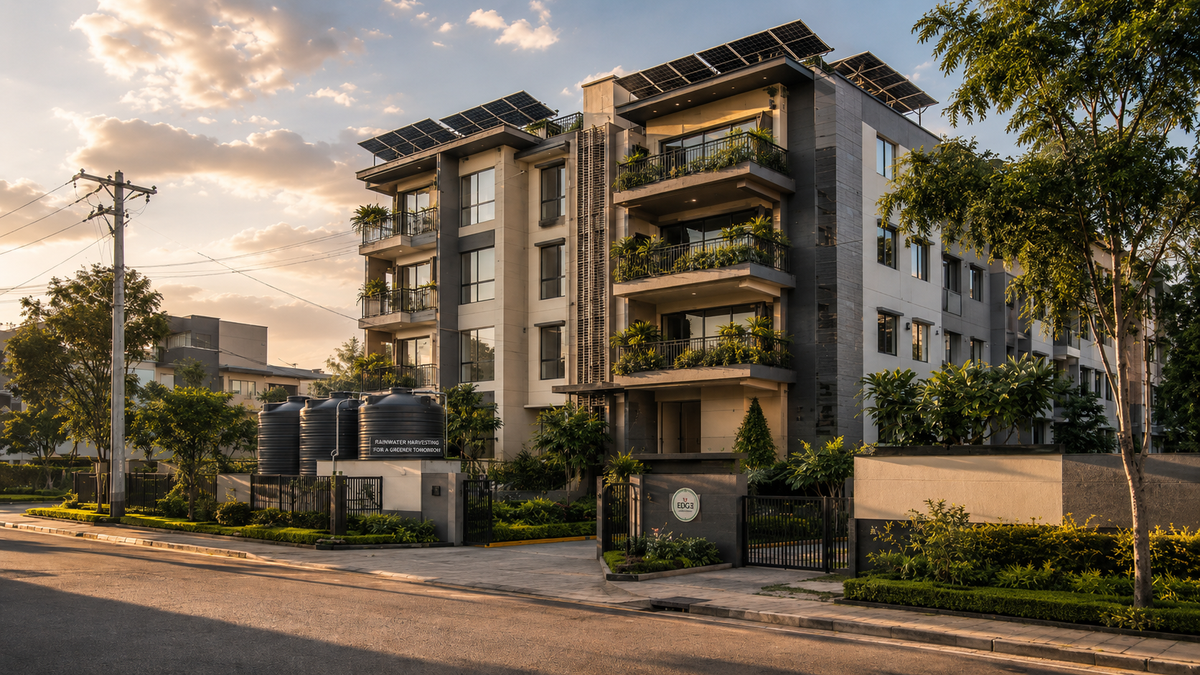
Green building features in Kenya respond to specific local conditions: unreliable grid electricity, periodic water scarcity, high solar radiation (an advantage for solar power), and a climate that reduces the need for heating but requires thoughtful cooling design. Here are the practical green features that matter most for Kenyan properties.
Energy Efficiency
Feature | What It Does | Typical Savings |
|---|---|---|
Solar water heating | Uses roof-mounted solar collectors to heat water — mandatory for new buildings in Kenya since 2017 (Energy Act) | 60-80% reduction in water heating electricity |
Solar PV panels | Generate electricity from sunlight, reducing grid dependence | 30-70% of a household's electricity needs |
LED lighting throughout | Replaces incandescent and CFL bulbs | 75% less energy than incandescent |
Natural ventilation design | Cross-ventilation, stack effect, and strategic window placement reduce need for air conditioning | Eliminates or reduces AC costs entirely |
Insulated roofing | Reduces heat gain in top-floor units — critical in Nairobi's intense afternoon sun | 20-30% cooling energy reduction |
Energy-efficient appliances | Rated fridges, washing machines, and HVAC systems | 20-40% compared to standard appliances |
Kenya-specific context: Solar water heating has been legally required for all new buildings with hot water systems since the Energy Act of 2019. However, enforcement remains inconsistent. When evaluating a new development, check whether solar water heating is genuinely installed and functional — not just mentioned in marketing materials.
Water Efficiency
Feature | What It Does | Why It Matters in Kenya |
|---|---|---|
Rainwater harvesting | Collects roof runoff in storage tanks for non-potable use | Nairobi receives 900-1,100mm annual rainfall — a substantial free water source |
Borehole with treatment | Independent groundwater supply | Reduces dependence on unreliable Nairobi Water Company supply |
Grey water recycling | Treats wastewater from showers and sinks for toilet flushing and irrigation | Can reduce potable water consumption by 30-40% |
Low-flow fixtures | Reduced-flow taps, showerheads, and dual-flush toilets | 20-30% water savings with no lifestyle impact |
Drip irrigation | Efficient landscaping water use | Particularly relevant for compounds with gardens |
Water is arguably more critical than energy in Kenya's green building equation. Nairobi faces periodic water rationing, and many residents supplement with expensive water tanker deliveries (KES 3,000-5,000 per 10,000-litre delivery). A building with rainwater harvesting and a functional borehole dramatically reduces both water costs and the inconvenience of supply interruptions.
Materials and Construction
Green building materials in Kenya focus on reducing embodied energy (the total energy consumed in producing and transporting building materials) and using locally sourced options that reduce transport emissions.
Locally relevant green materials: Interlocking stabilised soil blocks (ISSBs) use less cement and energy than conventional blocks. Expanded polystyrene (EPS) panel construction reduces material volume and construction waste. Locally quarried stone reduces transport energy compared to imported materials. Bamboo — abundant in western Kenya — is increasingly used for structural and decorative elements. Recycled steel and aluminium reduce the embodied energy of metalwork.
The Financial Case for Green Building in Kenya
The most common objection to green building is cost — the perception that sustainable features are a premium luxury. The data tells a different story.
Cost Factor | Green Building Impact | Payback Period |
|---|---|---|
Construction cost premium | 1-7% above conventional (EDGE estimates for Kenya) | — |
Electricity savings | 20-40% reduction in monthly bills | 3-5 years for solar PV; immediate for design-based efficiency |
Water savings | 20-30% reduction in water costs; eliminates or reduces tanker deliveries | 2-4 years for rainwater harvesting systems |
Maintenance costs | Lower long-term — quality materials, efficient systems | Ongoing savings |
Property value premium | Green-certified buildings increasingly command higher resale values and lower vacancy rates | Immediate on sale or rental |
Tenant retention | Lower utility costs make green buildings more attractive to tenants | Reduced vacancy and turnover costs |
For diaspora landlords, the financial case is compelling: a green building with solar power, rainwater harvesting, and efficient fixtures gives tenants lower utility costs — making the unit more attractive, reducing vacancy, and supporting premium rental pricing compared to conventional alternatives in the same area.
Kenya's Evolving Green Building Regulatory Landscape
Kenya is moving toward mandatory green building standards, though the timeline remains fluid. Key regulatory developments:
National Green Building Standard (in development): The NCA and the Ministry of Lands, Public Works, Housing and Urban Development are drafting a comprehensive green building standard. Draft regulations were expected in late 2025, with phased enforcement starting from 2026. The standard will eventually affect building approvals for new public, commercial, and large-scale residential buildings, with major renovations added later.
Energy Act 2019: Already mandates solar water heating for all new buildings with hot water systems. Enforcement is inconsistent but the legal requirement exists.
Kenya Green Building Society (KGBS): The industry body promoting sustainable construction, providing training, and developing the Safari Green Building Index (SGBI) — a locally adapted rating tool.
Proposed incentives: The government is considering tax breaks, fast-track building permits for green-certified projects, and green finance options from local banks. Public procurement may also favour certified green buildings, creating a demand signal that will push the commercial construction sector toward compliance.
What this means for buyers: Buildings constructed to green standards today are future-proofed against regulations that are coming. A conventional building that does not meet emerging standards may face retrofit costs or reduced marketability as regulations tighten. For investment properties, green features are a hedge against regulatory risk.
How to Evaluate Green Features When Buying Property
Not every developer who claims "green" features delivers genuine sustainability. Here is a practical checklist for evaluating green claims in Kenya's property market.
Check | What to Look For | Red Flag |
|---|---|---|
Certification | EDGE, LEED, or SGBI certification (ask for certificate number) | Claims of "green" or "eco-friendly" without any certification or measurable standard |
Solar water heating | Roof-mounted solar collectors with functioning hot water system | Panels installed but not connected, or undersized for the number of units |
Solar PV | Grid-tied or battery-backed solar PV system with documented capacity | Small decorative panels that do not meaningfully offset electricity consumption |
Water independence | Rainwater harvesting tanks, borehole with water quality report, backup storage capacity | Single small tank without filtration or treatment |
Natural ventilation | Cross-ventilation design, adequate window placement, ceiling height | Sealed windows requiring AC in a Nairobi climate that rarely needs it |
Insulation | Roof and wall insulation specified in building plans | No insulation in top-floor units (extremely common and causes significant heat problems) |
Landscaping | Mature trees, green spaces, permeable surfaces | Entirely paved compound with no vegetation |
When evaluating a development, ask the developer or agent for specific data: "What are the projected monthly electricity costs?" "What is the borehole yield and water quality?" "Is the solar system sized for common areas only or individual units?" Genuine green developers welcome these questions. Those who cannot answer them are likely using sustainability as marketing language rather than delivering measurable performance. See our due diligence checklist for broader evaluation guidance.
Green Building and Affordable Housing: Not Mutually Exclusive
A critical insight from Kenya's green building experience: affordable housing is inherently more sustainable than premium housing. Smaller unit sizes use fewer construction materials (lower embodied energy), smaller households consume less water and electricity, and affordable housing residents typically have lower car ownership (reducing transport emissions).
The Kwangu Kwako project in Kawangare — 42 affordable housing units achieving EDGE Advanced Certification — demonstrated this in practice. The project achieved 41% energy savings through design choices rather than expensive technology: optimised window-to-wall ratios, natural ventilation, and efficient fixtures. The additional cost was modest, and the operational savings benefit residents directly through lower utility bills.
For investors looking at affordable housing developments — an area where demand in Kenya vastly exceeds supply, with properties priced between KES 2-8 million performing strongly — green features add value without necessarily adding significant cost. See our market trends analysis for current demand patterns.
Notable Green Buildings in Kenya
Project | Location | Certification | Notable Features |
|---|---|---|---|
Garden City Mall | Thika Road, Nairobi | LEED Gold | First mixed-use development in East Africa to achieve LEED Gold; rainwater harvesting, energy-efficient HVAC, natural daylighting |
Google Kenya Office | Nairobi | LEED Gold | High-performance workspace with maximum energy efficiency and indoor environmental quality |
Kwangu Kwako Kawangare | Kawangare, Nairobi | EDGE Advanced | 42 affordable housing units; 41% energy savings; demonstrates green building in low-cost housing |
Multiple residential projects | Various, Nairobi | EDGE Certified | Part of 1M+ sqm of EDGE-certified space in Kenya as of March 2025 |
Frequently Asked Questions
What is green building and why does it matter in Kenya?
Green building refers to designing and constructing buildings that use resources (energy, water, materials) more efficiently while reducing environmental impact. In Kenya, it matters for practical reasons: unreliable grid electricity makes solar power valuable, periodic water scarcity makes rainwater harvesting essential, and rising utility costs make efficiency a financial benefit. Green-certified buildings typically deliver 20-40% energy savings and 20-30% water savings compared to conventional construction, with a construction cost premium of just 1-7%.
What is EDGE certification and how does it work in Kenya?
EDGE (Excellence in Design for Greater Efficiencies) is a green building certification developed by the International Finance Corporation (World Bank Group) specifically for emerging markets. It requires a minimum 20% improvement in energy, water, and materials efficiency compared to a local baseline. Kenya has surpassed one million square metres of EDGE-certified space as of March 2025. The certification involves using the EDGE software tool to model design choices, submitting to a third-party audit (through certifiers like SGS or Bureau Veritas), and receiving a preliminary certificate at design stage with final certification after construction.
Does green building cost more in Kenya?
Yes, but the premium is smaller than most people expect — typically 1-7% above conventional construction costs (EDGE estimates for the Kenyan market). This premium is recovered through lower operational costs: 20-40% electricity savings, 20-30% water savings, and reduced maintenance costs over the building's lifetime. Solar PV systems typically pay for themselves within 3-5 years. Rainwater harvesting systems pay back within 2-4 years. For investors, green features also support higher rents and lower vacancy rates compared to conventional alternatives.
Is solar power mandatory for new buildings in Kenya?
Solar water heating (not solar electricity/PV) has been legally required for all new buildings with hot water systems since the Energy Act of 2019. However, enforcement is inconsistent — some developers comply fully while others install minimal or non-functional systems. When buying a new property, verify that solar water heating is genuinely installed, properly connected, and adequately sized for the building. Solar PV (electricity generation) is not yet mandatory but is increasingly common in premium and green-certified developments.
How can I tell if a developer's green claims are genuine?
Ask for a specific certification: EDGE, LEED, or SGBI with a verifiable certificate number. Request projected utility costs backed by design data, not just marketing language. Check whether solar panels are genuinely functional and appropriately sized. Verify water systems (rainwater tanks, borehole yield, treatment quality). Ask about insulation, natural ventilation design, and fixture specifications. Genuine green developers provide measurable data; those using "green" as marketing language cannot answer specific performance questions. The Kenya Green Building Society (kgbs.co.ke) can verify certifications.
Will Kenya require green building certification for all new buildings?
Kenya is moving in that direction. The NCA and Ministry of Lands are drafting a national green building standard with phased enforcement expected from 2026. Initially, the standard will apply to new public, commercial, and large-scale residential buildings, with major renovations added later. The government is considering incentives including tax breaks, fast-track permits, and green finance options. While the timeline for full mandatory certification remains uncertain, buying or building to green standards today future-proofs your property against regulations that are clearly coming.
Green Building Is an Investment, Not Just an Ideal
Green building in Kenya is not about environmental idealism — it is about building smarter in a market where electricity is expensive, water is scarce, and buyers are increasingly aware of operational costs. The properties that perform best over 10-20 year hold periods will be those designed for resource efficiency from the start.
For buyers: prioritise developments with genuine green features — solar systems, water independence, natural ventilation, and insulation. Ask for certification or measurable data, not marketing language. Use our due diligence checklist alongside green feature evaluation.
For investors: green features reduce vacancy, support rental premiums, and lower long-term maintenance costs. In a market where apartment oversupply is emerging in some areas, the quality differentiator of green certification can be the factor that keeps your units occupied.
Browse current listings on Afriqahome and work with verified agents who can identify developments with genuine green credentials — reducing risk for your investment while contributing to a more sustainable built environment in Kenya.
Other Guides

Living in Juja, Kiambu: The University Town That Became a Satellite City — Prices, Estates & Honest Guide (2026)
Juja houses from KSh 1.2M, rent from KSh 2.5K. JKUAT area, Kenyatta Road estates, Kalimoni, Witeithie. Student yields 9-15%.

Westlands Property Guide: Prices, Lifestyle & Investment (2026)
Complete guide to Westlands real estate. Apartments from KES 8M, rental yields 6-8%, plus lifestyle amenities. Browse verified Westlands listings today.
Houses for Sale in Karen: Price Guide 2026
Karen house prices from KES 35M–250M+. 4-bedroom, 5-bedroom, villas. Karen Hardy, Ndege Road, budget breakdown. Updated March 2026.