What Is a Bedsitter in Kenya? Size, Cost & What to Expect
A bedsitter is a single room combining bedroom and living space — Kenya's most affordable rental from KES 5,000/month. Sizes and what's included.
What Is a Bedsitter? Kenya Rental Guide
You’re scrolling through rental listings in Nairobi and the same word keeps appearing: bedsitter. If you grew up in the UK, the US, or the Gulf, you’ve probably never heard it. Even if you’re Kenyan, the boundaries between a bedsitter, a studio, and a single room can feel blurry.
This guide explains exactly what a bedsitter in Kenya means, what it costs across different Nairobi neighbourhoods as of early 2026, who lives in them, and what to verify before you sign a lease. Whether you’re a diaspora buyer exploring rental investments or a first-time renter looking for your own space, this is the article you’ll wish you’d found first.
What Exactly Is a Bedsitter?
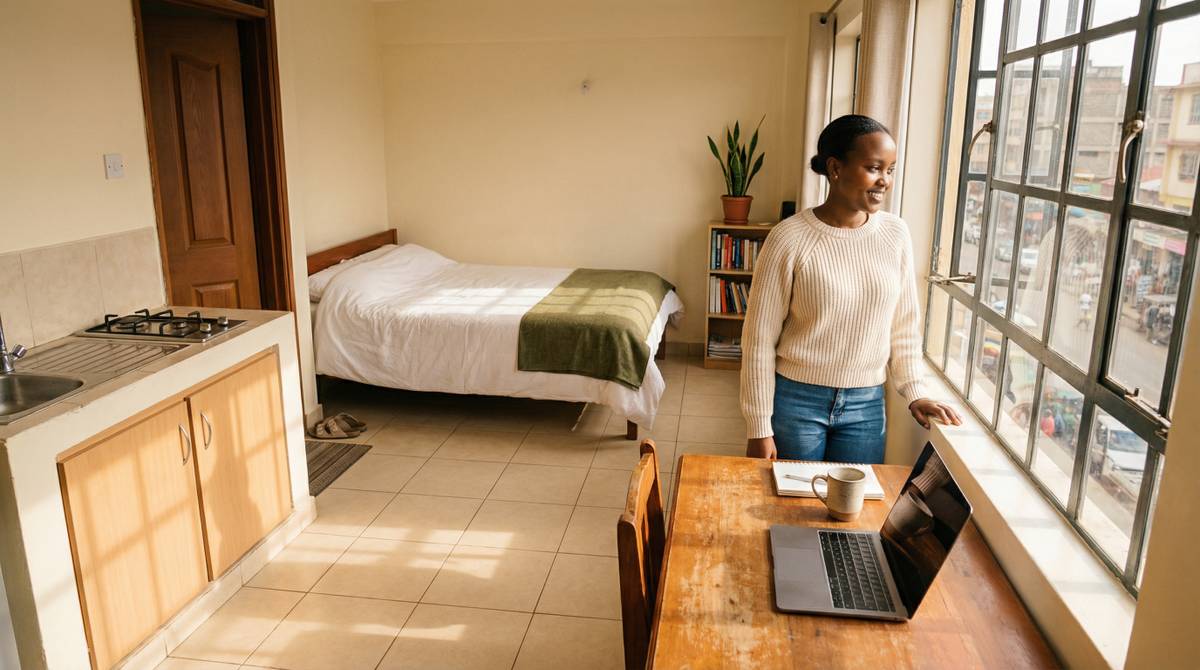
A bedsitter (sometimes spelled “bed-sitter”) is a self-contained, open-plan living unit. It combines your bedroom, living area, and usually a small kitchen zone into a single room, with a separate enclosed bathroom. Think of it as Kenya’s equivalent of a studio flat — but not quite.
The key features of a standard bedsitter:
One main room that serves as bedroom, lounge, and dining area
A built-in kitchen counter or kitchenette along one wall — typically a countertop, sink, a couple of cabinets, and a power socket for a cooker or kettle
A private ensuite bathroom with a toilet, shower (sometimes instant-heat), and basin
No separate bedroom door — the bed and the sofa share the same open space
The word “bedsitter” is uniquely Kenyan in everyday property language. If you see it on a listing, you now know: it’s a single room with its own bathroom and cooking area. Self-contained, but compact.
Bedsitter vs Studio vs Single Room vs One-Bedroom
This is where most renters — and diaspora investors — get confused. These four terms appear interchangeably on Kenyan listing sites, but they describe different unit types. Here’s how to tell them apart.
Feature | Single Room | Bedsitter | Studio | 1-Bedroom |
|---|---|---|---|---|
Size (sqm) | 9–15 | 20–35 | 25–45 | 35–55 |
Bathroom | Shared | Private ensuite | Private ensuite | Private ensuite |
Kitchen | None or shared | Built-in counter | Fitted kitchenette | Separate kitchen |
Bedroom | Same room | Same room | Same room (may have half-wall) | Separate room |
Rent Range (Nairobi) | KES 3,000–8,000 | KES 5,500–25,000 | KES 15,000–65,000 | KES 18,000–100,000+ |
Best For | Students on tight budget | Young professionals, first-timers | Singles wanting modern finishes | Couples, small families |
In practice, many Kenyan listings use “studio” to market a nicer bedsitter with modern finishes, gypsum ceilings, or a half-wall dividing the sleeping zone. If a listing says “studio” but the price is under KES 15,000, it’s most likely a bedsitter with upgraded finishes.
→ Coming soon: Studio vs Bedsitter vs One-Bedroom: Kenya Guide — where we go deeper into this comparison with floor plan visuals.
Size and Layout: What Fits Inside a Bedsitter?
A typical bedsitter in Nairobi measures between 20 and 35 square metres. That’s roughly the size of a large hotel room. At 25 sqm — the most common size — you can comfortably fit:
A double bed (or 4x6 bed, which is standard in Kenya)
A two-seater sofa and small coffee table
A TV stand or wall-mounted TV
A shoe rack and wardrobe (many units have built-in wardrobes)
A small desk or workspace — tight but workable for a laptop
The kitchen area is along one wall and typically includes a countertop, a sink with running water, two or three cabinets, and a power socket rated for cooking appliances. Most tenants use a two-burner gas cooker or a single hot plate. You’ll rarely find an oven — there simply isn’t space.
Bathrooms are small but functional: a shower (no bathtub), a toilet, and a wash basin. Higher-end bedsitters come with instant water heaters; budget units may have cold water only or a shared booster.
Bedsitter Rent by Nairobi Neighbourhood (Early 2026)
Bedsitter rent in Nairobi varies enormously depending on location. A bedsitter in Kilimani might cost four times what you’d pay in Zimmerman. Here’s what the market looks like as of early 2026, based on current listings across major property portals.
Premium Neighbourhoods
Neighbourhood | Bedsitter Rent (KES/month) | Approx. USD/month |
|---|---|---|
Kilimani | 15,000 – 25,000 | $115 – $195 |
Westlands | 20,000 – 65,000 | $155 – $505 |
Lavington | 20,000 – 40,000 | $155 – $310 |
Kileleshwa | 19,000 – 30,000 | $147 – $233 |
Westlands has the widest range because it includes everything from older walk-up apartments at KES 20,000 to fully furnished serviced studios at KES 65,000 or more. The higher end is essentially a furnished studio marketed as a bedsitter.
Mid-Range Neighbourhoods
Neighbourhood | Bedsitter Rent (KES/month) | Approx. USD/month |
|---|---|---|
Ngong Road corridor | 8,500 – 18,000 | $66 – $140 |
South B / South C | 8,000 – 15,000 | $62 – $116 |
Nairobi West | 8,000 – 15,000 | $62 – $116 |
South B and Nairobi West are popular with young professionals working along Mombasa Road or in the CBD. New-build bedsitters here come with modern finishes — CCTV, lifts, balconies — and cluster around the KES 10,000–12,000 range.
Budget Neighbourhoods
Neighbourhood | Bedsitter Rent (KES/month) | Approx. USD/month |
|---|---|---|
Eastleigh / Jogoo Road | 5,500 – 12,000 | $43 – $93 |
Zimmerman / Kahawa West | 5,000 – 8,000 | $39 – $62 |
Ruiru / Thika Road corridor | 5,000 – 10,000 | $39 – $78 |
Tassia / Pipeline / Embakasi | 5,500 – 10,000 | $43 – $78 |
Zimmerman, Kahawa West, and Ruiru consistently offer the lowest rents. The trade-off is a longer commute to the CBD — 45 minutes to over an hour during rush hour via matatu (public minibus). University towns like Juja also have bedsitters from KES 5,000, driven by student demand.
Note: All USD conversions use an approximate rate of KES 129 = $1, current as of early 2026. Rates fluctuate, so always check the live exchange rate.
Who Lives in a Bedsitter?
Bedsitters aren’t a compromise — for many Kenyans, they’re a strategic first step. Here’s who you’ll find renting them:
Young professionals starting out. Fresh graduates with their first job in Nairobi, earning KES 30,000–60,000 a month. A bedsitter at KES 8,000–12,000 keeps housing costs under a third of income, which is the rule of thumb for sustainable renting.
University and college students. Especially near campuses along Thika Road (JKUAT, Kenyatta University) and Ngong Road (Strathmore, Daystar). Students often share costs or choose hostels, but a private bedsitter offers independence.
Single expats and short-term workers. NGO staff, tech contractors, and consultants on short assignments sometimes prefer a bedsitter over an expensive hotel, especially in neighbourhoods like Kilimani or Westlands with good Wi-Fi and walkability.
Couples starting out. A newer bedsitter in South B or Nairobi West can work for a couple saving toward a one-bedroom. It’s a stepping stone, not a dead end.
The common thread: independence at an accessible price point. A bedsitter is your own space — your own bathroom, your own kitchen, your own front door.
Bedsitters as an Investment: What Diaspora Buyers Should Know
If you’re a Kenyan in the US, UK, or Gulf thinking about rental income back home, bedsitter blocks are one of the most common entry points for small-scale property investment. Here’s the realistic picture.
The Numbers
A bedsitter unit in a block of flats (the most common format) can sell for KES 2.3–5 million in satellite towns and KES 5–8 million in Westlands or Kilimani. Monthly rent ranges from KES 8,000 to KES 25,000 depending on location.
At the mid-range — say a KES 3.5 million unit in Ruiru renting at KES 10,000/month — the gross rental yield is approximately 3.4%. That’s before management, maintenance, vacancy, and tax. The KNBS 2023/2024 Real Estate Survey found bedsitter and studio yields averaging 2.2% nationally, though well-located, well-managed units in high-demand areas can exceed this.
For context, Nairobi apartments overall yield 5–9% gross, and satellite towns push 8–12%. Bedsitters sit at the lower end because purchase prices per square metre are relatively high for the small floor area.
The Upside
High occupancy. Demand for affordable bedsitters is relentless in a city where the population grows by an estimated 4% annually and affordable housing supply lags far behind.
Low maintenance costs. Small units mean fewer things to repair or replace.
Airbnb potential. Furnished bedsitters in Kilimani, Westlands, and Nairobi West can earn KES 2,500–4,000 per night on short-let platforms — but this requires active management and consistent occupancy rates of 50%+ to outperform long-term lets.
The Realistic Caution
Yields are modest compared to larger residential units. The KNBS data shows townhouses and maisonettes delivering 6–8% yields. If pure rental return is your goal, a one-bedroom or two-bedroom may serve you better.
Bedsitters work best as an entry-level investment — low capital outlay, steady demand — while you build toward larger assets. Treat them as a cash-flow foundation, not a growth engine.
What to Check Before Renting a Bedsitter
Finding a bedsitter is easy. Finding a good one takes a checklist. Here’s what experienced Nairobi renters verify before signing.
Water supply. Ask directly: does the building have a borehole, water tanks, or rely on Nairobi Water? Boreholes and tanks mean consistent supply; municipal-only buildings face rationing, especially in Eastlands.
****Look for a perimeter wall, CCTV cameras, and a 24-hour security guard or caretaker. Gated compounds are standard in mid-range and premium areas.
Wi-Fi and electricity. Many newer buildings offer free Wi-Fi and prepaid electricity meters (token meters). Ask about power back-up — generators are common in premium buildings, rare in budget ones.
****If you have a car, confirm a dedicated slot. Many bedsitter blocks prioritise tenants without cars, and parking can be an extra cost.
Caretaker reliability. The caretaker is your first point of contact for plumbing, electrical, and security issues. Ask current tenants about response times.
Lease terms and deposits. The standard deposit in Kenya is two months’ rent (one month’s rent + one month’s security deposit). Some landlords add a separate service charge or lease agreement fee of 2–20% of monthly rent. Get everything in writing before paying.
Cooking gas policy. Some buildings prohibit gas cylinders for safety reasons and require electric cookers only. Others allow gas but not inside enclosed kitchenettes. Clarify before you move in.
→ Read more: How to Avoid Property Scams in Kenya 2026 — essential reading before signing any lease.
→ Also useful: How to Verify a Real Estate Agent (EARB Guide) — if you’re dealing with an agent, verify their licence first.
📋 Download our free Nairobi Rental Checklist (PDF) — 12 things to verify before signing a lease, including deposit norms, water tests, and red-flag questions to ask the caretaker.
Red Flags in Bedsitter Listings
Not every listing is what it claims. Watch out for these warning signs.
“Spacious bedsitter” with no dimensions. If the listing says “spacious” but doesn’t mention square metres, it’s often 18–20 sqm — small even by bedsitter standards. Ask for the exact measurements before visiting.
No photos of the bathroom or kitchen. If the listing only shows the bed area with a wide-angle lens, the kitchen and bathroom may be in poor condition. Always request photos of every room — or better, visit in person.
Price significantly below area average. A KES 5,000 bedsitter in Kilimani doesn’t exist. If the price seems too good, the unit may have serious water issues, no security, or the listing may be a scam to collect deposit money.
“Bedsitter” with shared bathroom. That’s a single room, not a bedsitter. A genuine bedsitter has its own private bathroom. Shared facilities mean you’re paying bedsitter prices for a single-room experience.
Agent asks for viewing fees or upfront “reservation” payments. Legitimate agents don’t charge to show you a property. If someone asks for money before you’ve seen the unit, walk away.
→ Planning to rent in Kilimani specifically? Read our Living in Kilimani: Complete Guide 2026 for neighbourhood-specific advice on buildings, amenities, and commute times.
Find a Verified Bedsitter on Afriqahome
Searching for bedsitters online means wading through unverified listings, ghost agents, and photos that don’t match reality. Afriqahome addresses this by connecting you with verified property agents who display trust badges on their profiles.
Agents on Afriqahome can earn a Verified Agent badge by submitting identity and licence documentation. The badge is optional, so look for it rather than assuming it. That doesn’t make every transaction risk-free — no platform can promise that — but it reduces the chances of dealing with an unlicensed operator or a scam listing.
Here’s what you can do right now:
Browse verified bedsitter and studio rentals in Nairobi → afriqahome.com/to-rent/nairobi/
Filter by neighbourhood, price range, and property type
Contact agents directly through the platform — your details are shared only with the listing agent
Whether you’re moving to Nairobi next month or investing from abroad, starting with verified listings is the first step toward a rental experience without surprises.
Other Guides

Living in Juja, Kiambu: The University Town That Became a Satellite City — Prices, Estates & Honest Guide (2026)
Juja houses from KSh 1.2M, rent from KSh 2.5K. JKUAT area, Kenyatta Road estates, Kalimoni, Witeithie. Student yields 9-15%.

Westlands Property Guide: Prices, Lifestyle & Investment (2026)
Complete guide to Westlands real estate. Apartments from KES 8M, rental yields 6-8%, plus lifestyle amenities. Browse verified Westlands listings today.

Houses for Sale in Karen: Price Guide 2026
Karen house prices from KES 35M–250M+. 4-bedroom, 5-bedroom, villas. Karen Hardy, Ndege Road, budget breakdown. Updated March 2026.