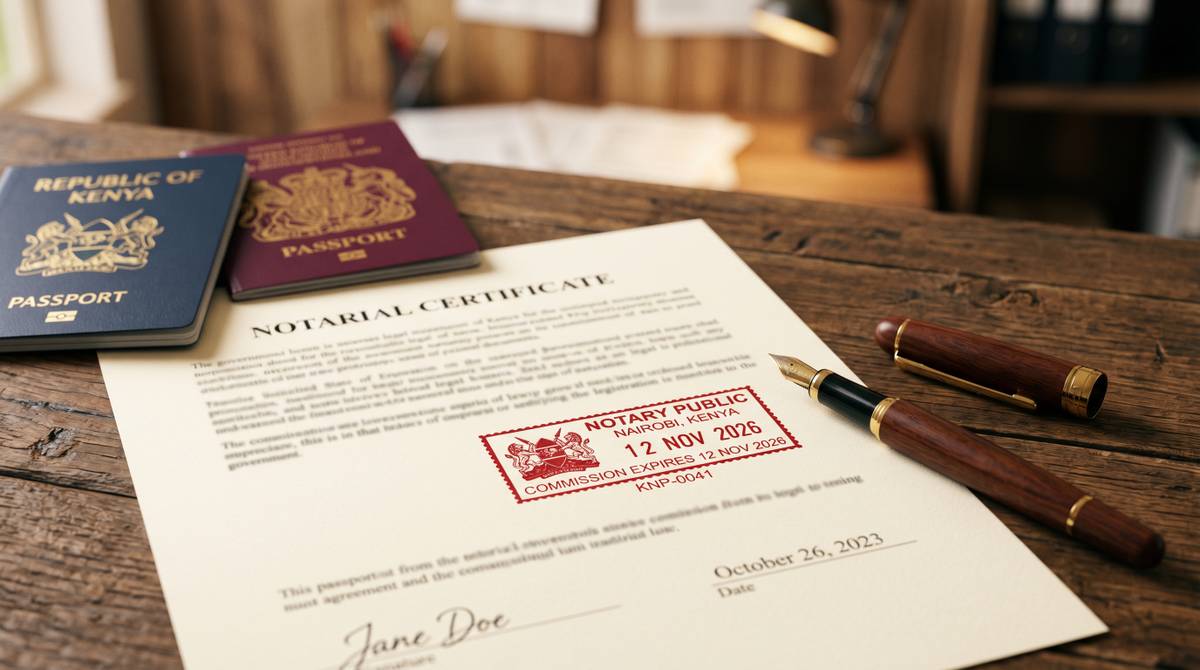
Power of Attorney for Property in Kenya: The Diaspora Buyer's Complete Guide
Buying Kenyan property from abroad? Learn how to get a PoA — types, notarisation, apostille by country, costs, registration, and how to avoid PoA fraud.
Introduction
If you are buying property in Kenya and cannot be physically present — whether you live in the USA, UK, UAE, Canada, or anywhere else — you will almost certainly need a Power of Attorney (PoA). A PoA is a legal document that authorises another person, usually your Kenyan lawyer, to sign documents and complete the transaction on your behalf. It is the legal bridge between you and a property purchase that happens 8,000 kilometres away.
But a PoA is also one of the most misused documents in Kenyan property transactions. Poorly drafted, overly broad, or incorrectly authenticated Powers of Attorney have been used to sell properties without the owner's knowledge, transfer land fraudulently, and commit outright theft. This guide explains what a PoA is, how to get one that works, and how to protect yourself from the documented ways it can go wrong.
What Is a Power of Attorney?
A Power of Attorney is a legal instrument through which one person (the donor or principal — that is you) authorises another person (the attorney or agent) to act on their behalf in specified legal matters. In Kenya, PoAs are governed by the Powers of Attorney Act (Cap 15) and, for property transactions, must comply with the Land Registration Act, 2012.
For property purchases, the PoA typically authorises the attorney to sign the sale agreement, pay stamp duty, execute the transfer documents, and register the title deed in your name.
Types of Power of Attorney in Kenya
Type | What It Covers | When to Use | Key Risk |
|---|---|---|---|
General PoA | Broad authority over multiple matters — property, banking, legal affairs | Extended absence from Kenya with ongoing business to manage | Too broad — can be misused for transactions you did not authorise |
Specific (Special) PoA | Limited to one defined task — e.g., purchasing a specific plot on a specific title number | One-time property purchase from abroad | Lower risk — scope is narrow and defined |
Enduring PoA | Continues even if the donor becomes mentally incapacitated | Estate planning, elderly parents, long-term arrangements | Cannot be revoked by the donor once incapacity occurs |
For diaspora property buyers, always use a Specific (Special) PoA. It should name the exact property (title number or plot reference), the exact transaction (purchase, not sale), the specific actions the attorney may take, and include an expiry date. A general PoA gives your attorney the legal authority to do things you never intended — including selling property you already own.
How to Get a PoA from Abroad — Step by Step
Step 1: Have your Kenyan lawyer draft the PoA
Your lawyer in Kenya should draft the PoA because they know the exact wording, scope, and format that the Kenyan Land Registry will accept. Do not draft it yourself or use a generic template — land registries have rejected PoAs for formatting and wording issues.
The PoA should specify: your full legal name (matching your Kenyan ID or passport exactly), the attorney's full legal name, the specific property (title number, plot number, or development name), the specific actions authorised (sign sale agreement, pay stamp duty, execute transfer, register title), and an expiry date (typically 6–12 months).
Step 2: Sign and notarise in your country of residence
Once your lawyer sends the draft, you sign it in front of a notary public in the country where you live. In some countries, you can also sign at the Kenyan Embassy or High Commission — this simplifies the authentication process because embassy-notarised documents are generally accepted directly by Kenyan authorities.
Step 3: Apostille or authenticate
If your country is a signatory to the Hague Apostille Convention (the USA, UK, Canada, Australia, and most European countries are), the notarised PoA must be apostilled by the relevant government authority in your country. An apostille certifies that the notarisation is legitimate.
If your country is not a Hague Convention signatory (notably the UAE is not, though it has a bilateral arrangement), the PoA must be authenticated through the Kenyan Embassy or High Commission in that country.
Country | Hague Convention | Authentication Method |
|---|---|---|
USA | Yes | Notarise → Apostille (Secretary of State) |
UK | Yes | Notarise → Apostille (Foreign, Commonwealth & Development Office) |
Canada | Yes (since 2024) | Notarise → Apostille (Global Affairs Canada) |
UAE | No | Notarise → Authenticate at Kenyan Embassy Abu Dhabi or Consulate Dubai |
Australia | Yes | Notarise → Apostille (DFAT) |
Germany | Yes | Notarise → Apostille (local court or regional government) |
Step 4: Send original to your Kenyan lawyer
The original, notarised, and apostilled PoA must be physically delivered to your Kenyan lawyer. A scanned copy is not sufficient for Land Registry purposes. Use a tracked courier service (DHL, FedEx, UPS) — never regular post.
Step 5: Register the PoA in Kenya
Your lawyer registers the PoA at the Lands Registry (for land transactions) or the Registrar of Documents (for general use). Registration must be done within 30 days of the PoA being executed. Registration fees include stamp duty on the PoA document. An unregistered PoA may not be accepted for land transactions.
Costs
Item | Estimated Cost | Notes |
|---|---|---|
Kenyan lawyer drafting fee | KSh 10,000–30,000 | Varies by lawyer and complexity |
Notarisation (abroad) | $50–$200 / £30–£100 | Depends on country and notary |
Apostille fee | $10–$50 / £30–£75 | Varies by country |
Courier (international) | $50–$150 | DHL/FedEx tracked |
Registration in Kenya | KSh 2,000–5,000 | Stamp duty + registry fee |
Total estimated | $200–$500 equivalent | Plus lawyer's drafting fee |
How PoAs Are Misused — and How to Protect Yourself
The documented risks with Powers of Attorney in Kenyan property transactions are real. Here is what to watch for:
Overly broad scope: A general PoA that authorises "all property transactions" gives your attorney the legal power to sell your existing property, not just buy new property. Always use a specific PoA limited to one transaction.
No expiry date: A PoA without an expiry date remains valid indefinitely — even if your relationship with the attorney deteriorates. Always include an expiry date (6–12 months is standard for a single purchase).
PoA granted to the wrong person: Grant the PoA to your lawyer, not to the selling agent, a family member handling "everything," or anyone connected to the seller's side of the transaction. Your lawyer has professional obligations and a licence at stake.
Seller asking you to sign a PoA: If a seller or agent asks you to sign a PoA in their favour, this is a major red flag. A legitimate transaction never requires the buyer to grant power of attorney to the seller.
Revocation: If you need to revoke a PoA, issue a written notice of revocation (witnessed), register it at the relevant registry, and notify the attorney and any third parties who may have relied on the PoA. Your lawyer can file the revocation using Form LRA 8 for land-related PoAs.
Frequently Asked Questions
Do I need a Power of Attorney to buy property in Kenya from abroad?
Not always. If you can travel to Kenya to sign documents in person, a PoA is not required. However, if you cannot be physically present for the signing of the sale agreement, transfer documents, or stamp duty payment, you need a PoA authorising someone (usually your lawyer) to sign on your behalf.
Who should I appoint as my attorney?
Your independent Kenyan lawyer is the safest choice. They have professional obligations, are regulated by the Law Society of Kenya, and their licence is at stake if they act outside the scope of the PoA. Avoid appointing family members, the selling agent, or anyone connected to the other side of the transaction.
Can I sign the PoA at a Kenyan Embassy?
Yes. Kenyan Embassies and High Commissions can notarise documents for Kenyan citizens abroad. Embassy-notarised PoAs are generally accepted directly by Kenyan authorities without needing a separate apostille. Contact your nearest embassy to confirm their current process and fees.
How long does a Power of Attorney take to prepare?
The drafting takes 1–3 days. Notarisation and apostille timing depends on your country — in the USA and UK, it can be done within a week. Courier delivery to Kenya takes 3–5 business days. Registration in Kenya takes 1–2 weeks. Total: approximately 2–4 weeks from drafting to registered PoA ready for use.
Can a Power of Attorney be used to sell my existing property without my knowledge?
If you have granted a general PoA with broad authority, yes — legally, the attorney could execute a sale. This is why specific PoAs with defined scope, named properties, and expiry dates are essential. If you suspect misuse, instruct your lawyer to file a revocation immediately and register a caution on the affected title at the Land Registry.
What happens if my PoA is rejected at the Land Registry?
Common reasons for rejection: incorrect format, missing apostille, names not matching exactly between the PoA and the title deed, or registration after the 30-day deadline. Your Kenyan lawyer should verify the PoA format before you sign it abroad to avoid costly re-execution. If rejected, you will need to re-execute and re-authenticate the PoA — which means starting the process again from your country of residence.
Next Steps
A Power of Attorney is a necessary tool for most diaspora property purchases — but it requires careful drafting and proper authentication. Start by engaging an independent Kenyan lawyer who can draft the PoA, guide you through the notarisation process, and register the document in Kenya.
For verified agents who work with diaspora buyers, browse Afriqahome's verified agent directory. For the complete diaspora buying process, see our country-specific guides: USA · UK · UAE · Canada.
Related guides: How to Buy Land in Kenya · Due Diligence Checklist · Ardhisasa Title Search Tutorial · Stamp Duty & Closing Costs · Common Mistakes Diaspora Buyers Make · Diaspora Investment Hub.
Other Guides

Living in Juja, Kiambu: The University Town That Became a Satellite City — Prices, Estates & Honest Guide (2026)
Juja houses from KSh 1.2M, rent from KSh 2.5K. JKUAT area, Kenyatta Road estates, Kalimoni, Witeithie. Student yields 9-15%.

Westlands Property Guide: Prices, Lifestyle & Investment (2026)
Complete guide to Westlands real estate. Apartments from KES 8M, rental yields 6-8%, plus lifestyle amenities. Browse verified Westlands listings today.

Houses for Sale in Karen: Price Guide 2026
Karen house prices from KES 35M–250M+. 4-bedroom, 5-bedroom, villas. Karen Hardy, Ndege Road, budget breakdown. Updated March 2026.