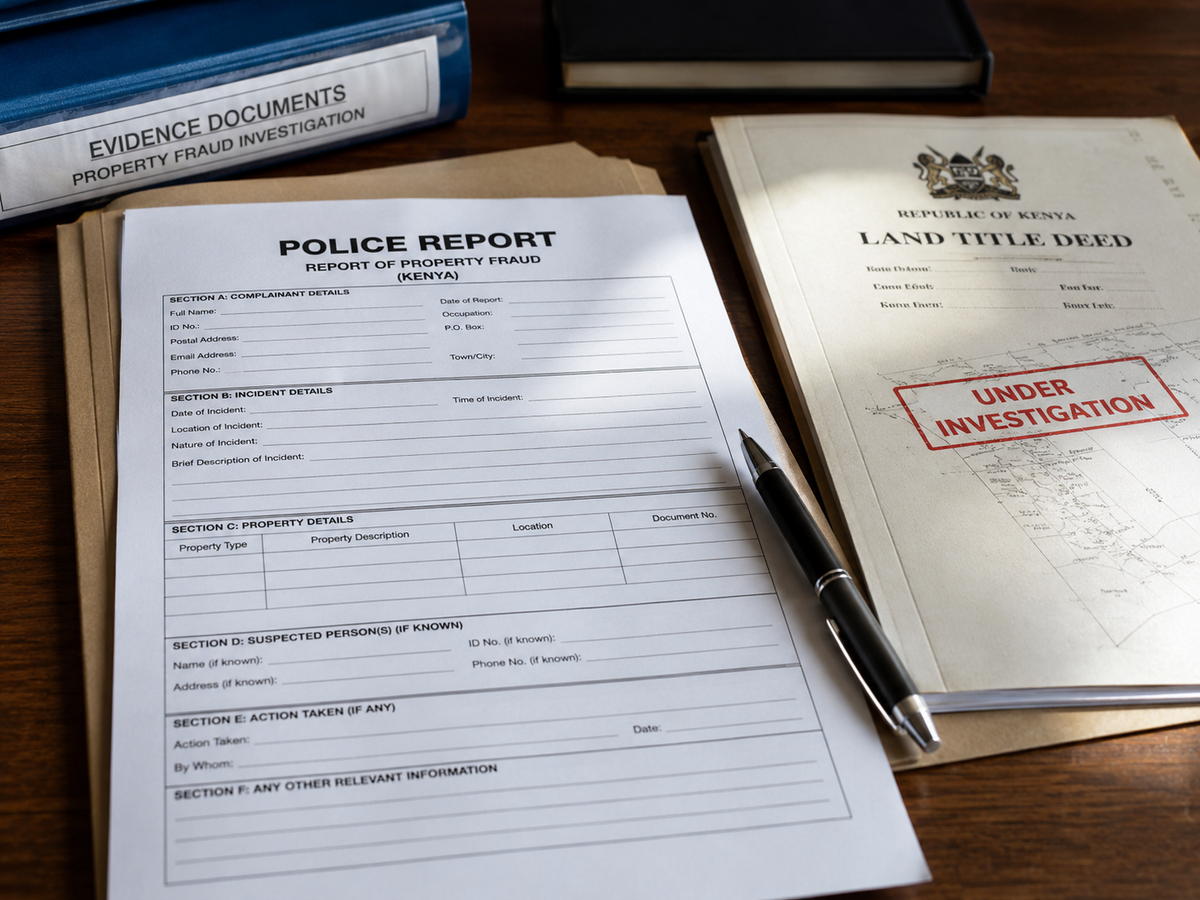
How to Report Property Fraud in Kenya: Where, How & What to Expect
How to report property fraud in Kenya: the first 48 hours, where to report (DCI, Lands, EACC), how to freeze the land, and the honest reality of recovery.
If you've been defrauded in a property deal in Kenya, the speed and accuracy of your response decides how much you can recover. Knowing how to report property fraud in Kenya — to the right bodies, in the right order, with the right evidence — is the difference between a case that goes nowhere and one that freezes the land, triggers a criminal investigation, and gives you a real shot at your money back. This guide walks through exactly what to do, who to report to, and the honest reality of recovery.
One thing first: act immediately. Fraudsters move fast to transfer land on or sell it again, and every day that passes makes recovery harder. The steps below are ordered for speed.
The First 48 Hours: What to Do Immediately
The moment you suspect fraud, your priorities are to preserve evidence, freeze the property, and get the matter on official record. In practice that means stopping any further payments, securing every document and message you have, reporting to the police and the DCI, and instructing an advocate to place a restriction on the land so it can't be transferred again while you act. The faster the land is frozen and the case is logged, the better.
Don't confront the fraudster alone or pay "to fix it." Scammers often follow up with a second approach — offering to "sort the paperwork" for an extra fee, or threatening you. Route everything through the police, the DCI, and your advocate instead. A second payment almost never recovers the first.
Gather Your Evidence First
Investigators can only act on what you can show them. Before and during reporting, assemble everything:
Copies of the title deed and any documents the seller provided
The sale agreement and any signed contracts
Payment records — M-Pesa statements, bank transfers, RTGS confirmations, receipts
All communication: messages, emails, call logs, agent details
Identification details the seller or "agent" gave you
Photos of the property and any advertisements or listings used
Keep originals safe and make copies for each body you report to. This evidence underpins both the criminal investigation and any civil claim to recover your money.
Where to Report Property Fraud
Kenya has several bodies involved in land and property fraud, each with a different role. You may need more than one.
Body | Role | When to use |
|---|---|---|
Police (nearest station) | Records the report, issues an OB number | Always — your first official record |
DCI Land Fraud Unit | Investigates and helps prosecute land fraud | For forgery, false-pretence registration, impersonation |
Ministry of Lands | Verifies title authenticity and ownership history | To confirm the fraud and support investigation |
National Land Commission (NLC) | Investigates land injustices and certain disputes | Historical injustice or contested public/community land |
EACC | Pursues corruption and grabbed public land | When officials or public land are involved |
Courts (via your advocate) | Nullify fraudulent titles, order recovery | For civil remedies and compensation |
Start with the police to get an OB (Occurrence Book) number, then take the matter to the DCI Land Fraud Unit, which investigates offences like obtaining title registration by false pretence and forgery of title deeds, wills, and powers of attorney. The Ministry of Lands helps verify the genuine ownership record, and the EACC steps in where corruption or public land is involved — the commission reported recovering over KES 5.2 billion in grabbed land in 2025.
Freeze the Land: Place a Caveat or Restriction
One of the most important early moves is to stop the property changing hands again. Through your advocate, you can lodge a caveat or restriction against the title at the land registry, which blocks further dealings — transfers, charges, or sub-divisions — until the dispute is resolved. This buys you time and protects the asset while the investigation and any court case proceed. Acting before the fraudster sells the parcel to a third party significantly improves your position.
The Legal Route: Criminal and Civil Remedies
Property fraud in Kenya runs on two tracks that often proceed in parallel. The criminal track, driven by the DCI and the prosecution, aims to investigate, charge, and convict the fraudsters — forensic document examiners may analyse signatures and seals for tampering. The civil track, driven by you and your advocate, aims to nullify the fraudulent title and recover your money or obtain compensation. Courts have repeatedly cancelled fraudulent titles where the evidence is clear.
Engage an advocate registered with the Law Society of Kenya early — they coordinate the registry restriction, the civil suit, and the interface with investigators. The cost of good legal help is small next to what's at stake.
The Laws That Protect You
Several statutes criminalise property fraud, which is useful to know when reporting:
Law | Covers |
|---|---|
Land Registration Act, 2012 | Fraudulent procuring of registration of title or land documents |
Land Act, 2012 | Unlawful occupation and dealings in public land |
Anti-Corruption and Economic Crimes Act, 2003 | Abuse of office, corruption in land offices |
Computer Misuse and Cybercrimes Act, 2018 | Online property scams and digital fraud |
Penal Code | Forgery and obtaining by false pretences |
The Honest Reality of Recovery
It's important to be straight about this: reporting fraud improves your chances, but recovery can be difficult and slow, and it is never guaranteed. If the money has been withdrawn and the fraudster has vanished, getting it back is hard. If the land has already been sold on to an innocent third party, untangling ownership is complex. What reporting reliably does is freeze the asset, create an official record, deter the fraudster from selling again, and open the legal routes to a remedy. Acting within days rather than weeks is the biggest factor in your favour.
This is exactly why prevention matters so much more than cure — the strongest protection is never to be defrauded in the first place.
Preventing Fraud in the First Place
Most property fraud is avoidable with a few disciplined checks. Verify the title through an official search on Ardhisasa or at the registry, confirm the seller is the registered owner, use an advocate's client account and traceable payments rather than cash, and never pay before due diligence is complete. Our Kenya property scams guide, fake title deeds warning signs, and due diligence checklist cover the full prevention playbook, while the safe payment methods guide and succession land fraud guide address the two stages where buyers most often lose money. Buying through a verified agent reduces — though never fully eliminates — exposure to fake sellers.
For Diaspora Victims
Diaspora buyers are disproportionately targeted and face an added hurdle: reporting from abroad. If you're overseas and suspect fraud, instruct a Kenyan advocate immediately — they can lodge the police and DCI reports, place a restriction on the title, and represent you without your needing to fly home, typically under a power of attorney. Send them your complete evidence file digitally. Our diaspora hub and remote buying guide explain how to set up trusted local representation before problems arise — the best time to arrange it is before you buy, not after.
Legitimate sellers welcome verification; fraudsters resist it. If anyone discourages you from running an official search, involving an advocate, or reporting concerns, treat that resistance itself as a warning sign.
Frequently Asked Questions
What should I do first if I'm scammed buying land in Kenya?
Act immediately. Stop any further payments, gather all your evidence (title documents, sale agreement, payment records, communications), and report to the nearest police station to get an OB number. Then take the matter to the DCI Land Fraud Unit and instruct an advocate to place a restriction on the title so the land can't be transferred again. Speed is the single biggest factor in whether you recover anything.
Where do I report property fraud in Kenya?
Start with the police for an official OB record, then the DCI Land Fraud Unit, which investigates forgery and fraudulent registration. Lodge a complaint with the Ministry of Lands to verify the genuine ownership record. Involve the National Land Commission for land-injustice or public-land disputes, and the EACC where corruption or grabbed public land is involved. Your advocate handles the civil case in court to recover money and nullify fraudulent titles.
How do I stop the fraudster from selling the land again?
Through your advocate, lodge a caveat or restriction against the title at the land registry. This blocks any further transfers, charges, or sub-divisions until the dispute is resolved, protecting the asset while the investigation and court case proceed. Doing this quickly — before the parcel is sold on to a third party — significantly strengthens your position.
Can I recover my money from land fraud in Kenya?
Sometimes, but it is difficult and never guaranteed. If the money has been withdrawn and the fraudster has disappeared, or the land has been sold to an innocent third party, recovery is complex. Reporting reliably freezes the asset, creates an official record, and opens legal routes to a remedy through the courts. Acting within days rather than weeks is the biggest factor in your favour.
What evidence do I need to report property fraud?
Gather copies of the title deed and seller documents, the sale agreement, all payment records (M-Pesa, bank transfers, RTGS confirmations, receipts), every communication including messages and call logs, the seller's or agent's identification details, and photos or listings used in the deal. Keep originals safe and provide copies to each body you report to — this evidence supports both the criminal investigation and your civil claim.
Which laws cover property fraud in Kenya?
Several. The Land Registration Act 2012 covers fraudulent registration of titles; the Land Act 2012 covers unlawful dealings in public land; the Anti-Corruption and Economic Crimes Act 2003 covers abuse of office; the Computer Misuse and Cybercrimes Act 2018 covers online scams; and the Penal Code covers forgery and obtaining by false pretences. These give the DCI and courts the basis to investigate, prosecute, and nullify fraudulent titles.
Explore Further
The best protection is prevention. Read the property scams guide, fake title deeds warning signs, and due diligence checklist before you buy, learn official verification in the title verification guide and Ardhisasa tutorial, pay safely using the safe payment methods guide, and follow the full land buying process. When you're ready, connect with a verified agent; diaspora buyers should start at the diaspora hub.
Data sources: Directorate of Criminal Investigations (Land Fraud Unit); Ethics and Anti-Corruption Commission; Ministry of Lands and National Land Commission; relevant Kenyan statutes (2025–2026). This is general information, not legal advice — consult a qualified advocate for your situation. Reporting improves but does not guarantee recovery, and verification reduces but does not eliminate risk.
Other Guides

Living in Juja, Kiambu: The University Town That Became a Satellite City — Prices, Estates & Honest Guide (2026)
Juja houses from KSh 1.2M, rent from KSh 2.5K. JKUAT area, Kenyatta Road estates, Kalimoni, Witeithie. Student yields 9-15%.

Westlands Property Guide: Prices, Lifestyle & Investment (2026)
Complete guide to Westlands real estate. Apartments from KES 8M, rental yields 6-8%, plus lifestyle amenities. Browse verified Westlands listings today.

Houses for Sale in Karen: Price Guide 2026
Karen house prices from KES 35M–250M+. 4-bedroom, 5-bedroom, villas. Karen Hardy, Ndege Road, budget breakdown. Updated March 2026.