Living in Kileleshwa, Nairobi: Rent from KES 55K (2026)
Kileleshwa apartments from KES 55K rent / KES 4.5M to buy. Quieter than Kilimani, cheaper than Lavington. Streets, schools, and yields for 2026.
Living in Kileleshwa, Nairobi: The Complete Guide for 2026
Kileleshwa is the neighbourhood people recommend when you tell them you like Kilimani but wish it were quieter. Or when you say you love Lavington but want to spend a little less. It sits between the two — geographically and in character — and draws people who have done the comparison shopping and chosen calm over convenience without giving up too much of either.
The name comes up in a specific way. Not as the first suggestion, not as the aspirational pick, but as the knowing recommendation from someone who has lived in Nairobi long enough to understand the trade-offs. Kileleshwa is the neighbourhood where you end up when you have worked out what you actually need rather than what sounds impressive.
This guide covers what Kileleshwa actually is in 2026: current rental and sale prices, the streets worth knowing, commute realities, who lives here, and an honest assessment of whether it is the right fit. Whether you are a young professional couple weighing your options, a family looking for a quieter base near good schools, or a diaspora investor comparing yields across Nairobi's upper-middle belt, the detail here is built for decisions, not daydreams.
→ Compare all Nairobi neighbourhoods in our 2026 guide
Kileleshwa at a Glance
Factor | Details |
|---|---|
Location | ~6km northwest of CBD; bordered by Lavington (west), Kilimani (south), Westlands (north), and Riverside (east). Ring Road Kileleshwa and Oloitoktok Road are the main arteries. |
Character | Quiet, leafy, residential — Lavington's calmer, slightly more affordable cousin. Tree-lined streets, lower density, fewer commercial strips. |
Best For | Families, quiet professionals, NGO/UN staff, long-term renters who prioritise peace over nightlife, diaspora investors seeking value |
1BR Apartment Rent | KES 40,000–79,000/month (~$310–$610 USD); BuyRentKenya avg KES 79K |
2BR Apartment Rent | KES 55,000–100,000/month (~$425–$775 USD) |
3BR Apartment Rent | KES 70,000–150,000/month (~$540–$1,160 USD); BuyRentKenya avg KES 150K |
Apartment Sale Price | KES 4.5M–35M; BuyRentKenya average KES 13.4M for ~146 sqm |
Rental Yield | 5–7% gross; upper-middle segment 7.1% total returns (Cytonn FY2024/25) |
Commute to CBD | 12–18 min off-peak via Ring Road / Valley Road; 25–40 min peak |
Commute to Westlands | 5–10 min off-peak; 15–25 min peak |
Public Transport | Matatu route 48B via Ring Road Kileleshwa to CBD (Odeon); KES 50–80 fare |
All prices approximate as of early 2026. USD conversions at KES 129 = $1. Confirm current pricing with a verified Kileleshwa agent on Afriqahome.
What Kileleshwa Actually Feels Like
Kileleshwa sits approximately 6 kilometres from the CBD — close enough that the commute is manageable, far enough that you do not hear it at night. The neighbourhood occupies the space between Lavington and Westlands, with Kilimani to the south and the Riverside area to the east. That geography matters: it means Kileleshwa residents are within a short drive of four of Nairobi's most active commercial areas without living in any of them.
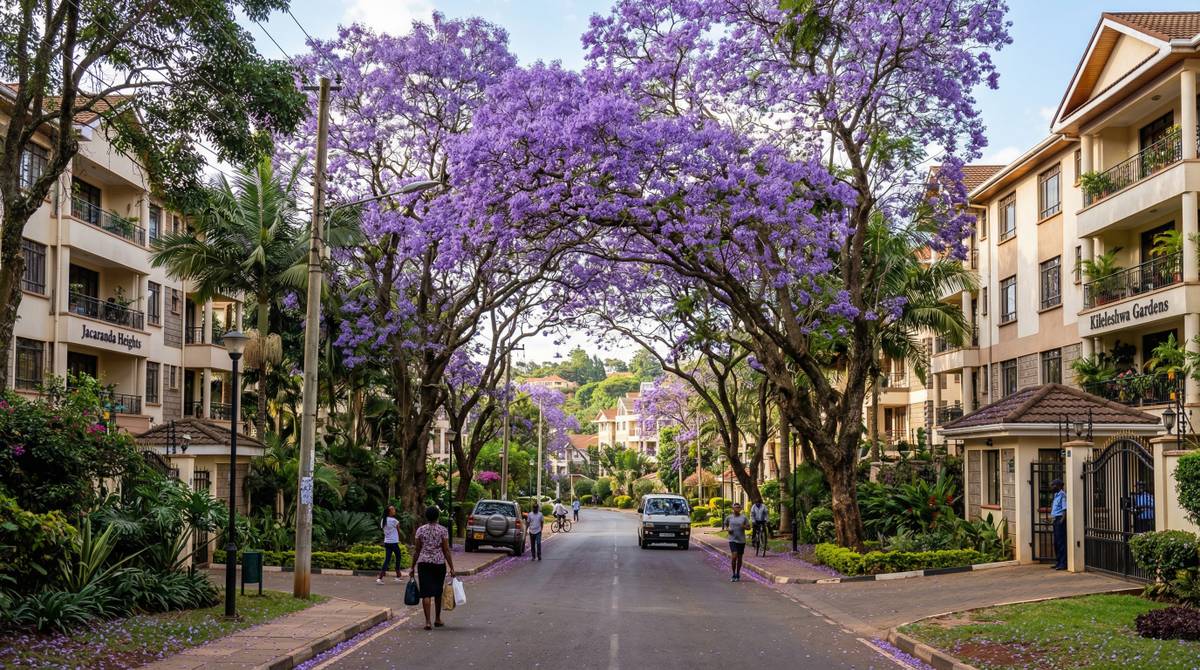
The first thing you notice is the tree canopy. Kileleshwa's streets are lined with mature eucalyptus and jacaranda, and the neighbourhood has retained more of its original green character than Kilimani, which has densified significantly over the past decade. The roads are wider than Kilimani's interior streets, traffic is lighter, and the general rhythm is slower. On a Wednesday evening, Kileleshwa is noticeably quieter than its neighbours.
The character is residential without being sleepy. Kileleshwa has a functioning commercial ecosystem — Kasuku Centre and Quickmart on Makueni Road handle daily convenience needs, Valley Arcade on the Lavington border provides a second retail node, and a scattering of cafes and restaurants along the main roads mean you are not entirely dependent on Westlands for a meal out. But this is not a neighbourhood with a social spine like Kilimani's Yaya Centre strip or Lavington's James Gichuru Road. Kileleshwa's identity is residential, and it is comfortable with that.
The social character is mixed in a specific Nairobi way. Young Kenyan professional couples share the neighbourhood with established families who have lived here for decades, NGO and UN staff who commute to Upper Hill or Gigiri, and a growing number of expat couples without children who find Kileleshwa's apartment quality attractive at prices lower than equivalent Lavington or Kilimani stock. It is a neighbourhood where people live rather than a neighbourhood where people go out.
Streets and Estates to Know
Ring Road Kileleshwa is the main artery, forming a rough semicircle that defines the neighbourhood's eastern boundary. It connects to Ngong Road in the south and Waiyaki Way in the north, providing two exit routes to the CBD and Westlands respectively. Traffic on Ring Road is lighter than Argwings Kodhek (Kilimani) or James Gichuru (Lavington), which is one of Kileleshwa's quiet advantages.
Oloitoktok Road runs through the centre of the neighbourhood, connecting to State House Road and providing a direct route toward Kilimani. This is where several of the newer apartment developments have gone up — a mix of mid-rise blocks targeting young professionals and families. The road is residential and reasonably quiet, though construction on some stretches has added temporary noise.
Gatundu Road is one of Kileleshwa's more established residential roads, known for older bungalows and compounds alongside newer apartment developments. The featured 4-bedroom + study + DSQ units off Gatundu Road (251–260 sqm, new build) represent the premium end of Kileleshwa's apartment market.
Mandera Road runs parallel to the Lavington border and carries a mix of residential and light commercial activity. The Tulips Restaurant and several small shops give this road a neighbourhood feel. Properties here benefit from proximity to Lavington's amenities while paying Kileleshwa rents.
Makueni Road is the daily convenience corridor — Quickmart, small shops, service businesses. It is not a destination strip but it handles the practical errands that make daily life work without requiring a drive to a larger mall.
Kasuku Centre is the closest thing Kileleshwa has to a commercial anchor — a small shopping centre with a supermarket, food outlets, and essential services. It is no Yaya Centre, but for daily needs it does the job.
The Riverside border — the eastern edge of Kileleshwa, near the Nairobi River — has seen increased apartment development. Some of these newer blocks market themselves as "Riverside" or "Kileleshwa/Riverside," which reflects the blurring boundary between the two areas. Properties near this edge tend to be slightly cheaper but also closer to the river's associated flooding and environmental risks.
Property Prices in Kileleshwa 2026
Kileleshwa is primarily an apartment market, though a shrinking number of standalone houses and townhouses remain, particularly on the older residential roads. The neighbourhood has seen significant new development in recent years, with Chinese-built apartment blocks adding supply at competitive prices.
Rental Market — as of early 2026
Unit Type | Monthly Rent (KES) | USD Equivalent | Notes |
|---|---|---|---|
Studio | 35,000–65,000 | $270–$500 | Growing segment. Newer builds along Oloitoktok Road from KES 55,000. |
1-Bedroom | 40,000–79,000 | $310–$610 | BuyRentKenya average: KES 79K. Unfurnished from KES 40K; furnished KES 80K–150K. |
2-Bedroom | 55,000–100,000 | $425–$775 | The core rental product. Most demand in KES 60K–85K range unfurnished. |
3-Bedroom | 70,000–150,000 | $540–$1,160 | BuyRentKenya average: KES 150K for ~240 sqm. Family market with DSQ. |
4-Bedroom | 100,000–250,000 | $775–$1,940 | Larger units with DSQ. UN-approved complexes at the premium end. |
Furnished / Serviced | 100,000–300,000+ | $775–$2,325+ | Corporate and expat market. Short-to-mid-term leases. |
Kileleshwa rents run approximately 10–20% lower than equivalent Kilimani apartments and 10–15% lower than Lavington for comparable specifications. The gap is largest at the 1–2 bedroom level — the segment where Kileleshwa offers the clearest value proposition.
Sales Market — as of early 2026
Unit Type | Price Range (KES) | USD Equivalent | Notes |
|---|---|---|---|
Studio | 3.5M–5.5M | $27K–$43K | Off-plan new builds. ~45 sqm typical. |
1-Bedroom | 4.5M–7M | $35K–$54K | Off-plan from KES 5.5M. Ready units KES 6–7M. |
2-Bedroom | 7M–15M | $54K–$116K | Core market. BuyRentKenya listings from KES 9M with DSQ. Off-plan from KES 9M. |
3-Bedroom | 12M–26M | $93K–$202K | Mandera Road listings at KES 26M for ~160 sqm all-ensuite + DSQ. |
4-Bedroom / Penthouse | 23M–35M | $178K–$271K | Duplex penthouses with DSQ. Limited stock. |
Apartment Average | KES 13.4M | ~$104K | BuyRentKenya average across all sizes, ~146 sqm. |
Source: BuyRentKenya, Kenya Property Centre, Sarabi Realty, and developer listings as of early 2026. Browse current Kileleshwa properties for sale on Afriqahome.
Kileleshwa Investment Outlook: 2025–2026 Market Data
Kileleshwa's market story in 2025–2026 is one of correction followed by early recovery.
HassConsult's Q4 2025 data shows Kileleshwa apartment prices dropped 10.3% year-on-year — the second-largest decline among Nairobi suburbs, behind only Westlands. This reflects the oversupply that multiple analysts have flagged: too many similar apartment blocks competing for the same tenant pool. However, the final quarter of 2025 showed signs of stabilisation, with Kileleshwa posting a 1.3% quarterly gain — suggesting the correction may have bottomed out.
The broader upper-middle segment (which includes Kileleshwa alongside Kilimani, Lavington, Loresho, and Ridgeways) delivered 7.1% average total returns in FY2024/25 per Cytonn — the best-performing residential segment in Nairobi, combining 6.0% rental yield with 1.2% price appreciation. Nairobi-wide rental yields hit 7.4%, the highest since records began in 2007.
Sarabi Realty's 2025 rental yield map places Kileleshwa in the 5–7% gross yield range, driven by demand from professionals, NGO staff, and families. The neighbourhood attracts fewer Airbnb-style short-stay investors than Kilimani, which means more stable long-term tenancies but lower peak yields.
Metric | Figure | Source |
|---|---|---|
Annual apartment price change | -10.3% YoY (correction) | HassConsult Q4 2025 |
Q4 2025 quarterly recovery | +1.3% (stabilising) | HassConsult Q4 2025 |
Upper-middle segment total returns | 7.1% (best in Nairobi) | Cytonn FY2024/25 |
Upper-middle rental yield | 6.0% | Cytonn FY2024/25 |
Gross yield range (Kileleshwa) | 5–7% | Sarabi Realty 2025 |
Average apartment price | KES 13.4M (~USD 104K) | BuyRentKenya Feb 2026 |
Nairobi-wide rental yield | 7.4% (highest since 2007) | HassConsult Q4 2025 |
Apartments' share of Nairobi sales | 71.1% (up from 23.5% in 2001) | HassConsult 2025 |
What this means for buyers: Kileleshwa's price correction creates a potential entry point. If you are buying now, you are purchasing at prices approximately 10% below the 2024 peak — while the broader rental market is strengthening. The risk is that oversupply continues to compress yields in generic stock. The opportunity is that quality apartments in good locations within Kileleshwa are now more affordable relative to Kilimani and Lavington than they have been in years.
For diaspora investors: Kileleshwa's value proposition is straightforward — lower entry prices than Kilimani or Lavington for comparable specifications, with a stable tenant base and fewer speculative short-stay investors competing for tenants. A 2-bedroom apartment at KES 9–12M renting for KES 60,000–85,000/month gives gross yields of 6–9% — competitive with Kilimani at a lower capital outlay. Verify any property through Kenya's Ardhisasa system before committing funds.
Who Lives in Kileleshwa
Kileleshwa's resident profile overlaps with Lavington's but skews slightly younger and more budget-conscious. The neighbourhood draws people who want the same residential quality as Lavington — tree-lined streets, manageable density, a grown-up atmosphere — but at a lower price point.
Young Kenyan professional couples form the largest segment, particularly those working in the CBD, Upper Hill, or Westlands who want a quiet residential base without Kilimani's density or Karen's distance. Many are dual-income households renting a 2-bedroom in the KES 60,000–85,000 range — the sweet spot where Kileleshwa offers the strongest value.
NGO and UN staff represent a significant portion of the rental market, particularly in the furnished and serviced apartment segment. Several Kileleshwa complexes hold UN-approved status, which guarantees a certain standard of security, generator backup, and water supply. The Upper Hill to Kileleshwa commute (10–15 minutes off-peak) makes this a natural corridor for international civil servants.
Established Kenyan families — many living in the older bungalows and compounds along Gatundu Road and the quieter interior streets — give the neighbourhood its residential stability. These are families that chose Kileleshwa twenty years ago and stayed because nothing else improved on the combination of quiet, location, and reasonable cost.
Expat couples and small families who find Kilimani too dense and Lavington too expensive are an increasing segment, drawn by apartment quality that has improved significantly with the new developments. The neighbourhood offers modern amenities — gym, pool, generator, fibre — at prices below Kilimani equivalents.
What Kileleshwa is not: a neighbourhood for people who want nightlife, restaurants, or social energy on their doorstep. It is also not a neighbourhood with a strong standalone-house market — if you want a house with a garden, Lavington or Karen serves that need better.
The Honest Pros of Living in Kileleshwa
Quieter Than Kilimani and Lavington
This is Kileleshwa's primary selling point and it is real. The traffic is lighter, the construction is less intense, and the general noise level is noticeably lower than Kilimani. If you work from home and need to concentrate, or if you have young children who need to sleep before 9pm, the quiet matters.
Lower Rents for Comparable Quality
A modern 2-bedroom apartment with pool, gym, and generator in Kileleshwa costs 10–20% less than an equivalent unit in Kilimani. For a young couple or a single professional, that difference — KES 10,000–20,000 per month — adds up to KES 120,000–240,000 per year. Same amenities, less noise, more savings.
Well Connected Without Being Central
Ring Road Kileleshwa provides two clean exit routes: south via Ngong Road to the CBD and Upper Hill, north via Waiyaki Way to Westlands. The CBD is 12–18 minutes off-peak. Westlands is 5–10 minutes. You are close to everything without being in the middle of it.
Green Streets, Mature Trees
Kileleshwa has retained more of its original tree canopy than Kilimani, where rapid densification has replaced gardens with parking basements. The jacaranda-lined streets and eucalyptus corridors give the neighbourhood a green, established feel that newer suburbs cannot replicate.
Good Schools Nearby
Kileleshwa Academy, Braeside School, Braeburn School (Gitanga Road campus), and Kileleshwa Primary are all within or adjacent to the neighbourhood. Strathmore and St Mary's in Lavington are a short drive. For families with school-age children, the school access is competitive with Lavington at lower housing costs.
Light Traffic
Ring Road Kileleshwa does not carry the same peak-hour volume as Argwings Kodhek (Kilimani) or James Gichuru (Lavington). Morning commutes to the CBD and Westlands are consistently shorter from Kileleshwa than from equivalent distances in those neighbourhoods.
The Honest Cons of Living in Kileleshwa
Fewer Walkable Amenities
Kileleshwa does not have a single commercial anchor like Yaya Centre (Kilimani) or the James Gichuru strip (Lavington). Kasuku Centre and the Makueni Road shops handle daily basics, but for serious shopping, dining, or entertainment you are driving to Westlands, Kilimani, or Lavington. This is the trade-off for the quiet.
Limited Nightlife and Social Scene
If you want to walk to a restaurant on a Friday night, Kileleshwa is not your neighbourhood. The dining and nightlife options within the area are thin. Westlands (5–10 minutes) and Kilimani (10–15 minutes) are the practical alternatives. Single professionals who value social proximity may find Kileleshwa too quiet.
Oversupply Risk in Some Blocks
HassConsult's data showing a 10.3% annual price decline reflects genuine oversupply. Some newer apartment blocks — particularly on the Riverside border — have struggled to fill units, leading to aggressive pricing and incentives. This benefits renters but represents a risk for buyers: not all Kileleshwa buildings will appreciate equally. Research the specific building's occupancy rate before buying.
Apartment Stock Quality Is Uneven
The wave of new Chinese-built developments has expanded supply but with variable quality. Some offer excellent value — modern amenities at lower prices than established blocks. Others have cut corners on finishes, water systems, or common area maintenance. Always inspect in person, check generator and borehole arrangements, and review service charge history before committing.
Limited House and Townhouse Stock
If you want a standalone house with a garden, Kileleshwa's options are shrinking as older plots are subdivided for apartment development. The neighbourhood is increasingly apartment-dominated. Families who want compound living should look at Lavington or Karen.
MCA-Led Restrictions on Nightlife Venues
The local MCA has actively campaigned against noisy clubs and lounges in the residential neighbourhood, which has kept the area quiet but also limited the development of dining and entertainment options. This is a pro if you want peace; a con if you want anything to do after 9pm.
Kileleshwa vs Nearby Neighbourhoods
Factor | Kileleshwa | Kilimani | Lavington |
|---|---|---|---|
Distance to CBD | ~6km | ~5km | ~7km |
Character | Quiet, residential, green | Dense, urban, walkable | Leafy, mixed, cosmopolitan |
Property Type | Apartments dominant | Apartments dominant | Apartments + houses mixed |
2BR Apt Rent | KES 55K–100K/mo | KES 65K–130K/mo | KES 75K–110K/mo |
Apt Sale (avg) | KES ~13.4M | KES ~9.4M | KES ~9.4M |
Rental Yield | 5–7% | 7–9% (quality stock) | 6.0–7.1% |
Nightlife | Very limited | Strong — walkable | Limited |
Traffic Peak | Light-moderate | Heavy | Moderate-heavy |
Best For | Quiet value-seekers | Urban convenience | Mixed lifestyle + space |
Kileleshwa vs Kilimani: Kilimani has more amenities, better walkability, and stronger nightlife. Kileleshwa has less noise, less traffic, and lower rents. If you need Yaya Centre and matatu routes, choose Kilimani. If you drive everywhere and value quiet evenings, Kileleshwa wins. The rent difference (10–20% lower) is the clincher for many.
Kileleshwa vs Lavington: Lavington has more commercial activity, a genuine walkable strip, and a mix of houses and apartments. Kileleshwa is even quieter but has fewer amenities. Lavington is slightly more expensive. If you want Lavington's character at a lower budget, Kileleshwa delivers most of it at a discount.
Kileleshwa vs Westlands: Westlands is commercial, social, and fast-paced — Nairobi's business and nightlife hub. Kileleshwa offers the proximity (5–10 minutes drive) without the noise and premium pricing. Many Westlands workers live in Kileleshwa for exactly this reason.
Schools, Hospitals, and Daily Amenities
Schools
Kileleshwa Academy — local private school within the neighbourhood
Braeside School — well-regarded international school; close to the Kileleshwa/Lavington border
Braeburn School (Gitanga Road) — Cambridge curriculum; technically in Lavington but within 10 minutes
Kileleshwa Primary School — public day primary school; local government run
Gichugu Road International School — international primary school on Gichugu Road
Strathmore School — within Lavington; 10–15 minutes from central Kileleshwa
St Mary's School — within Lavington; established private school
Hospitals and Medical Facilities
Nairobi Hospital — approximately 10–15 minutes via Ring Road / Valley Road; one of Nairobi's premier hospitals
MP Shah Hospital — approximately 10 minutes; major referral hospital
Aga Khan University Hospital — approximately 15 minutes via Ngong Road
AAR Healthcare — outpatient clinics accessible from Kileleshwa
Columbia Africa Healthcare — Lavington clinic on James Gichuru Road; 10 minutes
Shopping and Daily Needs
Kasuku Centre — Kileleshwa's primary commercial node; supermarket, food outlets, services
Quickmart (Makueni Road) — budget-friendly daily groceries
Valley Arcade (Lavington border) — Chandarana supermarket, cafes, Aga Khan medical
Yaya Centre (Kilimani) — 10–15 minutes; Carrefour, banking, restaurants — the larger shopping destination
Sarit Centre (Westlands) — 10–15 minutes; one of Nairobi's largest malls
Glovo and Uber Eats — strong coverage; most Westlands and Kilimani restaurants deliver to Kileleshwa
Recreation
Nairobi Arboretum — 10–15 minutes; 30+ hectares of green space, walking trails, weekend picnics
Karura Forest — 15–20 minutes via Waiyaki Way; cycling, running, hiking
Jaffrey's Sports Club — in Lavington; running track, football, volleyball
Getting Around from Kileleshwa
Destination | Off-Peak Drive | Peak Traffic |
|---|---|---|
Nairobi CBD | 12–18 min | 25–40 min |
Westlands (Sarit Centre) | 5–10 min | 15–25 min |
Upper Hill | 10–15 min | 20–30 min |
Lavington | 5–10 min | 10–20 min |
Kilimani (Yaya Centre) | 8–12 min | 15–25 min |
Karen | 25–35 min | 45–70 min |
JKIA Airport | 25–35 min | 50–75 min |
Kileleshwa benefits from two exit routes: Ring Road south toward CBD/Upper Hill, and north via Waiyaki Way toward Westlands. This reduces bottleneck dependence compared to Karen (Lang'ata Road) or parts of Kilimani (Ngong Road).
Matatu: Route 48B runs along Ring Road Kileleshwa to the CBD at Odeon. Fare: KES 50–80. Off-peak journey time: 15–25 minutes. Useful for non-peak commutes but less frequent than Kilimani's Ngong Road corridor.
Uber and Bolt: Widely available. Typical CBD–Kileleshwa Uber: KES 350–600 off-peak; higher during surge. The short distance to Westlands makes ride-hailing particularly practical for evening social plans.
Frequently Asked Questions About Living in Kileleshwa
What does it cost to rent a 2-bedroom apartment in Kileleshwa in 2026?
A 2-bedroom apartment in Kileleshwa rents for KES 55,000–100,000/month unfurnished, with most demand in the KES 60,000–85,000 range. This is approximately 10–20% less than equivalent Kilimani apartments. Furnished 2-bedrooms command KES 90,000–150,000.
Is Kileleshwa a good area for property investment?
Kileleshwa offers gross yields of 5–7%, with the broader upper-middle segment delivering 7.1% total returns in FY2024/25. Prices dropped 10.3% in 2025 due to oversupply but showed signs of stabilisation in Q4. This correction may represent a buying opportunity, particularly for quality apartments in well-managed buildings.
How does Kileleshwa compare to Kilimani?
Kilimani has more walkable amenities, nightlife, and matatu routes. Kileleshwa is quieter, greener, and 10–20% cheaper for comparable apartments. Choose Kilimani for urban convenience; choose Kileleshwa for residential calm at a lower price point.
Is Kileleshwa safe?
Kileleshwa is generally considered safe and quiet by Nairobi standards. Most apartment complexes have 24/7 security, CCTV, controlled access, and perimeter walls. The local MCA has actively restricted noisy commercial venues, which contributes to the neighbourhood's residential character. Standard Nairobi precautions apply.
What schools are near Kileleshwa?
Kileleshwa Academy and Kileleshwa Primary are within the neighbourhood. Braeside School, Braeburn (Gitanga Road), Strathmore, and St Mary's are all within 10–15 minutes. ISK in Karen is reachable in 20–25 minutes for families considering the international school corridor.
Is Kileleshwa good for diaspora buyers?
Yes, particularly for value-focused investors. Kileleshwa offers lower entry prices than Kilimani or Lavington for comparable specifications, with a stable tenant base and fewer speculative short-stay investors. A 2-bedroom at KES 9–12M renting for KES 60,000–85,000/month gives competitive yields at a lower capital outlay. Verify any property through Ardhisasa before purchasing.
Is Kileleshwa Right for You?
Kileleshwa Is Typically a Strong Fit If You…
Want a quiet residential base close to the CBD and Westlands. Value lower rents for comparable apartment quality. Work from home and need a peaceful environment. Have a young family and want good school access without Karen's distance. Are investing on a budget and prefer stable long-term tenancies over short-stay yield plays. Like Lavington's character but want to spend less.
You Might Prefer Somewhere Else If You…
Want walkable daily amenities and a commercial spine — Kilimani has Yaya Centre. Want nightlife and dining on your doorstep — Westlands is your answer. Need a house with a garden — Lavington or Karen offers that. Want the highest possible rental yields — Kilimani's quality stock at 7–9% beats Kileleshwa's 5–7%. Are buying for prestige — Kileleshwa is practical, not aspirational.
A Note for Diaspora Buyers
Kileleshwa's 2025 price correction means you may be buying at a relative discount compared to 12–18 months ago. The neighbourhood's tenant base — professionals, NGO workers, families — is stable and less volatile than the Airbnb-heavy Kilimani market. For a diaspora buyer who wants a rental investment at a lower entry point with dependable occupancy, Kileleshwa offers a compelling risk-adjusted proposition. Before purchasing, verify any property through Kenya's Ardhisasa system and work with a verified agent.
Explore Further
Explore Kileleshwa properties on Afriqahome →
See also: Compare all Nairobi neighbourhoods → Best Areas to Live in Nairobi 2026
Other Guides

Living in Juja, Kiambu: The University Town That Became a Satellite City — Prices, Estates & Honest Guide (2026)
Juja houses from KSh 1.2M, rent from KSh 2.5K. JKUAT area, Kenyatta Road estates, Kalimoni, Witeithie. Student yields 9-15%.

Westlands Property Guide: Prices, Lifestyle & Investment (2026)
Complete guide to Westlands real estate. Apartments from KES 8M, rental yields 6-8%, plus lifestyle amenities. Browse verified Westlands listings today.
Houses for Sale in Karen: Price Guide 2026
Karen house prices from KES 35M–250M+. 4-bedroom, 5-bedroom, villas. Karen Hardy, Ndege Road, budget breakdown. Updated March 2026.