Living in Kilimani: Complete Nairobi Guide 2026
Living in Kilimani, Nairobi? Rent & sale prices, streets to know, pros, cons, and honest neighbourhood comparisons.
Living in Kilimani: Complete Guide 2026
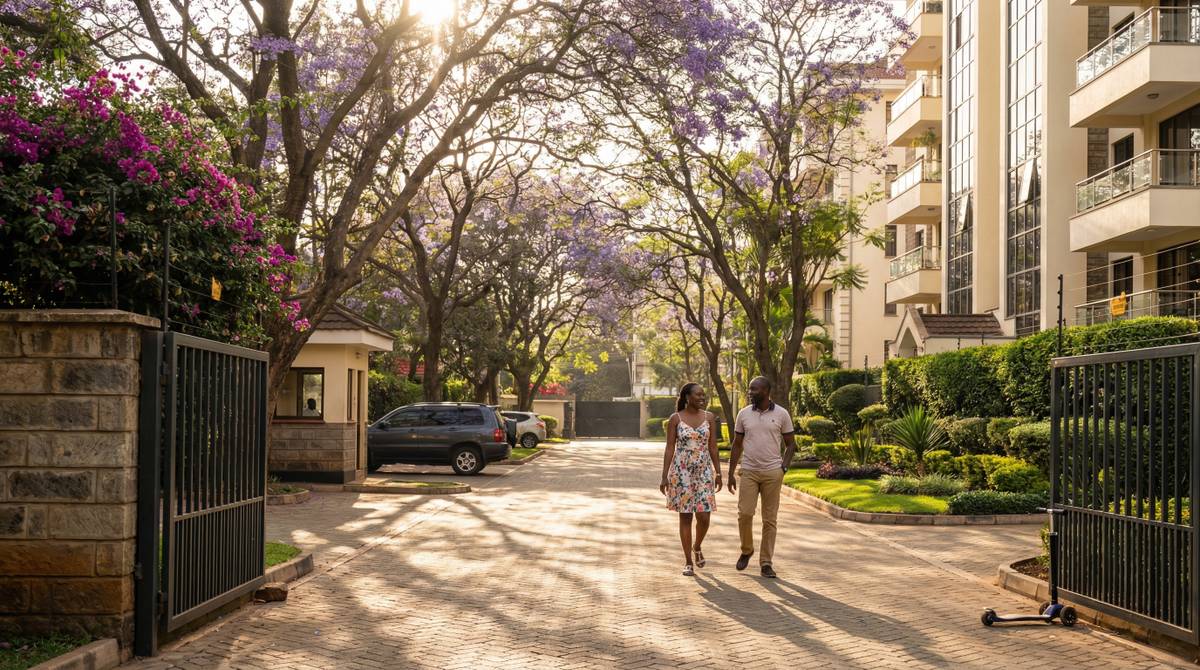
Saturday morning on Denis Pritt Road, and the pavements belong to families. A couple in running gear weaves past a school-age boy on a scooter. Two women carry Yaya Centre shopping bags toward a gate framed by bougainvillea. A watchman waters a strip of lawn while matatus rumble along Ngong Road a few blocks east. This is Kilimani — not the nightlife district outsiders sometimes imagine, but a genuine residential neighbourhood where people raise children, jog before work, and know their building's caretaker by name.
If you are considering living in Kilimani, Nairobi, this guide covers what the area actually feels like today, what you will pay for rent and purchase prices as of early 2026, which streets matter, and how Kilimani honestly compares to Westlands and Kileleshwa. Whether you are a young professional couple scouting your next base, a family weighing school proximity, or a diaspora buyer evaluating Nairobi's rental market from abroad, the detail here is built for confident decisions.
→ Compare all Nairobi neighbourhoods in our 2026 guide
Kilimani at a Glance
Factor | Details |
|---|---|
Location | Ngong Road corridor, between Nairobi CBD and Lavington. Bordered by Yaya Centre (south), Valley Road (east), Argwings Kodhek Road (west), and Ngong Road (north). |
Vibe | Established, apartment-dense, residential with a commercial spine along Ngong Road. Calmer than Westlands, more central than Kileleshwa. |
Best For | Families, dual-income professionals, long-term renters, Airbnb investors, diaspora rental portfolio buyers |
Avg Rent (1BR) | KES 45,000–100,000/month (~$350–$775 USD) |
Avg Rent (2BR) | KES 65,000–130,000/month (~$500–$1,000 USD) |
Avg Rent (3BR) | KES 85,000–160,000/month (~$660–$1,240 USD) |
Avg Sale Price (Apt) | KES 5M–40M (~$39,000–$310,000 USD) depending on bedrooms and building age |
Avg Rental Yield | 7–9% gross for quality stock; 4–5% for oversupplied corridors |
Commute to CBD | 10–20 min by car (off-peak) via Ngong Road or Valley Road. Ngong Road matatu routes run frequently. |
Key Landmarks | Yaya Centre, Prestige Plaza, Nairobi Arboretum, Hurlingham Shopping Centre |
All prices approximate as of early 2026. USD conversions at KES 129 = $1. Confirm current pricing with a verified Kilimani agent on Afriqahome.
What Kilimani Actually Feels Like
Kilimani is not one thing. The neighbourhood stretches from the edge of Upper Hill across to the Lavington border, and the character shifts street by street. On the older avenues — Hatheru Road, parts of Denis Pritt, the quiet pocket around Kilimani Gardens — you find compounds with mature jacaranda trees, low-rise blocks from the 1990s, and a sense of space. Walk five minutes toward Argwings Kodhek and the skyline changes: 15-storey towers, construction hoarding, and the steady hum of new development.
That mix is what defines modern Kilimani. It is a neighbourhood in transition, but it has not tipped into the commercial density of Westlands. The core identity remains residential. Families dominate. Most apartment complexes have children's play areas. The Saturday morning joggers share the pavement with the school-run traffic. Yaya Centre acts as the social anchor — a daily stop for groceries at Carrefour, a gym session, a coffee meeting, or quick banking.
The green pocket feel has not vanished, either. Nairobi Arboretum sits within walking distance for most Kilimani residents. The older estates still have proper tree canopy. Compare this to the glass-and-concrete corridor of Westlands' Waiyaki Way, and Kilimani feels noticeably gentler on the lungs and the eyes.
Streets and Estates to Know in Kilimani
Kilimani is a neighbourhood best understood street by street. Here is what each area offers and what to watch for.
Argwings Kodhek Road
The main artery connecting Hurlingham to Lavington. Recently resurfaced under Governor Sakaja's road programme (completed late 2025), ending years of pothole frustration. Drainage upgrades are ongoing along sections near Valley Arcade. Some low-lying pockets still experience surface flooding during heavy rains, though the drainage work along Cotton Avenue and towards Yaya Centre is specifically targeting these trouble spots. Apartment developments line both sides. Noise levels are higher than the interior streets, but access is excellent.
Denis Pritt Road
Kilimani's school corridor. Quieter, more residential, and favoured by families. The road connects to Ngong Road near Prestige Plaza. Several established apartment blocks with reasonable management fees sit here. This is the stretch where Kilimani feels most like a neighbourhood and least like an emerging commercial district. Alina Valley Apartments, a 17-floor development expected to complete in December 2026, is one of the notable new projects adding to the area's premium apartment stock.
Kirichwa Road
Apartment-dense, with some of Kilimani's highest concentration of new builds. Good access via Argwings Kodhek. Several off-plan developments are under construction here, including projects along the Wood Avenue intersection. If you want a modern apartment with full amenities — gym, pool, lift, generator — Kirichwa Road has the densest selection.
Lenana Road and Yaya Centre Area
The commercial heart. Lenana Road borders Kilimani and runs past Yaya Centre, linking to Hurlingham and onwards to the CBD. This stretch mixes retail, offices, and residential towers. Convenient for daily errands but busier and noisier than the interior streets. Parking near Yaya Centre can be tight during weekday lunchtimes.
Ngong Road
Kilimani's spine. The matatu corridor, the main vehicle artery, and the access route to Prestige Plaza, Jamhuri, and Karen. Traffic at peak hours — especially the stretch near the Ngong Road and Valley Road junction — can be frustrating. But for non-drivers, the frequent matatu service along Ngong Road is one of Kilimani's strongest advantages over quieter suburbs like Karen or Runda.
Valley Road and Upper Kilimani
The eastern edge where Kilimani meets Upper Hill. Valley Road can build congestion during morning and evening rush, particularly around the Kenyatta National Hospital turnoff. Upper Kilimani — the area closer to the Lavington border, around Muchai Drive and Gitanga Road — is typically quieter and slightly more premium. Golfscape Residences, off Muchai Drive, is one new development here offering 1BR units from KES 5.6M with projected rental ROI of up to 10%.
Estates Worth Noting
Kilimani Gardens offers a pocket of calm between the busier roads. The Hatheru Road area has some of the neighbourhood's most established compounds with mature gardens. Upper Kilimani (near Lavington border) tends to attract families willing to pay a slight premium for wider roads and lower density.
Zoning Alert: Kilimani's Height Limit Battle
Kilimani's development future is actively contested. In March 2024, Governor Sakaja proposed allowing buildings up to 75 floors. By February 2025, an Environment and Land Court ruling capped development at 16 levels in Zone 4B. In September 2025, the Court of Appeal upheld the 2016 NIUPLAN and directed the county to gazette updated zoning guidelines within six months. The proposed 2025 Development Control Policy limits Kilimani to 15 floors.
What this means for buyers: If you are buying off-plan in a building that exceeds 15 floors, verify that the developer has current NEMA approval and an approved county development permit. Regulatory uncertainty creates real risk for uncompleted projects.
Property Prices in Kilimani 2026
Kilimani is primarily an apartment market. Houses and maisonettes exist — particularly in the older pockets — but the overwhelming majority of available stock is apartments. Here is what you can expect to pay as of early 2026, based on current listing data from major Kenyan property portals.
Rental Prices
Unit Type | Typical Range (KES/month) | USD Equivalent | Notes |
|---|---|---|---|
Studio/Bedsitter | 25,000–45,000 | $195–$350 | Limited stock. Entry point for young professionals. |
1-Bedroom | 45,000–100,000 | $350–$775 | Most common: KES 50,000–65,000 unfurnished. Furnished units near Yaya fetch KES 80,000–100,000. |
2-Bedroom | 65,000–130,000 | $500–$1,010 | The dominant unit type. Highest demand. Average around KES 90,000–105,000 for a modern block. |
3-Bedroom | 85,000–160,000 | $660–$1,240 | Family market. Premium buildings with DSQ reach KES 130,000–160,000. |
Furnished (Short-stay) | 100,000–300,000 | $775–$2,325 | Airbnb/serviced apartments. Strong demand from expats and business travellers. |
Prices vary significantly by building age, amenities, and exact location. Always confirm current pricing with the listing agent. Browse current Kilimani rentals on Afriqahome.
Sale Prices
Unit Type | Typical Range (KES) | USD Equivalent | Notes |
|---|---|---|---|
Studio | 4.5M–5.5M | $35,000–$43,000 | New-build off-plan. ~43–45 sqm typical. |
1-Bedroom | 5.5M–9M | $43,000–$70,000 | Off-plan from KES 5.5M. Ready units KES 7–9M. Avg 60–75 sqm. |
2-Bedroom | 9M–20M | $70,000–$155,000 | Average KES 9.5M (BuyRentKenya). Premium new builds KES 12–15M. ~100–110 sqm. |
3-Bedroom | 13M–30M | $101,000–$233,000 | New towers KES 13–15M. Established premium blocks KES 20–30M. ~120–140 sqm. |
4-Bed / Penthouse | 25M–40M+ | $194,000–$310,000+ | Limited stock. Top-floor penthouses with views command the highest premiums. |
Maisonette / House | 30M–65M+ | $233,000–$504,000+ | Rare in Kilimani. Older plots off Rose Avenue and Hatheru Road. Premium for land value. |
Source: Kenya Property Centre, BuyRentKenya, Jiji, and developer listings as of Jan–Feb 2026. Off-plan prices reflect pre-completion rates. Browse current Kilimani properties for sale on Afriqahome.
Buy vs Rent: What Your Money Gets You
At KES 15M (~$116,000), you can buy a modern 2-bedroom apartment in a new development with amenities — gym, pool, lift, 24-hour security. That same apartment would rent for approximately KES 80,000–100,000 per month. For diaspora investors, the rental yield math is straightforward: a KES 15M apartment generating KES 90,000/month produces roughly 7.2% gross annual return before expenses. Kilimani's consistent tenant demand — driven by professionals, expats near Upper Hill, and short-stay visitors — keeps vacancy rates relatively low compared to more peripheral neighbourhoods.
For a deeper look at what a bedsitter or studio costs as an entry-level investment, read our guide: What Is a Bedsitter? Kenya Rental Guide.
Kilimani Investment Outlook: 2025–2026 Market Data
The numbers tell two stories about Kilimani, and both are true.
The bull case: HassConsult's Q4 2025 Property Index shows Nairobi-wide residential yields hit 7.4% — the highest in 20 years. Kilimani rents rose 2.6% in Q4 alone. Sarabi Realty reports gross yields of 7–9% for quality apartments with strong tenant profiles. RE/MAX Kenya cites 5–8% yields with approximately 10% annual capital growth for well-located stock. The upper-middle segment (which includes Kilimani, Lavington, and Kileleshwa) delivered 7.1% average total returns in FY2024/25 per Cytonn — the best-performing residential segment in Nairobi.
The bear case: Roots Africa's 2025 analysis warns that oversupply has pushed some buildings to 30–40% vacancy rates. Apartments purchased at KES 12M struggle to rent at KES 50,000/month — yielding only 5% before vacancy losses. Some properties that sold for KES 12–14M in 2021 now struggle to find buyers at KES 10–11M. Discounts of up to 20% from peak prices have been documented. Independent investor guides explicitly warn against Ngong Road due to oversupply and pollution.
The resolution: Quality differentiates. Furnished 1-bedroom apartments generate 20–40% higher rental income than unfurnished units. Well-located properties near Yaya Centre on premium streets still achieve 7–9% yields. The oversupply primarily affects undifferentiated mid-range stock on secondary streets.
Metric | Figure | Source |
|---|---|---|
Nairobi-wide rental yield | 7.4% (highest in 20 years) | HassConsult Q4 2025 |
Kilimani Q4 rent growth | +2.6% quarter-on-quarter | HassConsult Q4 2025 |
Quality apartment gross yield | 7–9% | Sarabi Realty 2025 |
Upper-middle segment total returns | 7.1% (best in Nairobi) | Cytonn FY2024/25 |
Average price per sqm | KES 87,000–121,000 (~USD 670–930) | BuyRentKenya Feb 2026 |
Active Airbnb listings | 1,424 (largest in Nairobi) | Airbtics Dec 2025 |
Airbnb avg annual revenue | $8,139/listing at 48% occupancy | Airbtics Dec 2025 |
Airbnb revenue trend | -8.19% year-on-year | Airbtics Dec 2025 |
What this means for buyers: If you are buying in Kilimani, location within the neighbourhood matters more than the neighbourhood itself. A well-managed 2-bedroom on Denis Pritt Road and an undifferentiated block on lower Ngong Road are in the same postcode but different markets. Do not treat Kilimani as one thing.
For diaspora investors: The smart money in Kilimani's short-stay market is pivoting from nightly Airbnb to mid-term rentals (1–3 month stays) targeting expats and digital nomads. Nightly rates that once commanded $70 now struggle at $40. Monthly furnished lets of KES 100,000–150,000 offer more predictable income with lower management overhead. Verify any property through Kenya's Ardhisasa system before committing funds.
Who Lives in Kilimani
Walk through any Kilimani apartment complex and the mix is visible. Established Kenyan families who moved from Karen or Lang'ata because they wanted proximity to work without the two-hour commute. Young professional couples — both working in the CBD or Upper Hill — sharing a two-bedroom along Kindaruma Road. Expats on embassy or NGO contracts, particularly those working in the Upper Hill diplomatic corridor, who appreciate the combination of central access and residential quiet.
A growing group: Kenyan diaspora returnees. People who lived abroad for 10–15 years and chose Kilimani as their re-entry point because it feels established without being pretentious. The apartment lifestyle suits the transition — secure, manageable, close to everything.
Remote workers and digital nomads have also found Kilimani. The fibre internet infrastructure is strong, co-working spaces operate within walking distance, and the café culture along Lenana Road and near Yaya Centre supports the work-from-anywhere lifestyle. If you work from home three days a week and need to reach Westlands or the CBD on the other two, Kilimani is well positioned.
For Kenyans living abroad, Kilimani has become a favoured landing spot for a specific reason: it feels like a real neighbourhood rather than a speculative investment zone. When you buy a two-bedroom here to rent out or to prepare for your eventual return, you are buying into a community where people actually live, not a tower block marketed solely to investors. That distinction matters. Tenants in Kilimani tend to stay. Occupancy rates are consistently among the highest in Nairobi's central belt. The area has attracted a growing number of Chinese-built developments, which has expanded the available stock and introduced more competitive pricing at the mid-range level — good news for buyers seeking modern finishes at accessible price points.
Pros of Living in Kilimani
Central but Residential
Kilimani sits inside Nairobi's inner ring without the commercial intensity of Westlands. You can reach the CBD in 10–20 minutes, Upper Hill in under 10, and Karen in about 30 (off-peak). Yet the interior streets — Denis Pritt, Hatheru, parts of Kirichwa — feel quiet enough for a weekend lie-in.
Yaya Centre as a Daily Anchor
Carrefour supermarket for groceries. Banking. A gym. Restaurants and cafés for meetings. All in one complex, walkable from most Kilimani apartments. Having a reliable daily-needs hub within walking distance is something not every Nairobi neighbourhood delivers.
Strong School Cluster
Nairobi School, Upper Hill School, Braeburn Gitanga Road, and ISK (International School of Kenya) are all accessible from Kilimani. The Denis Pritt Road corridor is particularly popular with families because it puts several school options within a short morning drive.
Healthcare Access
MP Shah Hospital is within Kilimani. Aga Khan University Hospital is a five-minute drive. Nairobi Hospital sits on the Upper Hill border. For families, having three major hospitals within 10 minutes is a significant safety net.
Matatu Routes for Non-Drivers
Ngong Road is one of Nairobi's busiest matatu corridors. If you don't drive or prefer not to in peak traffic, you can reach the CBD, Prestige Plaza, and connections to Westlands and Karen from regular matatu stops along Ngong Road. This gives Kilimani a public transport advantage over quieter suburbs like Runda or Karen.
Strong Rental Demand
Kilimani consistently ranks among Nairobi's highest-demand rental markets. The combination of central location, professional tenant base, and Airbnb potential means landlords typically experience lower vacancy periods. For diaspora investors, this translates to more predictable rental income.
Green Space
Nairobi Arboretum provides a genuine green lung within walking distance. The older Kilimani estates retain mature tree canopy. Compared to Westlands' increasingly concrete skyline, Kilimani still breathes.
Honest Cons of Living in Kilimani
Flooding on Some Low-Lying Streets
Argwings Kodhek Road and some sections near Cotton Avenue and Valley Arcade have historically experienced surface flooding during heavy rains. The Nairobi County road and drainage upgrade programme (2025–2026) has targeted these specific areas — Governor Sakaja personally inspected the Argwings Kodhek and Cotton Avenue drainage improvements in December 2025. But heavy rainy seasons can still cause temporary disruptions. Before signing a lease, ask residents and the building caretaker about flooding history in that specific block.
Increasing Apartment Density
Kilimani is being built upward. New 15–22-storey towers are replacing older compounds on streets like Kirichwa Road, Wood Avenue, and Kindaruma Road. Some long-term residents report feeling squeezed as construction sites multiply and green space shrinks on certain streets. The trade-off is more modern housing stock with better amenities. But if you want the "old Kilimani" feel, look specifically at Hatheru Road, Denis Pritt, and Upper Kilimani near the Lavington border.
Ngong Road Traffic
Peak hours on Ngong Road are genuinely unpleasant. The matatu corridor brings volume, noise, and congestion, particularly around the Prestige Plaza stretch. If your apartment faces Ngong Road, expect traffic noise. Interior streets are significantly quieter.
Water Supply Inconsistency
Nairobi's water supply affects all central neighbourhoods, and Kilimani is no exception. As recently as February 2026, the Nairobi City Water and Sewerage Company announced a 26-hour supply interruption affecting Argwings Kodhek, Denis Pritt, Hurlingham, and surrounding areas. Newer buildings typically have borehole and rooftop tank backup. Older blocks may not. Check water infrastructure before committing to any building.
Parking Scarcity Near Commercial Areas
Apartment blocks near Yaya Centre and along Lenana Road often have limited visitor parking. If you own a car, verify that your building allocates a designated parking bay — and check whether it is covered. Some older buildings offer only one space per unit, which can be a problem for two-car households.
Before renting or buying anywhere in Kilimani, protect yourself with our guide to avoiding property scams in Kenya, and learn how to verify your real estate agent through EARB.
Kilimani vs Nearby Neighbourhoods
Most people considering Kilimani are also looking at Westlands and Kileleshwa. Here is how they compare in practical terms.
Kilimani vs Westlands
Factor | Kilimani | Westlands |
|---|---|---|
Vibe | Residential, family-anchored, apartment-dense | Commercial, fast-paced, nightlife and dining hub |
Rent (2BR) | KES 65,000–130,000 | KES 80,000–180,000+ |
Best For | Families, long-term renters, quiet professionals | Young professionals, expats, nightlife seekers, corporate tenants |
Green Space | More — Arboretum, mature estates | Less — rapid commercial development |
Traffic | Ngong Road congestion at peak | Waiyaki Way congestion, busier overall |
Verdict | Choose Kilimani for residential calm and family life | Choose Westlands for energy, dining, and corporate proximity |
For the full Westlands breakdown, read our companion guide: Living in Westlands: Complete Guide 2026.
Kilimani vs Kileleshwa
Kileleshwa is Kilimani's quieter sibling. It sits slightly further from the CBD, offers greener streets and lower density, and generally costs 10–20% less for comparable units. The trade-off is fewer walkable amenities — Kileleshwa lacks a single anchor like Yaya Centre — and fewer matatu routes. If you prioritise calm above all else and drive everywhere, Kileleshwa may suit you. If walkability, school proximity, and daily convenience matter, Kilimani typically wins.
Kilimani vs Lavington
Lavington is more spacious, more expensive for houses, and more mixed in property type. It attracts families who want compound living with gardens — bungalows and townhouses rather than apartment towers. Kilimani offers the apartment lifestyle at lower entry prices with better access to public transport. Lavington suits those who drive everywhere and want space. Kilimani suits those who want convenience and community density. → Read our complete Lavington guide.
Schools, Hospitals, and Daily Amenities
Schools
Nairobi School (national school, within the Kilimani/Upper Hill corridor), Upper Hill School, Braeburn School Gitanga Road, and the International School of Kenya (ISK) in Lavington are all accessible. St. Hannah's School and Cavina School serve the local primary market. Several Montessori and pre-school options operate along Denis Pritt Road and surrounding streets.
Hospitals
MP Shah Hospital sits within Kilimani proper. Aga Khan University Hospital is a five-minute drive along Ngong Road. Nairobi Hospital occupies the Upper Hill border. Coptic Hospital on Ngong Road provides an additional option. Nairobi Women's Hospital (Hurlingham branch) is also within the immediate vicinity.
Supermarkets and Daily Shopping
Carrefour at Yaya Centre is the primary anchor. Chandarana Foodplus operates in the area. Quickmart provides a budget-friendly alternative. Prestige Plaza adds more retail options including Naivas. For most Kilimani residents, daily errands are walkable or a short drive away.
Gyms, Co-Working, and Cafés
Several gym chains operate in and around Kilimani. Co-working spaces have multiplied along Ngong Road and near Yaya Centre. Café culture is strong — Java House, Artcaffé, CJ's, and a growing number of independent coffee shops provide meeting spots and work-from-café options throughout the neighbourhood.
Getting Around from Kilimani
Ngong Road is the primary transport artery. Matatu routes along Ngong Road connect to the CBD, Prestige Plaza, Jamhuri, Karen, and onward connections. Uber and Bolt are reliable throughout Kilimani, with typical wait times of 3–7 minutes.
By car, Valley Road provides an alternative route to Upper Hill and the CBD, avoiding Ngong Road congestion. Argwings Kodhek connects to Lavington, Kawangware, and the wider Dagoretti area. The Nairobi Expressway is accessible from Valley Road and Uhuru Highway.
Destination | Off-Peak Drive | Peak Traffic |
|---|---|---|
Nairobi CBD | 10–15 min | 25–45 min |
Westlands (Sarit Centre) | 10–15 min | 20–35 min |
Upper Hill | 5–10 min | 15–25 min |
Karen | 20–30 min | 45–75 min |
JKIA Airport | 30–40 min | 60–90 min |
Drive times are estimates based on typical Nairobi traffic patterns. Always allow extra time during rainy season.
One of Kilimani's underrated advantages is route flexibility. If Ngong Road is jammed, Valley Road offers a parallel option toward the CBD. Argwings Kodhek connects west to Lavington and Kawangware. For destinations south — Lang'ata, the airport — Ngong Road feeds into Mbagathi Way. This is a neighbourhood where you are rarely stuck with a single commute path, unlike more peripheral suburbs where one blocked road can ruin your morning.
Boda-boda (motorcycle taxi) services operate throughout Kilimani and can be useful for short trips to Yaya Centre or nearby appointments. However, exercise normal Nairobi caution with boda-boda travel, particularly after dark. For airport transfers, pre-book through a ride-hailing app or trusted transfer service. The drive to JKIA takes 30–40 minutes off-peak but can stretch past an hour during evening rush.
Frequently Asked Questions About Living in Kilimani
What is the average apartment price in Kilimani in 2026?
The average apartment in Kilimani costs approximately KES 9.4M (~USD 73,000) for around 108 sqm, according to BuyRentKenya data from early 2026. Prices range from KES 3–8.5M for a 1-bedroom to KES 13–30M for a 3-bedroom, depending on building age, amenities, and exact street location.
Is Kilimani a good investment for rental income?
Kilimani can deliver 7–9% gross yields for quality, well-located apartments — among the best in Nairobi. However, oversupply in some corridors means generic mid-range stock faces 30–40% vacancy rates. Location within Kilimani matters enormously: Denis Pritt Road and Wood Avenue outperform Ngong Road and lower Argwings Kodhek.
Is Kilimani safe?
Kilimani is generally considered safe by Nairobi standards. Most apartment complexes have 24/7 security, CCTV, controlled access, and perimeter walls. The neighbourhood benefits from its proximity to Kilimani Police Station and the diplomatic corridor along Upper Hill. Standard Nairobi precautions apply — avoid walking alone late at night on unlit streets.
How does Kilimani compare to Westlands for living?
Kilimani is more residential and family-oriented; Westlands is more commercial with stronger nightlife and dining. Kilimani rents are typically 15–25% lower than equivalent Westlands apartments. Choose Kilimani for residential calm and walkable daily amenities. Choose Westlands for corporate proximity and social energy.
What is the Airbnb market like in Kilimani?
Kilimani has approximately 1,424 active Airbnb listings — the largest concentration in Nairobi. Average annual revenue per listing is $8,139 at 48% occupancy. However, the market is softening: revenue declined 8.19% year-on-year. The trend is shifting from nightly stays toward mid-term furnished rentals (1–3 months) for expats and digital nomads.
Does Kilimani flood?
Some low-lying sections of Kilimani experience surface flooding during heavy rains, particularly along parts of Argwings Kodhek Road and near Cotton Avenue. The Nairobi County road and drainage upgrade programme (2025–2026) has specifically targeted these areas. Always ask the building caretaker about flooding history before signing a lease.
Is Kilimani Right for You?
Kilimani Is Typically a Strong Fit If You…
Want a central Nairobi location without the noise and commercial intensity of Westlands. Value walkable daily amenities — supermarket, gym, cafés, banking — within minutes. Need school and hospital proximity for your family. Work in the CBD, Upper Hill, or Westlands and want a reasonable commute. Are investing in rental property and want consistent tenant demand across both long-term and furnished short-stay markets.
You Might Prefer Somewhere Else If You…
Want active nightlife and dining within walking distance — Westlands is your answer. Prioritise maximum quiet and the lowest possible density — Kileleshwa or Lavington offers that. Need a large compound with a garden for children and dogs — Karen or Lavington suits the house-and-garden lifestyle. Are budget-first and flexible on location — satellite towns like Ruiru, Kitengela, or the Ngong Road corridor further out offer significantly lower entry prices.
A Note for Diaspora Buyers
If you are purchasing from abroad, Kilimani offers something specific: a proven rental market with a stable tenant base. Unlike some newer Nairobi suburbs where oversupply is a concern, Kilimani's central location and established infrastructure create consistent demand. The area also has strong property management options, which matters when you are managing an investment from overseas. Before purchasing, verify any property through Kenya's Ardhisasa system and work with a verified agent. Distance should not mean less due diligence — it should mean more.
Explore Further
Explore Kilimani properties on Afriqahome →
See also: Compare all Nairobi neighbourhoods → Best Areas to Live in Nairobi 2026
Other Guides

Living in Juja, Kiambu: The University Town That Became a Satellite City — Prices, Estates & Honest Guide (2026)
Juja houses from KSh 1.2M, rent from KSh 2.5K. JKUAT area, Kenyatta Road estates, Kalimoni, Witeithie. Student yields 9-15%.

Westlands Property Guide: Prices, Lifestyle & Investment (2026)
Complete guide to Westlands real estate. Apartments from KES 8M, rental yields 6-8%, plus lifestyle amenities. Browse verified Westlands listings today.
Houses for Sale in Karen: Price Guide 2026
Karen house prices from KES 35M–250M+. 4-bedroom, 5-bedroom, villas. Karen Hardy, Ndege Road, budget breakdown. Updated March 2026.