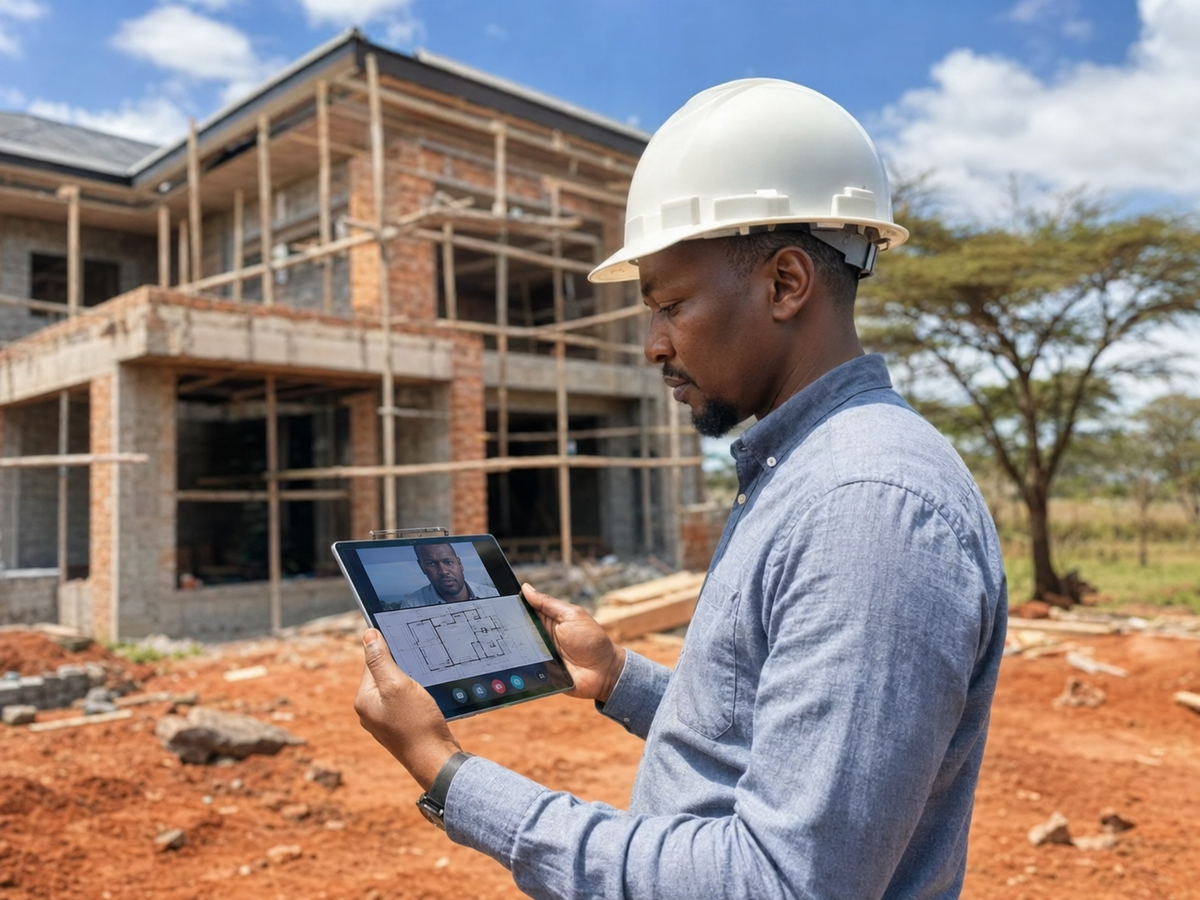
Building a House in Kenya from Abroad: The Complete 2026 Cost & Process Guide
Build a house in Kenya from the diaspora: real 2026 costs (KES 35K–100K+/m²), the NCA/BORAQS process, milestone payments & how to avoid fraud.
Thousands of Kenyans abroad dream of one thing: not just buying a finished property, but building a house in Kenya from abroad — on their own plot, to their own design. It is one of the most rewarding investments a diaspora family can make, and also one of the easiest to get wrong from 8,000 kilometres away. In 2026, residential construction in Kenya runs from roughly KES 35,000 per square metre for basic finishes to KES 100,000+ per square metre for luxury homes (2026 Construction Costs in Kenya Handbook), so a single mistake in who you trust or how you pay can cost millions. This guide walks through the full process, the real numbers, and — most importantly — how to reduce the risk that distance creates.
The hard truth first. The State Department for Diaspora Affairs has acknowledged that real estate disputes and construction fraud rank among the top grievances Kenyans abroad report. Distance is exactly what fraudulent developers and "contractors" exploit. Building successfully from abroad is less about construction and more about building a verification and oversight system you control. That is the real subject of this guide.
Quick Facts: Building From Abroad in 2026
Item | Detail |
|---|---|
Typical build cost (mid-range) | KES 50,000–65,000 / m² |
3-bedroom bungalow (≈100–120 m²) | KES 4.5M–9.5M depending on finish & location |
4-bedroom maisonette | KES 8M–16M+ |
Typical timeline | 8–18 months for a standalone home |
Regulators involved | County government, NCA, NEMA (where applicable) |
Professionals required | BORAQS architect, EBK structural engineer, registered quantity surveyor, NCA contractor |
Who can build | Any Kenyan citizen, including dual citizens, with no residency requirement |
Why Diaspora Builders Get Targeted
Before the how-to, understand the threat — because honest awareness is your best protection. Investigations by the Daily Nation and others have documented developers collecting millions in down payments from diaspora buyers, doing minimal token construction to fake progress, then abandoning the project or vanishing entirely.
The pattern is consistent. Fraudulent operators set up legitimate-looking companies with offices in upscale Nairobi neighbourhoods, produce polished YouTube and Facebook marketing aimed directly at Kenyans in the USA and UK, and sell "off-plan" units on plots they sometimes do not even own. Victims in the reported cases — nurses, drivers, teachers working double shifts abroad — paid between KES 4M and KES 9M each. One US-based buyer reportedly faces losing KES 57M across five units.
Two structural problems make this possible: Kenya's off-plan housing market remains poorly regulated, and criminal prosecutions are rare because operators simply close one company and open another. The Kenya Diaspora Policy 2024 (launched March 2025) commits the government to better protections, but policy is not yet a system you can rely on. Until it is, your own due diligence is the system.
Buying a plot first is the safest path. The most controllable way to build from abroad is to buy verified land yourself, then commission construction on your own title — rather than handing a lump sum to an off-plan developer who controls both the land and the build. Afriqahome connects diaspora buyers with verified agents for the land-purchase stage, where verification matters most. Read our guide to property scams in Kenya before you send any money.
How to Build a House in Kenya From Abroad: Step by Step
Step 1 — Secure the land (and verify the title)
Everything starts with clean land you legally own. Before paying, conduct an official land search and confirm ownership. The title search document must be no more than three months old at approval stage. Verify the title yourself through Ardhisasa, cross-check the seller, and use a verified agent rather than an unknown intermediary. Our how to buy land in Kenya guide covers this stage in full, and the fake title deed warning signs guide shows you what forged documents look like.
Step 2 — Appoint a trusted representative (Power of Attorney)
Because you cannot sign every document in person, you will likely grant a limited Power of Attorney (PoA) to someone you trust — a family member or your advocate — to act on defined matters only. Keep it narrow: specify exactly what they can and cannot do, and never grant a blanket PoA that lets one person both control the money and approve the work.
Step 3 — Engage registered professionals
Kenyan law requires that your drawings be prepared by a registered architect and structural engineer. This is not optional — engaging unregistered designers leads to rejected permits.
Professional | Role | Verify with |
|---|---|---|
Architect | Architectural drawings, design, often project lead | BORAQS |
Structural engineer | Structural drawings, foundation safety | EBK / ERB |
Quantity surveyor (QS) | Bill of Quantities (BoQ), cost control | BORAQS |
Contractor | Actual construction | NCA database |
Always verify credentials directly through the Board of Registration of Architects and Quantity Surveyors (BORAQS) for architects and QSs, the Engineers Board of Kenya (EBK) for engineers, and the National Construction Authority (NCA) database for contractors. A name on a glossy brochure means nothing until you confirm it on the regulator's records.
Step 4 — Get your approvals
Construction is governed by the Physical and Land Use Planning Act (2019), the Building Code (2020) and NCA Regulations. The approval chain typically runs: architect submits stamped drawings to the county for a building permit; for projects with environmental impact, a NEMA report or full Environmental Impact Assessment (EIA) is required; and the project is registered with the NCA, which issues a compliance certificate.
Budget for the NCA building levy of 0.5% of project value for projects valued above KES 5,000,000, a county application fee (around KES 5,000), and a mandatory on-site signboard (around KES 25,000). Building may begin once drawings are stamped, even while the permit finalises.
Step 5 — Sign a milestone-based construction contract
This is the single most important document you will sign. A proper contract ties payments to verified construction milestones — not to a calendar, and never as one large upfront sum. The architect or QS certifies that each stage is genuinely complete before the next payment is released.
Step 6 — Build with active remote supervision
This is where most diaspora projects succeed or fail. You need independent eyes on site that are not the contractor's own. Options include hiring a separate project manager or clerk of works, scheduling regular video walkthroughs, and requiring date-stamped photo and video reports at every milestone.
Step 7 — Close out: completion and occupation certificate
At the end, your architect issues a completion certificate, the county conducts a final inspection, and — if the building meets standards — issues the occupation (occupancy) certificate, usually within about 14 days. This document confirms your home is legally habitable. Do not consider the project finished, or make a final payment, until it is issued.
What It Costs to Build a House in Kenya in 2026
Construction in Kenya is priced per square metre of built area. The rate depends on finish quality, design complexity and location. According to the 2026 Construction Costs in Kenya Handbook and corroborating industry sources:
Finish level | Cost per m² (2026) | 100 m² house estimate |
|---|---|---|
Basic / low-end | KES 35,000–45,000 | ≈ KES 3.5M–4.5M |
Mid-range | KES 50,000–65,000 | ≈ KES 5M–6.5M |
High-end | KES 70,000–95,000 | ≈ KES 7M–9.5M |
Luxury | KES 100,000+ | KES 10M+ |
Location moves these numbers significantly. Building in central Nairobi runs roughly 25–30% above the national average, while outskirts and rural areas can be 10–15% cheaper — and a simple rural brick home can cost as little as KES 14,000–20,000 per m². Aalis Studios, a Nairobi architecture firm, puts a typical 2026 3-bedroom bungalow at KES 5.5M–9.5M and a 4-bedroom maisonette at KES 8M–16M+.
Two cost notes for 2026. First, cement — the backbone of any build, at roughly KES 720–1,250 per 50kg bag, with a standard 3-bedroom house needing about 250–350 bags — has been comparatively stable after earlier volatility. Second, sources disagree on inflation: one cites construction cost inflation of around 12% into 2026, while quarterly indices showed YoY construction inflation as low as 0.74% in Q3 2025. The honest takeaway is that costs have risen and remain higher than a few years ago, so always add a 10–15% contingency to any quote.
Beyond the build itself, budget for the soft costs most first-time builders forget:
Cost item | Typical range |
|---|---|
Architect + structural engineer fees | Often a % of project value, agreed upfront |
Quantity surveyor (BoQ) | Agreed fee or % of value |
NCA building levy | 0.5% of project value (above KES 5M) |
County permit + signboard | ≈ KES 5,000 + ≈ KES 25,000 |
NEMA report (if applicable) | Varies by project |
Land transfer costs (if buying the plot) | ≈ 5–7% of plot price — see below |
If you are buying the plot as part of this project, remember the land-purchase costs are separate: stamp duty of 4% (urban) or 2% (rural), advocate fees from around KES 28,000, and other transfer charges totalling roughly 5–7% of the purchase price. Estimate yours with the stamp duty calculator, and see the full breakdown in our stamp duty and closing costs guide.
How to Pay and Avoid Losing Money
Money discipline is what separates a finished home from a cautionary tale. Three rules protect diaspora builders more than anything else.
1. Pay against milestones, never in one lump. Release funds only when an independent professional certifies a stage is genuinely complete — foundation, walling, roofing, finishes, and so on. In several documented fraud cases, victims paid large deposits against promised "90-day" completions that never started.
2. Separate the money from the work. The person who controls your funds should not be the same person doing or supervising the construction. Consider using an advocate's account or an escrow-style arrangement where funds are released only on verified milestones. This single separation removes the most common failure point.
3. Keep a paper trail and independent oversight. A signed, stamped Bill of Quantities from a registered QS gives you a benchmark to measure spending against. Detailed contracts plus close financial monitoring are the documented mitigations for misuse of funds, and they give you legal recourse if a contractor underperforms.
Verification reduces risk; it does not eliminate it. No process guarantees a flawless build. But verifying every professional with their regulator, paying against certified milestones, and keeping independent eyes on site dramatically reduces the exposure that distance creates. Start with the land — use verified agents and confirm the title before anything else.
Honest Pros and Cons
Pros | Cons |
|---|---|
Full control over design and quality | Requires active management across time zones |
Often cheaper per m² than buying a finished comparable home | Cost overruns are common without a strict BoQ and contingency |
You own clean title from the start (if you buy the plot directly) | Timelines slip — 8–18 months is realistic, not guaranteed |
Builds long-term equity and a future home base | High exposure to fraud if oversight is weak |
No residency requirement for Kenyan citizens | Foreigners cannot own freehold agricultural land (citizens/dual citizens unaffected) |
Strong emotional and family value | Disputes are slow and costly to resolve in court |
Which Approach Fits Your Situation
Your situation | Recommended approach |
|---|---|
Limited time, want minimal involvement | Buy a finished, verified home instead of building — see country guides below |
Have trusted family on the ground | Buy plot directly, appoint a clerk of works, build with milestone contract |
No trusted contacts in Kenya | Hire an independent project manager separate from the contractor; consider delaying until you can visit |
First diaspora investment | Start smaller — buy land or a finished unit first, build later once you know the market |
Frequently Asked Questions
How much does it cost to build a 3-bedroom house in Kenya in 2026?
A mid-range 3-bedroom house of around 100–120 m² typically costs KES 4.5M–9.5M, depending on finishes and location. Basic finishes start near KES 35,000 per m² and luxury finishes exceed KES 100,000 per m². Building in central Nairobi adds roughly 25–30% over the national average, while rural areas can be 10–15% cheaper. Always add a 10–15% contingency.
Can I build a house in Kenya while living in the USA or UK?
Yes. Any Kenyan citizen, including dual citizens, can build in Kenya with no residency requirement. The practical challenge is oversight, not eligibility. Most diaspora builders grant a limited Power of Attorney to a trusted person for in-person signings and hire independent supervision on site. See our country-specific guides for the USA and UK.
How do I pay a contractor in Kenya from abroad?
Pay against verified construction milestones rather than a single upfront sum. Release each payment only after a registered architect or quantity surveyor certifies that the stage is genuinely complete. Where possible, route funds through an advocate's account or an escrow-style arrangement so the person controlling the money is not the person doing the work. This separation is the strongest protection against misuse of funds.
How do I verify a contractor or architect is legitimate?
Check the regulator's records directly. Architects and quantity surveyors must be registered with BORAQS; structural engineers with the Engineers Board of Kenya (EBK); and contractors with the National Construction Authority (NCA) database. Never rely on a brochure, website, or YouTube video alone — fraudulent operators specifically produce polished marketing to win diaspora trust. Our agent verification guide explains the same principle for property professionals.
How long does it take to build a house in Kenya?
A standalone home typically takes 8–18 months from groundbreaking to occupation certificate, depending on size, finishes, weather, cash flow and approvals. Be wary of any contractor promising completion in 90 days for a full house — unrealistic timelines were a feature of several documented diaspora fraud cases. Build buffer into both your schedule and your budget.
Is it safer to build or to buy a finished house in Kenya?
Both carry risk, but they are different risks. Building gives you control and clean title but demands active remote oversight. Buying a finished, verified home is faster and simpler but requires careful title and seller verification. For first-time diaspora investors with limited time, buying a verified existing property is often the lower-stress entry point. Explore houses for sale in Nairobi or plots for sale to compare.
Explore Further
Building from abroad starts with safe land and trusted professionals. Begin with the fundamentals: how to buy land in Kenya, the due diligence checklist, and how to verify a title deed. If you are still deciding between building and buying, our diaspora property investment guide and country pages for the USA, UAE and Canada lay out the options. For market context, see Kenya real estate 2026.
When you are ready to buy the plot, work with a verified agent and browse plots for sale in Nairobi. Afriqahome's verification is designed to reduce the risk that distance creates — though no platform can eliminate it, which is why your own due diligence at every step still matters most. Visit the diaspora hub to start.
Other Guides

Living in Juja, Kiambu: The University Town That Became a Satellite City — Prices, Estates & Honest Guide (2026)
Juja houses from KSh 1.2M, rent from KSh 2.5K. JKUAT area, Kenyatta Road estates, Kalimoni, Witeithie. Student yields 9-15%.

Westlands Property Guide: Prices, Lifestyle & Investment (2026)
Complete guide to Westlands real estate. Apartments from KES 8M, rental yields 6-8%, plus lifestyle amenities. Browse verified Westlands listings today.
Houses for Sale in Karen: Price Guide 2026
Karen house prices from KES 35M–250M+. 4-bedroom, 5-bedroom, villas. Karen Hardy, Ndege Road, budget breakdown. Updated March 2026.