Freehold vs Leasehold in Kenya: What Every Property Buyer Needs to Know
Freehold = indefinite ownership. Leasehold = fixed term (usually 99 years). Learn how each affects mortgages, inheritance, foreigners, and lease expiry.
Freehold vs Leasehold in Kenya: What Every Property Buyer Needs to Know
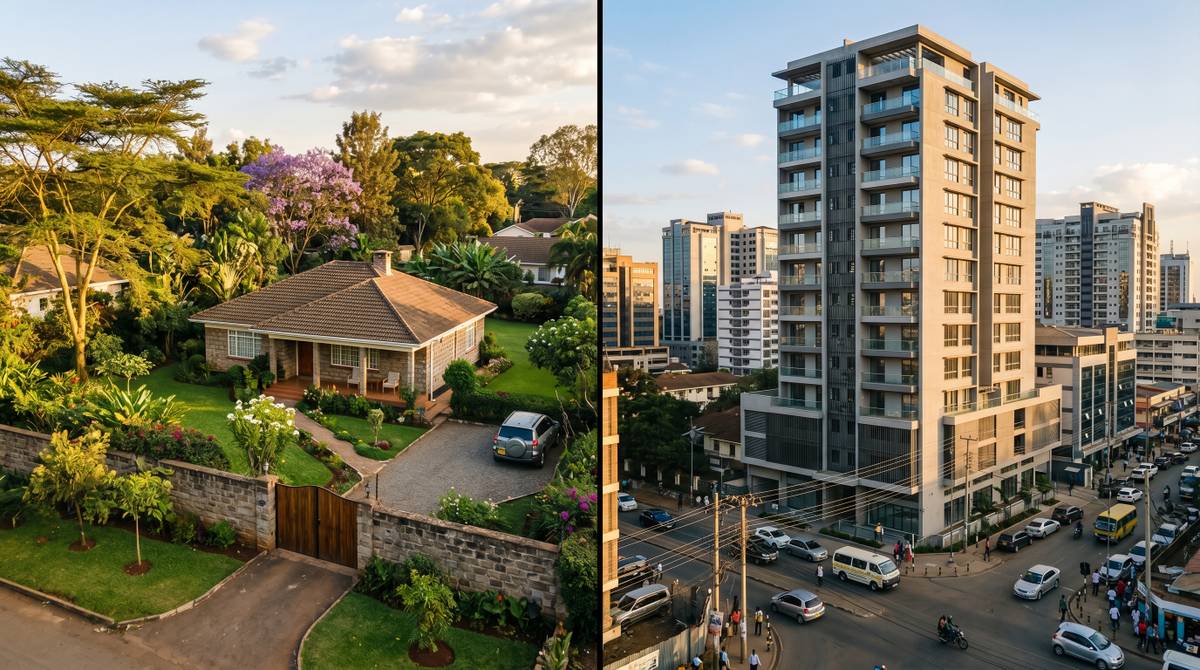
Every piece of land in Kenya has a tenure type — and the two you will encounter most often are freehold and leasehold. The distinction is not academic. It determines how long you own the property, what you can do with it, whether a bank will lend against it, and what happens when a lease expires. If you are buying a house in Karen, you are likely buying freehold. If you are buying an apartment in Kilimani, you are almost certainly buying leasehold. Understanding which is which — and what each means in practice — is one of the first things any buyer in Kenya should do.
What Is Freehold Ownership?
Freehold is the strongest form of property ownership in Kenya. A freehold owner holds the land indefinitely — there is no expiry date, no lease to renew, and no superior landlord above them. The land passes to your heirs through succession, and you can sell, develop, subdivide, or transfer it freely (subject to zoning regulations and local planning laws).
Freehold ownership is proven by a title deed (Certificate of Title) issued under the Land Registration Act, 2012.
Key characteristics:
Feature | Freehold |
|---|---|
Duration | Indefinite — no expiry |
Annual rent | No ground rent payable |
Document | Certificate of Title (title deed) |
Control | Full — develop, sell, subdivide, inherit |
Common locations | Rural areas, agricultural land, some older Nairobi suburbs (Karen, Langata, parts of Kiambu) |
Who can hold it | Kenyan citizens and Kenyan-owned companies ONLY |
Critical restriction: Under the Constitution of Kenya (2010), Article 65, non-citizens cannot hold freehold land. Foreigners are limited to leasehold tenure for a maximum of 99 years. If you are a diaspora investor who has renounced Kenyan citizenship, this affects you directly — confirm your citizenship status before pursuing freehold property.
What Is Leasehold Ownership?
Leasehold means the government (or another freeholder) owns the land, and you are granted the right to use it for a fixed period — typically 33, 50, or 99 years. When the lease expires, the land reverts to the owner unless the lease is renewed.
Leasehold ownership is proven by a Certificate of Lease issued under the Land Registration Act, 2012.
Feature | Leasehold |
|---|---|
Duration | Fixed — typically 99 years (sometimes 33 or 50) |
Annual rent | Ground rent payable to the lessor (government or private landlord) |
Document | Certificate of Lease |
Control | Subject to lease conditions — permitted use, development restrictions |
Common locations | Nairobi CBD, Kilimani, Westlands, Kileleshwa, Mombasa, most urban centres |
Who can hold it | Kenyan citizens AND foreigners (max 99 years for non-citizens) |
The practical implication: Most apartments and commercial properties in Nairobi are leasehold. If you are buying in Kilimani, Westlands, Kileleshwa, or any other central Nairobi neighbourhood, check the unexpired lease term before committing. A 99-year lease granted in 1960 has approximately 33 years remaining in 2026 — that affects both the property's value and your ability to get a mortgage.
Direct Comparison
Factor | Freehold | Leasehold |
|---|---|---|
Ownership duration | Indefinite | Fixed period (typically 99 years) |
Ground rent | None | Annual payment to lessor |
Inheritance | Passes to heirs automatically | Passes to heirs for remaining lease term |
Bank lending | Preferred — no expiry risk | Accepted if unexpired term exceeds loan period (usually 25+ years remaining) |
Foreign ownership | Kenyan citizens only | Open to foreigners (max 99 years) |
Renewal | Not applicable | Must apply to National Land Commission before expiry |
Cost | Generally higher per unit area | Generally lower — you are paying for limited tenure |
Typical use | Residential homes, agricultural land, family plots | Apartments, commercial property, urban development |
What Happens When a Lease Expires?
This is the question most buyers do not ask until it is too late. When a leasehold expires, the land and all improvements (buildings, infrastructure) technically revert to the lessor — usually the government. The leaseholder can apply for renewal through the National Land Commission (NLC), but renewal is not automatic. It involves a fresh application, payment of fees, and may include updated conditions or a revised ground rent.
The apartment risk: Many older Nairobi apartments are built on developer leases. Individual apartment buyers receive sub-leases derived from the developer's head lease. If the head lease expires or is forfeited for unpaid rent, the sub-leases are technically terminated as well. Kenyan courts have shown some willingness to protect individual apartment owners in such cases, but the legal position is not fully settled.
What to check: Before buying any leasehold property, ask your lawyer to confirm the unexpired lease term, the current ground rent position (is it paid up?), and the permitted user clause (does the lease allow the current use of the property?).
What About Sectional Title?
Kenya's Sectional Properties Act (2020) introduced a third form of ownership specifically for apartments and multi-unit developments. Under sectional title, each apartment owner receives their own individual title (not a sub-lease from a developer) and becomes a member of the management corporation that collectively owns the common areas.
Sectional title is a significant improvement for apartment buyers because your ownership is not dependent on a developer's head lease. Newer developments in Nairobi are increasingly being constituted under this law. When buying an apartment, ask whether the development has sectional titles under the Sectional Properties Act or the older leasehold sub-lease model. The former gives you stronger, more independent ownership.
Which Should You Buy?
Your situation | Likely tenure | Why |
|---|---|---|
Building a family home on your own plot | Freehold | Permanent ownership, no renewal risk, passes to heirs |
Buying an apartment in Nairobi for rental income | Leasehold (check for sectional title) | Most urban apartments are leasehold — verify unexpired term |
Buying agricultural land in rural Kenya | Freehold | Most rural land is freehold tenure |
Foreign investor buying in Kenya | Leasehold (max 99 years) | Constitutional restriction — freehold not available to non-citizens |
Buying land in a satellite town for development | Either — check the specific title | Some satellite towns have freehold, others leasehold. Verify. |
Regardless of tenure type, always conduct a title search on Ardhisasa and follow our due diligence checklist before purchasing.
Frequently Asked Questions
Can I convert leasehold land to freehold in Kenya?
There is no general statutory mechanism for converting leasehold to freehold in Kenya as of 2026. The two tenure types are legally distinct. What you can do is apply to renew your lease when it expires, which gives you a new leasehold term — not a freehold conversion. There have been policy discussions about a conversion mechanism, but no such law currently exists.
Can foreigners buy freehold land in Kenya?
No. Under Article 65 of the Constitution of Kenya (2010), non-citizens cannot hold freehold land. Foreign nationals and foreign-owned companies are limited to leasehold tenure for a maximum of 99 years. Kenyan citizens who hold dual citizenship can still hold freehold land — but those who have renounced Kenyan citizenship cannot.
How much ground rent do I pay on leasehold land?
Ground rent varies by property and location. It is specified in the lease document and is payable annually to the government (for government leases) or the freeholder (for private leases). Amounts range from a few hundred shillings for older leases to tens of thousands for newer commercial leases. Non-payment can result in lease forfeiture, so always check the ground rent position before buying leasehold property.
How do I check how many years are left on a lease?
Conduct an official land search on Ardhisasa through eCitizen. The search result shows the tenure type and, for leasehold property, the lease start date and term. Your lawyer should calculate the unexpired years and advise whether the remaining term is sufficient for your intended use and financing.
Will banks give a mortgage on leasehold property?
Yes, but most banks require the unexpired lease term to exceed the loan repayment period — typically by at least 5–10 years. A leasehold property with 20 years remaining on the lease may be difficult to finance with a 15-year mortgage. Always check with your bank before committing to a leasehold purchase.
What is better for investment — freehold or leasehold?
It depends on your investment strategy. Freehold offers permanent ownership and simpler succession, making it better for long-term family holdings and agricultural land. Leasehold gives access to prime urban locations where most rental demand and capital appreciation occur. The key is not the tenure type itself but the specific terms — a 90-year leasehold in Westlands may be a far better investment than a freehold plot in a remote area with no infrastructure.
Next Steps
Before buying any property in Kenya, verify the tenure type on the title document and conduct a search on Ardhisasa. For leasehold properties, calculate the unexpired term and confirm the ground rent status. For apartments, ask whether the development is constituted under the Sectional Properties Act or the older sub-lease model.
Browse verified agents on Afriqahome to find professionals who can guide you through the process. For detailed buying guidance, see our land buying guide, first-time buyer guide, and stamp duty and closing costs breakdown.
For diaspora investors who cannot hold freehold land due to citizenship status, our diaspora investment hub covers leasehold strategies and country-specific guides for the USA, UK, UAE, and Canada.
Other Guides

Living in Juja, Kiambu: The University Town That Became a Satellite City — Prices, Estates & Honest Guide (2026)
Juja houses from KSh 1.2M, rent from KSh 2.5K. JKUAT area, Kenyatta Road estates, Kalimoni, Witeithie. Student yields 9-15%.

Westlands Property Guide: Prices, Lifestyle & Investment (2026)
Complete guide to Westlands real estate. Apartments from KES 8M, rental yields 6-8%, plus lifestyle amenities. Browse verified Westlands listings today.
Houses for Sale in Karen: Price Guide 2026
Karen house prices from KES 35M–250M+. 4-bedroom, 5-bedroom, villas. Karen Hardy, Ndege Road, budget breakdown. Updated March 2026.