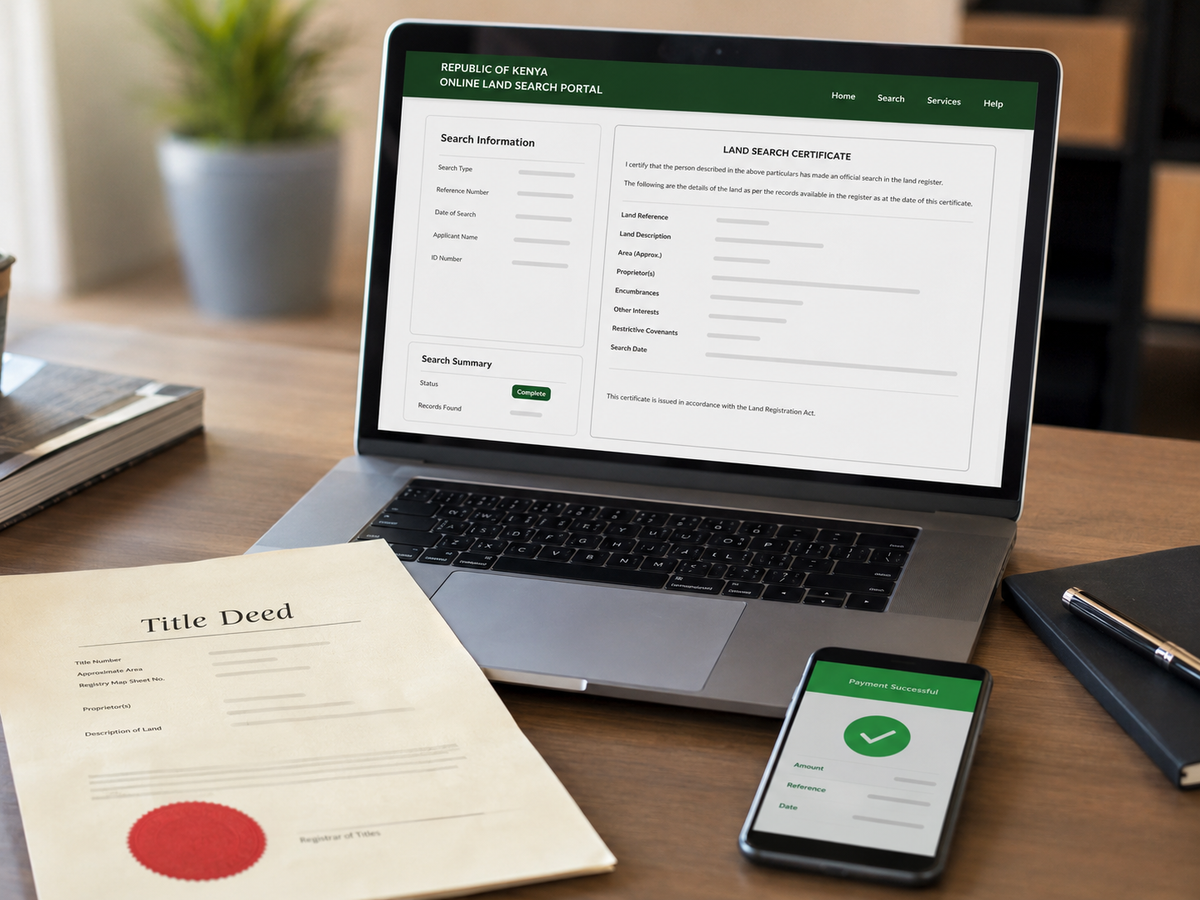
How to Check Land Ownership in Kenya Online (2026): Ardhisasa & eCitizen
How to check land ownership in Kenya online: step-by-step Ardhisasa and eCitizen searches, costs, what the search certificate reveals, and coverage gaps.
Before you pay a shilling for any plot, you can find out exactly who legally owns it — online, in a day, for a few hundred shillings. Knowing how to check land ownership in Kenya online is the single cheapest and most effective fraud check available, and in 2026 it's easier than ever thanks to the Ardhisasa and eCitizen platforms. This guide explains what an online land search reveals, how to run one on each platform, where the coverage gaps are, and how to read the results so you don't get caught out.
The point of the search is simple: it confirms whether the person selling you land is actually its registered owner, and whether the parcel carries any hidden loans, caveats, or court orders. Over 30% of Kenyan land disputes stem from unverified titles — and almost all of those could have been avoided with a search.
What an Online Land Search Reveals
An official land search produces a Land Search Certificate (RL27 on eCitizen), which is the document your advocate, bank, or SACCO needs for due diligence. It shows the key facts about the parcel:
The registered owner's name — confirms the seller actually owns it
The parcel size and location
The land tenure type — freehold, or leasehold with its expiry date
Encumbrances — registered charges (mortgages), caveats, court orders, leases, or other restrictions
If the owner's name on the certificate doesn't match the person selling, stop. That mismatch is the most common red flag in Kenyan property fraud.
The Two Systems: Ardhisasa vs eCitizen
Kenya's land records are split across two online platforms depending on whether the property's registry has been digitised.
Platform | Covers | Speed | Cost |
|---|---|---|---|
Ardhisasa (ardhisasa.go.ke) | Fully digitised registries — Nairobi and Murang'a, with rollouts in Kiambu, Isiolo, Mombasa, Machakos | Near-instant to 24 hours | ~KES 500 |
eCitizen (ecitizen.go.ke) | Legacy registries in other counties — Kisumu, Nakuru, and most areas outside Ardhisasa zones | 1–3 working days | ~KES 500–1,000 (+ platform fee) |
Before you start, confirm with the Ministry of Lands which system applies to your specific parcel. A few areas — notably Ngong and Kikuyu — are not yet fully online and still require a physical registry visit.
How to Check Land Ownership on Ardhisasa
For properties in Nairobi and other digitised counties, Ardhisasa is the fastest route:
Step | Action |
|---|---|
1 | Go to ardhisasa.go.ke and register or log in using your ID number and mobile number |
2 | Open Land Registration Services and select "Search" |
3 | Click "New Application" and enter the land parcel or title number exactly as it appears on the title deed |
4 | Upload a copy of the title deed and your national ID |
5 | Pay the search fee (around KES 500) via M-Pesa or card |
6 | Download the Land Search Certificate from your dashboard, often within hours |
For a deeper walkthrough of the platform, including account setup and other services, see our Ardhisasa tutorial.
Accuracy matters more than you'd think. Enter the parcel or title number exactly as written on the title deed. A single wrong digit returns either no results or the wrong parcel — and a fraudster may rely on you misreading a number. Double-check before you pay.
How to Check Land Ownership on eCitizen
For properties outside the fully digitised Ardhisasa zones, use eCitizen and the RL27 search:
Step | Action |
|---|---|
1 | Log into ecitizen.go.ke using your ID and password |
2 | Find the Ministry of Lands, then the State Department for Lands and Physical Planning |
3 | Select "Search Land Ownership Records (RL27)" |
4 | Enter the property details exactly as on the title deed and upload a clear scan of the deed |
5 | Pay the fee (around KES 500–1,000) via M-Pesa, card, or bank transfer |
6 | Receive the RL27 Certificate of Official Search by email, typically within 1–3 working days |
The RL27 certificate is generally valid for six months, so run a fresh search close to your transaction date rather than relying on an old one.
When You Must Visit the Registry
Online coverage is growing but not complete. For parcels in areas not yet migrated — Ngong, Kikuyu, and various rural registries — you'll need to visit the relevant county land registry in person, complete a manual search form (such as RL26), pay the fee, and submit it. Your advocate can do this on your behalf. If your online search returns nothing despite a correct parcel number, the property may simply sit in a registry that isn't online yet — confirm with the Ministry of Lands rather than assuming the land doesn't exist.
Reading the Results: What to Look For
When the certificate arrives, check three things in order. First, does the registered owner's name match the seller exactly? Second, what is the tenure — and if leasehold, how many years remain, since a short remaining lease affects value. Third, are there any encumbrances? A registered charge means there's an outstanding loan against the land; a caveat or court order means someone has a legal claim or there's an active dispute. Any of these needs to be resolved or accounted for before you proceed. A clean certificate showing the seller as owner with no encumbrances is what you want to see.
The Limits of an Online Search
An online search is essential, but it isn't the whole job. It confirms the record — not the ground. The records themselves can occasionally be out of date, and a search won't tell you whether the boundaries on the ground match the title, whether someone is occupying the land, or whether the physical plot even matches what you were shown. A land search (KES 500–1,000) is a different thing from a land survey (KES 30,000–100,000+), which marks actual boundaries.
For any real purchase, treat the online search as step one of several: combine it with a physical site visit, confirmation that the seller's ID matches the owner on the certificate, and an advocate's review. These steps together reduce — though never fully eliminate — the risk of fraud. Our due diligence checklist and title deed verification guide set out the full sequence, and the land buying guide shows where the search fits in the process.
A Powerful Tool for Diaspora Buyers
For Kenyans abroad, online land searches are transformative. You can confirm a parcel's registered owner and legal status from anywhere in the world before sending any money, without needing someone on the ground for the preliminary check. That said, the online search should still be paired with a trusted local person or advocate doing a physical site visit and an in-person registry check for major purchases — distance makes the boundary-and-occupation risks harder to spot. Our diaspora hub and remote buying guide explain how to combine online verification with safe local representation.
Legitimate sellers have nothing to hide from a land search and will give you the correct parcel number without fuss. A seller who is evasive about the parcel number, discourages you from running a search, or pressures you to pay first is showing you the clearest warning sign there is.
Common Search Problems and Fixes
A few issues trip people up repeatedly. If your search returns nothing, the most likely cause is a mistyped parcel number — re-check every digit against the title deed. If it still fails, the parcel may sit in a registry that isn't online yet, so confirm with the Ministry of Lands whether a physical search is needed. If the platform won't accept your application, make sure your account details exactly match your national ID and that your uploaded title deed scan is clear and under the size limit. And if the registered owner's name comes back different from your seller's — or the parcel size or location doesn't match what you were shown — treat that as a serious red flag and pause the transaction until an advocate has investigated. None of these problems mean you should pay first and check later.
Frequently Asked Questions
How do I check who owns a piece of land in Kenya?
Run an official land search online using the parcel or title number from the title deed. For Nairobi and other digitised counties, use Ardhisasa (ardhisasa.go.ke); for most other areas, use the eCitizen RL27 search (ecitizen.go.ke). The Land Search Certificate that's generated shows the registered owner's name, the parcel size and location, the tenure type, and any encumbrances. If the owner's name doesn't match the seller, do not proceed.
How much does a land search cost in Kenya?
An official land search costs around KES 500 per parcel on Ardhisasa, and roughly KES 500–1,000 on eCitizen once platform fees are included. This is separate from — and far cheaper than — a full land survey, which marks physical boundaries and costs KES 30,000–100,000 or more. Given that it can prevent a multi-million-shilling loss, the search fee is the best-value protection in any property purchase.
How long does an online land search take?
On Ardhisasa, results are often available within hours and usually within 24 hours of payment. On eCitizen, the RL27 certificate typically arrives by email within one to three working days. The eCitizen certificate is generally valid for six months, so for a purchase it's best to run a fresh search close to your transaction date rather than relying on an older one.
Which counties are covered by Ardhisasa?
As of early 2026, Ardhisasa is fully operational in Nairobi and Murang'a counties, with active rollouts in Kiambu, Isiolo, Mombasa, and Machakos. Other counties' records are still handled through eCitizen, and a few areas such as Ngong and Kikuyu require a physical registry visit. Confirm with the Ministry of Lands which system applies to your specific parcel before starting.
Is an online land search enough to verify a property?
No — it's essential but not sufficient on its own. An online search confirms the official record: the owner, tenure, and any encumbrances. It does not confirm that the boundaries on the ground match the title, whether anyone is occupying the land, or that the physical plot is the one you were shown. For a real purchase, combine the search with a physical site visit, an ID match against the certificate, and an advocate's review.
What is a Land Search Certificate (RL27)?
It's the official document produced by a land search, confirming the property's legal status. On eCitizen it's issued as form RL27, the Certificate of Official Search. It lists the registered owner, parcel size and location, tenure type, and any registered charges, caveats, or restrictions. Your advocate, bank, or SACCO will require this certificate as part of due diligence before a transaction or loan.
Explore Further
Make the search part of a full check: read the Ardhisasa tutorial, the title deed verification guide, and the due diligence checklist. Protect yourself with the property scams guide and fake title deeds warning signs, pay safely with the safe payment methods guide, and know what to do if something goes wrong with the reporting property fraud guide. When you're ready, browse plots for sale or connect with a verified agent.
Data sources: Ardhisasa (ardhisasa.go.ke) and eCitizen (ecitizen.go.ke) official portals; Ministry of Lands; Kenyan conveyancing and registry guidance (2026). Platform coverage and fees change as digitisation expands — confirm current details before searching. Verification reduces but does not eliminate risk.
Other Guides
Living in Juja, Kiambu: The University Town That Became a Satellite City — Prices, Estates & Honest Guide (2026)
Juja houses from KSh 1.2M, rent from KSh 2.5K. JKUAT area, Kenyatta Road estates, Kalimoni, Witeithie. Student yields 9-15%.

Westlands Property Guide: Prices, Lifestyle & Investment (2026)
Complete guide to Westlands real estate. Apartments from KES 8M, rental yields 6-8%, plus lifestyle amenities. Browse verified Westlands listings today.

Houses for Sale in Karen: Price Guide 2026
Karen house prices from KES 35M–250M+. 4-bedroom, 5-bedroom, villas. Karen Hardy, Ndege Road, budget breakdown. Updated March 2026.