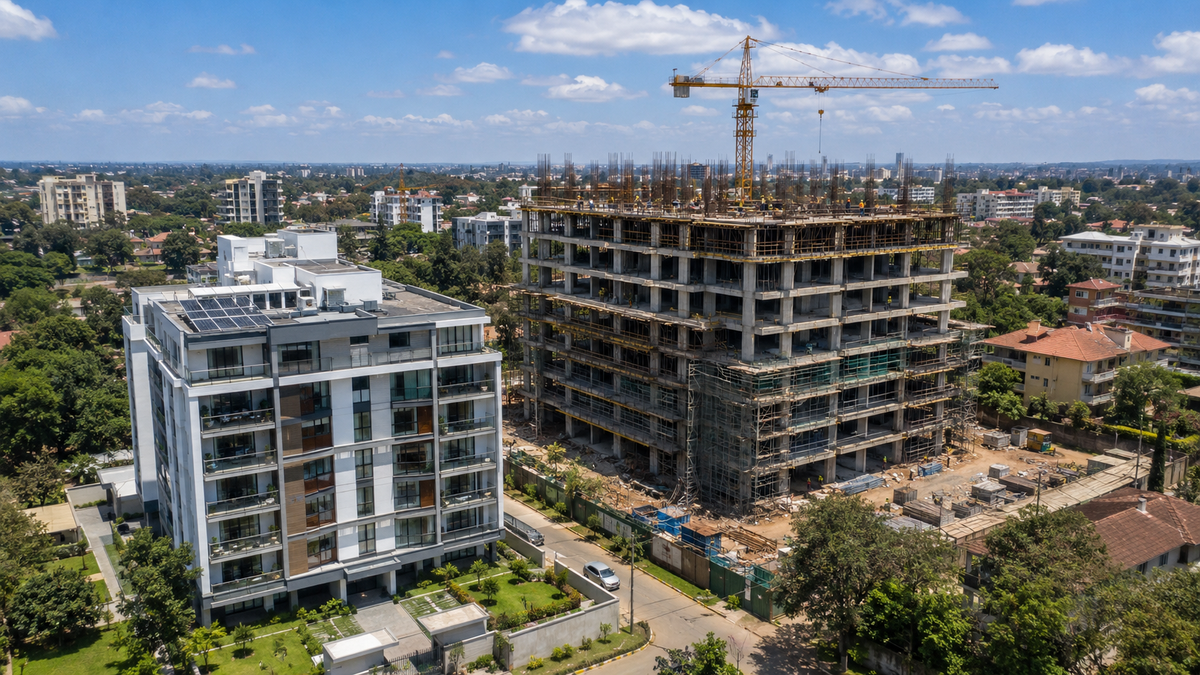
Off-Plan Property in Kenya: Is It Worth It? An Honest Guide to Prices, Risks, and Due Diligence
Should you buy off-plan in Kenya? Nairobi prices by area, 10-point due diligence checklist, sale agreement essentials, and honest risk assessment for 2026.
What Off-Plan Property Actually Means in Kenya — and Why It's Both Opportunity and Risk
Buying off-plan property in Kenya means paying for a home or apartment before it is built — sometimes before construction has even started. You commit money based on architectural drawings, 3D renders, and a developer's promise that they will deliver a finished unit that matches what they showed you. In Nairobi's fast-moving market, off-plan sales are common in areas such as Kilimani, Kileleshwa, Westlands, Ruaka, Syokimau, and Ruiru, and they account for a significant share of residential transactions.
The appeal is real: lower entry prices (typically 15–25% below completed units), flexible payment plans spread over 24–60 months, and the chance to customise finishes before construction is complete. A KES 10 million off-plan unit in a prime Nairobi location may be worth KES 12–13 million by the time you collect the keys.
But the risks are equally real. Developers have disappeared with buyer deposits. Projects have stalled for years. Finished units have arrived smaller, cheaper, and less equipped than what was promised. Kenya has no dedicated off-plan property legislation — which means your protection depends almost entirely on your due diligence, your sale agreement, and the developer's track record.
This guide gives you a balanced, evidence-based assessment of whether off-plan property is worth it in Kenya's 2026 market. No hype. No scare tactics. Just the numbers, the risks, and the specific steps that reduce them.
How Off-Plan Purchases Work in Kenya
The process follows a standard pattern, though the details vary by developer:
Stage | What Happens | Your Commitment | Timeline |
|---|---|---|---|
1. Reservation | Choose a unit from architectural plans or show flat. Sign a reservation letter. | Reservation fee: KES 50,000–500,000 (usually deducted from deposit) | Day 1 |
2. Sale agreement | Developer's lawyer prepares the sale agreement. Your lawyer reviews it. | Deposit: typically 10–30% of purchase price | Within 14–30 days of reservation |
3. Construction phase | Developer builds. You make staged payments tied to construction milestones. | Instalments per agreed schedule (e.g., 20% at foundation, 20% at slab, etc.) | 18–36 months (typical) |
4. Completion | Developer notifies you the unit is ready. You inspect (snagging). | Final payment (balance) | At handover |
5. Title transfer | Developer processes sectional title or long lease in your name. | Stamp duty (4% urban) + legal fees + registration | 30–90 days post-completion |
Critical point: You are paying for something that does not exist yet. The developer is using your money — along with other buyers' deposits and potentially bank financing — to fund construction. This is fundamentally different from buying a completed property where you can see, touch, and inspect what you are getting.
The Real Benefits of Buying Off-Plan
Lower Entry Price
Off-plan units in Nairobi's prime suburbs typically sell at 15–25% below the price of comparable completed units. For a 2-bedroom apartment in Kileleshwa that might sell for KES 12 million when completed, an off-plan price of KES 9–10 million is common. This discount compensates you for the risk you are taking and the time you are waiting.
Flexible Payment Plans
Unlike buying a completed property — where you need the full amount upfront or a mortgage — off-plan purchases spread payments across the construction period. A typical structure:
Milestone | Payment | Example (KES 10M unit) |
|---|---|---|
Reservation | 5–10% | KES 500,000–1,000,000 |
Sale agreement signing | 10–20% | KES 1,000,000–2,000,000 |
Foundation complete | 15–20% | KES 1,500,000–2,000,000 |
Slab/structural frame | 15–20% | KES 1,500,000–2,000,000 |
Finishing stage | 15–20% | KES 1,500,000–2,000,000 |
Handover | 10–20% (balance) | KES 1,000,000–2,000,000 |
This makes off-plan particularly attractive for diaspora investors who can spread contributions over 2–3 years alongside their regular living expenses abroad. For guidance on the complete diaspora buying process, see our diaspora property investment guide.
Capital Appreciation Before Handover
In well-located projects by credible developers, the property value increases as construction progresses. By the time you collect your keys, your unit may be worth 15–25% more than what you paid. This is not guaranteed — it depends on the market, the location, and the developer's reputation — but it is a documented pattern in Nairobi's prime suburbs.
Customisation
Many developers allow off-plan buyers to choose finishes: kitchen countertops, bathroom tiles, floor materials, and sometimes even layout modifications. With a completed unit, you get what you get.
Modern Amenities
Off-plan developments tend to include contemporary amenities — gym, swimming pool, co-working spaces, backup water and power systems, fibre-optic internet — that older completed buildings may lack. These amenities increase both rental demand and long-term value.
The Real Risks — and They Are Serious
These are not theoretical risks. Every one of them has played out in the Kenyan market.
Risk 1: Developer Fails to Complete
This is the worst-case scenario. You pay deposits and instalments, construction stalls, and the developer runs out of money, mismanages funds, or simply disappears. Recovering your money through the courts is possible but slow, expensive, and uncertain. Some Nairobi projects have been stalled for 5+ years with buyers still waiting.
Why it happens: Developers who rely entirely on buyer deposits to fund construction (rather than having independent financing) are most vulnerable. If sales slow or costs rise, the project stalls. Unscrupulous developers may also divert funds from one project to finance another.
Risk 2: Delays
Construction delays are the norm, not the exception. A project promised for 24-month delivery may take 36–48 months. During this time, you have no property, no rental income, and your money is locked in. If you planned to move in or generate rental income by a specific date, delays can cause cascading problems.
Risk 3: What You Get Is Not What Was Promised
Marketing brochures show marble countertops and spacious rooms. The reality may be laminate surfaces and rooms that feel smaller than the plans suggested. Specifications downgrades — cheaper materials, omitted amenities, smaller unit sizes — are common complaints. Without a detailed, legally binding specification in your sale agreement, you have limited recourse.
Risk 4: Oversupply in Your Segment
HassConsult's Q1 2026 data shows apartment prices declining in several Nairobi suburbs — Westlands apartments dropped 2.8% and Upper Hill fell 2.5% quarter-on-quarter. Parts of Kilimani have experienced oversupply in the mid-tier apartment segment. If you buy off-plan in an oversupplied area, you may receive a completed unit worth less than what you paid for it.
Risk 5: Title and Legal Problems
Some developers sell units on land they do not fully own, or where approvals are incomplete. If the mother title has encumbrances (mortgages, caveats, disputes) or if the developer lacks proper NCA approvals and county planning permission, your investment is at risk. For a deep dive on title verification, see our Ardhisasa tutorial and due diligence checklist.
Risk 6: Management Company Control
Some developers set up a management company for the completed development and retain permanent control — charging service fees without accountability to residents. The sale agreement should address when and how management transfers to a residents' committee.
Off-Plan vs Completed Property: Side-by-Side Comparison
Factor | Off-Plan | Completed/Ready |
|---|---|---|
Price | 15–25% lower at entry | Market price — what you see is what you pay |
Payment | Staged over 18–36 months | Full amount upfront or mortgage |
Inspection | You cannot inspect what doesn't exist yet | Full physical inspection before buying |
Rental income | Zero until completion (could be 2–4 years) | Immediate — start earning from day one |
Customisation | Often possible (finishes, layout tweaks) | What you see is what you get |
Developer risk | High — project may stall, developer may fail | Low — building exists, you can assess quality |
Specification risk | High — final product may differ from marketing | None — you inspect the actual unit |
Capital appreciation | Potential 15–25% gain during construction | Standard market appreciation only |
Title transfer | Delayed until completion and sectional plan registration | Can be completed immediately |
Best for | Patient investors, budget-conscious buyers, diaspora building equity over time | End-users who need a home now, investors wanting immediate rental income |
Current Off-Plan Price Ranges in Nairobi (2026)
Location | Unit Type | Off-Plan Price Range (KES) | Completed Price Range (KES) | Typical Discount |
|---|---|---|---|---|
Kilimani | 1BR apartment | 4.5M–7M | 6M–9M | 15–25% |
Kileleshwa | 2BR apartment | 9M–14M | 12M–18M | 15–22% |
Westlands | 1BR apartment | 6M–10M | 8M–13M | 15–25% |
Lavington | 3BR apartment | 15M–25M | 20M–30M | 15–20% |
Ruaka | 2BR apartment | 5M–8M | 7M–10M | 15–25% |
Syokimau | 3BR apartment | 6M–10M | 8M–13M | 15–20% |
Ruiru | 2BR apartment | 3.5M–6M | 5M–8M | 20–30% |
Sources: Market estimates from developer listings, BuyRentKenya, and Afriqahome data, 2026. Prices vary by specific project, floor level, finishes, and developer.
Browse current apartment listings in Nairobi — including both off-plan and completed units from verified agents on Afriqahome — to compare what is available in your target area.
The 10-Point Off-Plan Due Diligence Checklist
Before you commit any money, work through every item on this list. Skip one, and you increase your exposure to loss.
# | Check | How to Verify | Red Flag |
|---|---|---|---|
1 | Developer track record | Visit 2–3 of their completed projects. Talk to residents. Check for delays and quality issues. | No completed projects in Kenya; only renders and promises |
2 | Land ownership | Independent title search on Ardhisasa or eCitizen. Verify the mother title is in the developer's name. | Title in a different name; encumbrances on the title |
3 | NCA registration | Check that the project is registered with the National Construction Authority | No NCA project registration |
4 | County planning approval | Verify with the county planning department that the development has approved building plans | No approved plans or plans under dispute |
5 | Environmental impact assessment | Check for NEMA approval where required | No NEMA clearance for developments near wetlands, rivers, or protected areas |
6 | Sale agreement review | Have your own independent lawyer review the agreement before signing | Developer insists on using only their lawyer; refuses independent review |
7 | Payment structure | Payments should be tied to verified construction milestones, not arbitrary dates | Large upfront payment (>30%) before construction starts |
8 | Specifications in writing | Detailed unit specifications (size, finishes, amenities) must be in the sale agreement — not just the brochure | "Specifications subject to change" with no buyer consent clause |
9 | Completion and penalty clauses | Agreement should state a completion date and penalties for late delivery | No completion date or penalty clause |
10 | Exit and refund terms | Agreement should state what happens if the project is not completed — including refund process | No refund provision; "all payments are non-refundable" |
The golden rule: Never buy off-plan from a developer you have not independently verified. Visit their completed projects. Talk to people who bought from them. Check their title. Have your own lawyer — not the developer's lawyer — review the sale agreement. A developer who discourages you from doing any of this is a developer you should avoid.
What Your Sale Agreement Must Include
The sale agreement is your only legal protection in an off-plan purchase. It must be comprehensive, specific, and reviewed by your own lawyer. At minimum, it should cover:
Clause | What It Must Specify | Why It Matters |
|---|---|---|
Unit description | Exact unit number, floor, size (square metres), number of rooms, parking bay | Prevents "substitution" of a different or smaller unit |
Specifications | Detailed list of finishes: flooring, kitchen, bathroom, fixtures, appliances if included | Prevents specification downgrades |
Price and payment schedule | Total price in KES, payment milestones tied to construction stages, payment methods | Protects against arbitrary payment demands |
Completion date | Specific date or "within X months of commencement" | Creates a legally enforceable deadline |
Delay penalties | Compensation to buyer for late delivery (e.g., X% per month of delay) | Creates financial incentive for the developer to deliver on time |
Defects liability period | Developer responsible for fixing defects for 6–12 months after handover | Covers construction flaws that appear after you move in |
Title transfer timeline | When and how the sectional title or lease will be registered in your name | Prevents indefinite delay of your ownership documentation |
Refund in case of non-completion | Full refund process, timeline, and whether interest is payable | Your only recovery route if the project fails |
Management company | How the building will be managed post-completion and when control transfers to residents | Prevents developer from retaining permanent control and charging unchecked fees |
Dispute resolution | Mediation, arbitration, or court — and which jurisdiction | Determines where and how disputes are resolved |
For more on sale agreements in general, see our sale agreement guide.
Off-Plan for Diaspora Investors: Special Considerations
Off-plan purchases are particularly popular among Kenyans abroad because the staged payment structure aligns with monthly saving from diaspora income. However, distance adds specific risks:
Challenge | Mitigation |
|---|---|
You cannot physically inspect construction progress | Appoint a trusted local representative (lawyer, family member, or verified agent) to visit the site quarterly and send photos/video |
You are relying on digital communication with the developer | Insist on written updates tied to payment milestones. No payment without verified progress. |
Time zone differences make dispute resolution harder | Choose a developer with a documented track record of completing projects. Check references from other diaspora buyers. |
Currency fluctuation affects total cost | Budget for KES volatility. Set payment amounts in KES, not USD, so you know exactly what is owed. |
Power of Attorney needed for document signing | Execute PoA at a Kenyan Embassy or High Commission. Register it with the Lands Registry. |
Country-specific guides for diaspora buyers: USA · UK · UAE · Canada
Market Context: Is 2026 a Good Time for Off-Plan?
The answer depends on where, what, and who:
Factor | Current State (2026) | Implication for Off-Plan Buyers |
|---|---|---|
Interest rates | CBK base rate 8.75% (held April 2026); commercial mortgage rates 13–16% | Off-plan's staged payments reduce need for expensive mortgage financing |
Nairobi apartment prices | Suburban houses +1.1% QoQ, but apartments falling in some areas (Westlands -2.8%, Upper Hill -2.5%) | Choose location carefully — oversupplied areas may see negative appreciation |
Suburban rents | Record highs — KES 201,832/month average (HassConsult Q1 2026) | Strong rental demand means completed off-plan units should find tenants |
Satellite towns | Land prices +2.3% QoQ; yields 5.3–9% depending on area | Off-plan in satellite towns (Ruiru, Ruaka, Syokimau) offers higher yields but higher completion risk |
Oversupply risk | Parts of Kilimani, Ngong Road, Upper Hill have excess apartment stock | Avoid off-plan in areas with already high vacancy rates |
Sources: HassConsult Q1 2026 Property Price Index; CBK Monetary Policy Committee April 2026; Cytonn Investments.
For the full market picture, see our Kenya real estate trends 2026 report and market overview.
Pros and Cons Summary
Pros | Cons |
|---|---|
Lower entry price (15–25% discount) | Developer may fail to complete |
Flexible payment plans over 2–3 years | Delays are common — budget extra time |
Potential capital appreciation during construction | Finished product may differ from marketing |
Customisation options for finishes | No rental income until completion |
Modern amenities in new developments | Title transfer can be slow after completion |
Good fit for diaspora saving patterns | Market may decline during construction period |
Potential to resell at profit before completion | No dedicated off-plan legislation in Kenya |
Frequently Asked Questions
Is buying off-plan property in Kenya safe?
It can be, but only with thorough due diligence. The safety of an off-plan purchase depends almost entirely on the developer's credibility, your sale agreement, and the legal checks you perform before committing money. Kenya has no specific off-plan property law, so your sale agreement is your primary protection. Always verify the developer's track record by visiting their completed projects, conduct an independent title search on Ardhisasa, have your own lawyer review the sale agreement, and ensure payments are tied to verified construction milestones. Work with verified agents on Afriqahome who can help you identify credible developers.
How much deposit do I need for an off-plan property in Kenya?
Most developers require a deposit of 10–30% of the total purchase price, payable within 14–30 days of signing the reservation letter. For a KES 10 million unit, that means KES 1–3 million upfront. The remainder is typically spread across construction milestones over 18–36 months. Some developers offer lower initial deposits (as low as 5–10%) to attract buyers, with larger payments due at later milestones. Always confirm the exact payment structure in writing before signing.
What happens if the developer does not complete the project?
This is the biggest risk of off-plan buying. If the developer fails to complete, your options depend on your sale agreement. A well-drafted agreement should include a refund clause that specifies the timeline and process for returning your money if the project is not completed by a specified date. Without such a clause, you may need to pursue legal action through the courts — which is slow and expensive. In practice, recovering money from an insolvent developer is very difficult, which is why verifying the developer's financial health and track record before buying is more important than any contractual protection.
Can I sell my off-plan unit before completion?
Yes, in most cases. This is called an "assignment" or "resale" of the off-plan contract. Many developers allow it, sometimes with a transfer fee (typically 1–3% of the purchase price). The key is to check whether your sale agreement permits assignment and what conditions apply. If the property has appreciated since your purchase, you can sell at the higher market value and pocket the difference — this is one of the main profit strategies for off-plan investors. However, if the market has declined or the project has problems, finding a buyer may be difficult.
How do I check if a developer is legitimate in Kenya?
Start by visiting 2–3 of their completed projects in person. Talk to residents about construction quality, delay history, and whether the delivered product matched the marketing. Then verify: is the development land registered in the developer's or their company's name (title search on Ardhisasa)? Is the project registered with the National Construction Authority? Does the county government have approved building plans on file? Is the developer's company properly registered at the Business Registration Service (check on eCitizen)? A credible developer will welcome your due diligence. One who discourages it is a red flag.
Is off-plan better than buying a completed property?
Neither is universally better — it depends on your situation. Off-plan is better if you want a lower price, can wait 2–3 years for delivery, prefer staged payments, and are comfortable with the risks. A completed property is better if you need a home immediately, want to inspect exactly what you are buying, need rental income now, or want certainty about the final product. For first-time buyers who need a home within the next 12 months, completed units are generally lower risk. For investors with a longer time horizon and the discipline to verify developers, off-plan can offer better returns.
Explore Further
Browse apartments for sale in Nairobi — off-plan and completed, all from verified agents
Find a verified agent — every agent on Afriqahome is identity-checked and EARB-verified
Property Due Diligence Checklist — the complete verification process
How to Use Ardhisasa for Title Searches — verify land ownership yourself
Stamp Duty and Closing Costs 2026 — every fee you will pay
Total Cost of Buying Property in Kenya — beyond the purchase price
Property Scams in Kenya: How to Protect Yourself — common fraud patterns
Sale Agreement for Land in Kenya — essential clauses and mistakes to avoid
First-Time Home Buyer Guide Kenya — complete step-by-step
Diaspora Property Investment Guide — buying from abroad
Kenya Real Estate Trends 2026 — market outlook
Other Guides

Living in Juja, Kiambu: The University Town That Became a Satellite City — Prices, Estates & Honest Guide (2026)
Juja houses from KSh 1.2M, rent from KSh 2.5K. JKUAT area, Kenyatta Road estates, Kalimoni, Witeithie. Student yields 9-15%.

Westlands Property Guide: Prices, Lifestyle & Investment (2026)
Complete guide to Westlands real estate. Apartments from KES 8M, rental yields 6-8%, plus lifestyle amenities. Browse verified Westlands listings today.

Houses for Sale in Karen: Price Guide 2026
Karen house prices from KES 35M–250M+. 4-bedroom, 5-bedroom, villas. Karen Hardy, Ndege Road, budget breakdown. Updated March 2026.