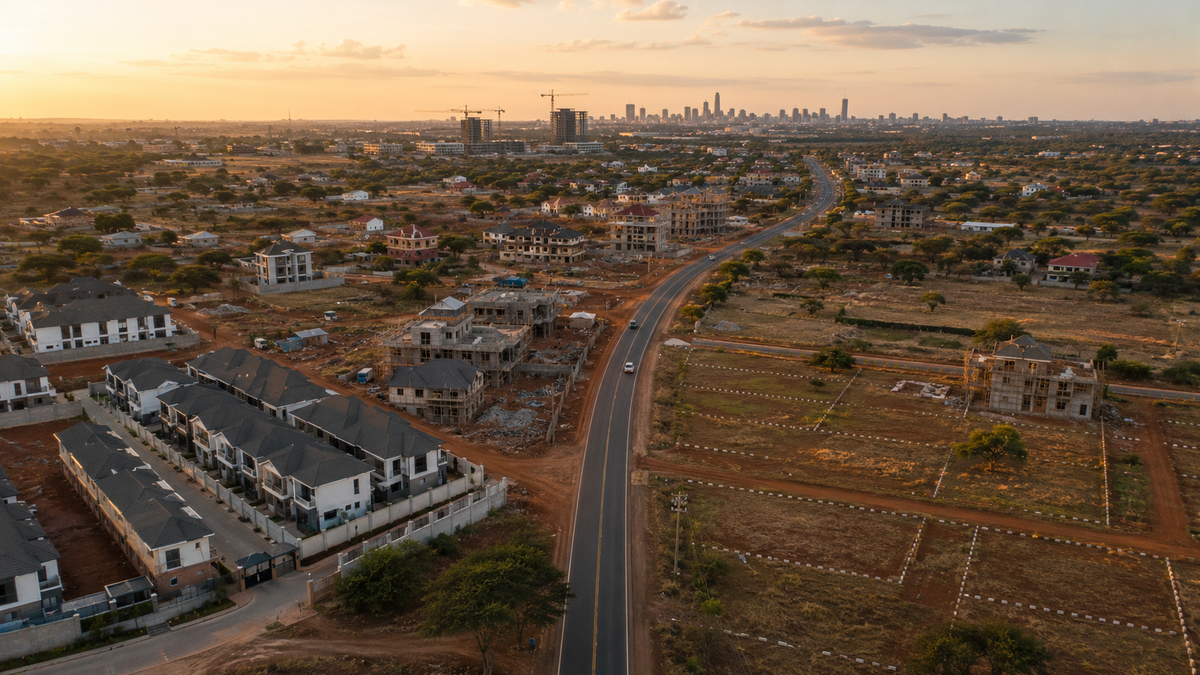
Satellite Towns ROI Comparison 2026: Land Prices, Yields & Where the Returns Really Are
Compare Nairobi satellite towns for 2026: Ruiru KES 40.5M, Kitengela 18.8M/acre, yields 6–10%. Honest ROI, appreciation outlook & risks, town by town.
For most of the last decade, Nairobi's satellite towns were the easiest ROI story in Kenyan real estate: buy a plot, wait, watch it double. This satellite towns ROI comparison for 2026 tells a more honest — and more useful — story. The HassConsult Land Price Index now shows several satellite markets declining year-on-year in 2026, as infrastructure gains that once drove explosive growth get fully priced into land values. That doesn't mean the opportunity is gone. It means returns are now driven by selection, not the tide. Below we compare the major towns — Ruiru, Kitengela, Juja, Athi River, Syokimau, Ngong, Kikuyu and Rongai — on land price, appreciation, rental yield and risk, so you can see where the realistic ROI actually sits in 2026.
Key Findings
Finding | Detail |
|---|---|
The boom has cooled | Several satellite towns posted land-price declines in 2026 (Athi River −2.5%, Ngong −1.7%) as infrastructure value matured |
Thika Road still leads growth | Ruiru rose +2.8% to KES 40.5M/acre; Juja +1.2% to KES 26.6M/acre |
Yields beat premium suburbs | Developed satellite plots typically yield 6–10% gross, versus falling prices in some Nairobi premium apartment markets |
Affordability is the real driver | A 3–4 bedroom townhouse in Kitengela or Ruiru (KES 4–7M) replaces a KES 12–14M apartment in Westlands or Kilimani |
Forward returns are lower | Investors entering in 2026 should not expect to replicate 2017–2026 returns — single-digit appreciation is the realistic base case |
How We Measure Satellite Town ROI
"ROI" gets thrown around loosely, so let's define it. Land near Nairobi delivers return through two channels: capital appreciation (the plot rising in value) and rental yield (income once you develop the plot into housing). A pure land-banking play earns only the first; a build-and-rent strategy earns both.
Two cautions throughout this report. First, yields quoted are gross (annual rent ÷ property value) unless stated — net yields after service charge, management, vacancy and maintenance are typically 1.5–2.5 percentage points lower. Second, published index data can lag the live market by three to six months, so treat every figure as a range, not a promise.
Macro Context: Why the Market Cooled in 2026
The slowdown is structural, not a crash. According to the HassConsult report, the price decline in several satellite towns is attributed to infrastructure gains already being priced into land values, combined with a tighter economic environment. When the Thika Superhighway, the SGR, the Eastern and Southern bypasses and Konza were under construction, land near them repriced sharply in anticipation. Now that much of that infrastructure exists, the easy re-rating is done.
On financing, the Central Bank of Kenya base rate sits at 8.75%, with commercial mortgages still in the 13–16% range — which keeps mortgage-driven demand modest and favours cash and incremental "lipa mdogo mdogo" plot buyers. The net effect: 2026 rewards investors who buy on fundamentals (genuine demand drivers, clean title, real infrastructure) rather than on hype.
Satellite Town Land Prices 2026
Here is the 2026 picture for price per acre, with year-on-year change, drawn from the HassConsult Land Price Index as reported by Money254:
Town | Price / acre 2026 | YoY change | Corridor |
|---|---|---|---|
Mlolongo | KES 47.1M | −0.1% | Mombasa Rd |
Ruiru | KES 40.5M | +2.8% | Thika Rd |
Syokimau | KES 39.5M | −0.7% | Mombasa Rd / SGR |
Ngong | KES 35.6M | −1.7% | Southern |
Tigoni | KES 34.8M | −0.9% | Limuru |
Ongata Rongai | KES 29.4M | +0.9% | Southern |
Limuru | KES 27.4M | −0.7% | Northwest |
Juja | KES 26.6M | +1.2% | Thika Rd |
Athi River | KES 20.8M | −2.5% | Mombasa Rd / SGR |
Kitengela | KES 18.8M | +0.8% | Mombasa Rd |
Kiserian | KES 13.5M | −0.1% | Southern |
At the plot level, a standard 50×100 ft (1/8 acre) plot in these towns ranges from roughly KES 500K to KES 3.5M depending on town, distance from the highway, and whether it has water, electricity and road access. Entry-level value-plots in outer markets like Matuu start near KES 199K. Use our how to buy land in Kenya guide to understand what those service connections add to a plot's real value.
Town-by-Town ROI Breakdown
Ruiru and Juja (Thika Road corridor)
The clearest 2026 outperformers. Ruiru's +2.8% rise to KES 40.5M/acre reflects sustained demand from Tatu City, proximity to Thika Road and a maturing rental market. Juja's +1.2% gain is anchored by JKUAT's student population — a structural, year-round rental demand driver that few other towns match. Both still command higher entry prices, so appreciation upside is more measured than in cheaper markets, but rental demand is among the most predictable.
Kitengela and Athi River (Mombasa Road / SGR corridor)
The affordability champions. Kitengela's KES 18.8M/acre is among the lowest of the established towns, and it edged up +0.8% in 2026. Athi River, despite the sharpest 2026 decline (−2.5% to KES 20.8M), benefits from industrial employment and SGR connectivity, which underpins tenant demand. These towns suit build-and-rent strategies where a modest plot price plus development can produce 7–10% gross yields, particularly serving middle-income tenants.
Syokimau (Mombasa Road / SGR)
A more mature, higher-priced market (KES 39.5M/acre, −0.7%) with the advantage of the SGR terminus and airport proximity. Appreciation has flattened, so Syokimau in 2026 is more of a yield-and-stability play than a fast-growth bet.
Ngong, Kikuyu and Rongai (Southern and Northwest)
Lifestyle-led markets. Ngong (KES 35.6M, −1.7%) and Kikuyu offer cooler climate, scenic views and a suburban feel that attracts owner-occupiers more than yield investors. Industry estimates put steadier 6–11% long-term appreciation potential here with lower entry risk than the fastest-growing zones. Rongai (+0.9%) sits between value and lifestyle.
Satellite Towns ROI Comparison 2026
Pulling it together — a side-by-side comparison. Appreciation reflects the realistic forward expectation, not historic peaks; yields are gross on developed plots.
Town | Entry (per acre) | 2026 price trend | Realistic appreciation outlook | Gross rental yield (developed) | Best for |
|---|---|---|---|---|---|
Ruiru | High (KES 40.5M) | Rising | Moderate | 7–9% | Predictable rental demand |
Juja | Medium (KES 26.6M) | Rising | Moderate–high | 8–10% | Student rentals (JKUAT) |
Kitengela | Low (KES 18.8M) | Rising slightly | Moderate | 7–10% | Affordable build-and-rent |
Athi River | Low (KES 20.8M) | Falling | Moderate | 7–9% | Industrial tenant demand |
Syokimau | High (KES 39.5M) | Flat/declining | Low–moderate | 6–8% | Stability, SGR access |
Ngong/Kikuyu | Medium–high | Flat/declining | Low–moderate | 5–7% | Lifestyle / owner-occupier |
The headline: there is no single "best" town. Juja and Kitengela offer the strongest combination of accessible entry and yield; Ruiru offers the most predictable demand at a higher price; Syokimau and Ngong are stability and lifestyle plays where you should not bank on rapid appreciation.
Rental Yields Across Satellite Towns
The yield case strengthened recently. HassConsult data showed satellite town rents rising 8.7% in 2025 while prices rose 4.5% — meaning yields improved as income outpaced capital values. Developed 50×100 plots (bedsitters or small apartment blocks) typically generate 6–10% gross, with the upper end in university and industrial zones like Juja and Athi River where tenant demand is structural.
Compare that to Nairobi's premium suburbs, where HassConsult recorded Westlands apartment sale prices falling 11.5% across 2025 on a wave of new supply. For income investors, well-selected satellite stock is competing strongly on yield. See our rental yield by neighbourhood report for the full citywide comparison.
The Risks — Honestly
Risk | Severity | Mitigation |
|---|---|---|
Appreciation slowdown | High | Buy for yield + modest growth, not for a doubling; pick towns with real demand drivers |
Oversupply in fast-building zones | Medium–high | Avoid markets flooded with identical units; favour quality and differentiated stock |
Land fraud / fake titles | High | Verify title on Ardhisasa, use a verified agent, engage an advocate |
Off-plan developer fraud | High | See our property scams guide; prefer ready-title plots over off-plan promises |
Infrastructure gaps | Medium | Confirm actual (not promised) water, power and road access on-site |
Currency risk (diaspora) | Medium | Factor KES/USD movement into return expectations |
Guidance by Buyer Type
Buyer | Strategy |
|---|---|
First-time / budget | Kitengela or Juja — low entry, real rental demand. Start with a serviced 50×100 plot. |
Yield investor | Build-and-rent in Juja (students) or Athi River (industrial workers); target 7–10% gross. |
Land-banker | Thika Road corridor (Ruiru) where demand is sustained; accept moderate, not explosive, growth. |
Owner-occupier | Ngong, Kikuyu or Limuru for climate and lifestyle; ROI is secondary to living quality. |
Diaspora investor | Ready-title plots only, verified agent, advocate-led transfer; avoid off-plan from a distance. |
For Diaspora Investors
Satellite towns are popular with diaspora buyers because they combine affordability with appreciation potential — but distance amplifies the fraud risk. Documented cases of diaspora buyers losing millions almost always involve off-plan promises on land the "developer" did not control. The safer route is buying a ready-title plot through a verified agent, with an advocate handling the transfer and an independent title search on Ardhisasa. Our diaspora property investment guide and due diligence checklist walk through the safeguards. Verification reduces the risk distance creates; it does not eliminate it, so your own checks at every step still matter.
Frequently Asked Questions
Which satellite town has the best ROI in Kenya in 2026?
There is no single winner — it depends on your strategy. For yield, Juja (student demand from JKUAT) and Kitengela (low entry, build-and-rent) lead at 7–10% gross. For predictable rental demand at a higher price, Ruiru on Thika Road is strongest. For stability over growth, Syokimau. Investors chasing rapid appreciation should temper expectations: 2026 returns are single-digit, not the doubling seen in past years.
Are satellite town land prices falling in 2026?
Several are. The HassConsult Land Price Index showed 2026 declines in Athi River (−2.5%), Ngong (−1.7%), Tigoni (−0.9%), Syokimau (−0.7%) and Limuru (−0.7%), while Ruiru (+2.8%), Juja (+1.2%), Rongai (+0.9%) and Kitengela (+0.8%) rose. The cause is infrastructure value being fully priced in plus a tighter economy — a cooling, not a collapse.
What is the cheapest satellite town to buy land near Nairobi?
Among established towns, Kiserian (KES 13.5M/acre) and Kitengela (KES 18.8M/acre) are the most affordable, followed by Athi River (KES 20.8M). At the 50×100 plot level, prices range from about KES 500K to 3.5M depending on services, with outer-market value plots (e.g. Matuu) starting near KES 199K. Always confirm water, power and road access before assuming a low price is a bargain.
What is the rental yield in Kitengela?
Developed plots in Kitengela typically generate around 7–10% gross rental yield, driven by affordable property prices and steady middle-income tenant demand. Net yields after service charge, vacancy and management run roughly 1.5–2.5 points lower. Yield depends heavily on the specific building, purchase price and management quality, so treat these as ranges.
Is Ruiru a good investment in 2026?
Ruiru was one of the few towns to post a 2026 land-price rise (+2.8% to KES 40.5M/acre), supported by Tatu City, Thika Road access and a maturing rental market. Entry prices are higher than cheaper towns, so appreciation upside is moderate, but rental demand is among the most predictable. It suits investors prioritising stable income over speculative growth.
Should diaspora investors buy land off-plan in satellite towns?
Approach off-plan with extreme caution. Most documented diaspora land losses involve off-plan schemes on plots the seller did not legally control. The safer path from abroad is a ready-title plot bought through a verified agent, with an advocate handling transfer and an independent Ardhisasa title search. Read our property scams guide before sending any money.
Methodology & Sources
Land price and year-on-year figures are drawn from the HassConsult Land Price Index (2026) as reported by Money254, cross-referenced with BuyRentKenya and industry listing data from licensed Kenyan agents. Yield estimates are gross ranges based on listing rents against asking prices and depend on the specific property, purchase price and management. Macroeconomic figures (CBK base rate, mortgage rates) are from the Central Bank of Kenya. Published indices may lag live market conditions by three to six months; all figures should be treated as ranges for planning, not guarantees.
Explore Further
For the citywide picture, see Kenya real estate 2026 and the rental yield by neighbourhood report. Before buying any plot, work through how to buy land in Kenya, the due diligence checklist, and the Ardhisasa tutorial. Estimate your transfer costs with the stamp duty calculator and read the closing costs guide.
Ready to compare actual listings? Browse plots for sale near Nairobi from verified agents who have passed Afriqahome's document verification. Diaspora investors can start at the diaspora hub. Verification reduces the risk that distance and fraud create — though no platform eliminates it, which is why your own due diligence on every plot remains essential.
Other Guides

Living in Juja, Kiambu: The University Town That Became a Satellite City — Prices, Estates & Honest Guide (2026)
Juja houses from KSh 1.2M, rent from KSh 2.5K. JKUAT area, Kenyatta Road estates, Kalimoni, Witeithie. Student yields 9-15%.

Westlands Property Guide: Prices, Lifestyle & Investment (2026)
Complete guide to Westlands real estate. Apartments from KES 8M, rental yields 6-8%, plus lifestyle amenities. Browse verified Westlands listings today.
Houses for Sale in Karen: Price Guide 2026
Karen house prices from KES 35M–250M+. 4-bedroom, 5-bedroom, villas. Karen Hardy, Ndege Road, budget breakdown. Updated March 2026.