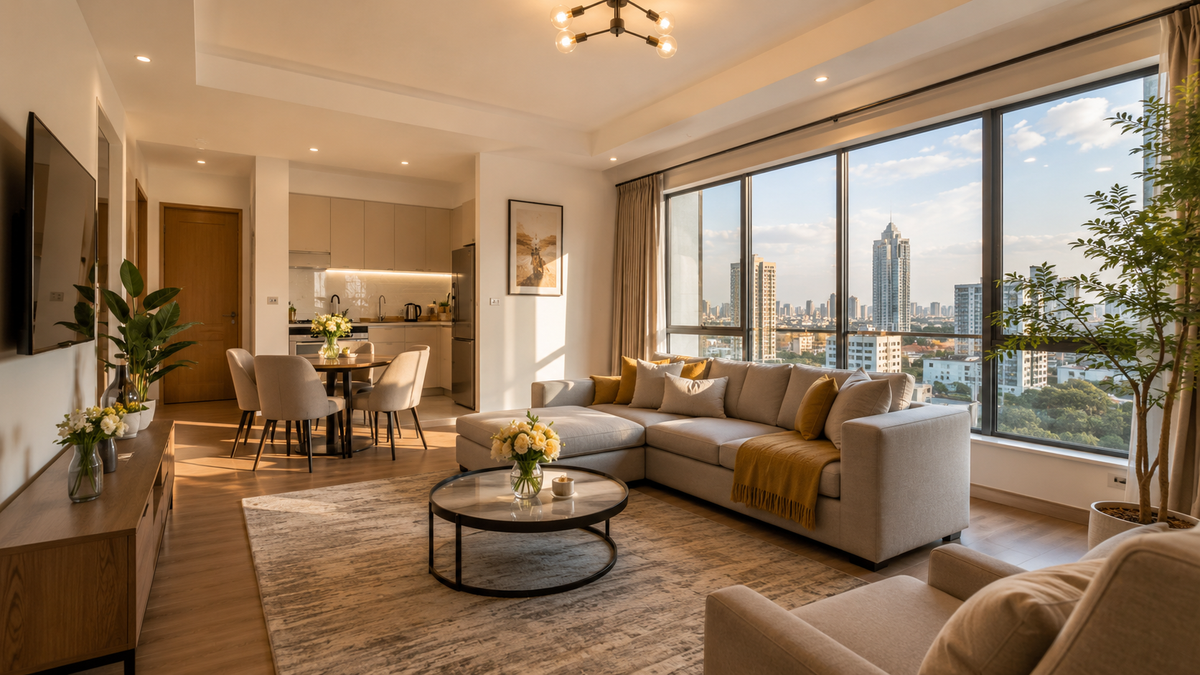
Airbnb Investment in Kenya 2026: Real Numbers, Real Costs, and Whether It's Actually Worth It
Is Airbnb profitable in Kenya? Real data: 31–46% occupancy, KES 5,700/night ADR, setup costs, best Nairobi areas, tax rules, and management options for 2026.
The Honest Truth About Airbnb Investment in Kenya in 2026
Airbnb investment in Kenya is no longer the easy money opportunity it was in 2019. Nairobi now has over 4,000 active short-term rental listings. Competition has pushed average occupancy rates down to 31–46% across the city. Supply is growing faster than demand in some neighbourhoods. And yet, well-located properties with professional management are still generating returns that significantly exceed traditional long-term rentals.
The difference between profitable Airbnb hosts and struggling ones is entirely predictable: it comes down to location, property type, management quality, and realistic expectations. This guide gives you the actual numbers — not the hype — so you can decide whether short-term rental investment in Kenya makes sense for your situation.
For context on the broader property market, see our Kenya real estate trends 2026 report. For diaspora investors considering Airbnb from abroad, our managing rental property from abroad guide covers the operational challenges.
Nairobi Airbnb Market: The Real Numbers
Metric | Nairobi Average (2025–2026) | What It Means |
|---|---|---|
Active listings | 3,700–4,000+ | Large market with significant competition |
Average daily rate (ADR) | USD 44–56 (KES 5,700–7,300) | Varies widely by neighbourhood and property type |
Average occupancy rate | 31–46% | Well below hotel-level occupancy — expect empty nights |
Average annual revenue | USD 4,200–7,000 (KES 545,000–910,000) | Average, not top performers — location and management shift this dramatically |
Peak months | November, December, July, August | Strong seasonality — corporate travel (Nov–Dec) and holiday tourism (Jul–Aug) |
Guest profile | ~60% domestic / business, ~40% international tourists | Corporate travel provides the most consistent demand |
Sources: AirROI 2026 dataset, AirDNA, Airbtics. Figures represent market averages — individual properties can perform significantly above or below these numbers.
Critical distinction: Average annual revenue of KES 545,000–910,000 is gross revenue before expenses. After property management (15–25% of revenue), cleaning, utilities, furnishing depreciation, maintenance, and taxes, your net income may be 40–60% of gross. Many new hosts are surprised by how much of their revenue goes to operating costs.
Airbnb vs Long-Term Rental: The Comparison
Factor | Airbnb / Short-Term Rental | Long-Term Rental (12+ month lease) |
|---|---|---|
Gross income potential | 1.5–2.5× long-term rent (when well-managed) | Steady, predictable monthly income |
Occupancy | 30–60% average; 70–85% for top performers | 95–100% (when tenanted) |
Management effort | High — guest communication, cleaning between stays, reviews, dynamic pricing | Low — collect rent monthly, handle occasional maintenance |
Management cost | 15–25% of revenue (professional management) | 8–10% of rent (if using property manager) |
Furnishing required | Full — furniture, kitchenware, linen, TV, WiFi, décor | Typically unfurnished in Kenya |
Setup cost | KES 300,000–1,000,000+ (furnishing a 1–2BR to Airbnb standard) | Minimal |
Wear and tear | Higher — frequent guest turnover means more cleaning, breakage, and replacement | Lower — one tenant for 12+ months |
Vacancy risk | Seasonal dips; new listing ramp-up period (3–6 months to build reviews) | Risk of 1–2 month vacancy between tenants |
Tax treatment | Same as rental income (MRI 7.5% for residents; 30% withholding for non-residents) | Same |
Regulatory risk | Currently low in Kenya — but regulations may tighten as market grows | Established legal framework |
Best for | Investors willing to treat it as a business; properties in high-demand tourist/corporate areas | Passive investors; diaspora owners who want minimal management |
Best Locations for Airbnb in Nairobi
Neighbourhood | Guest Profile | ADR Range (KES/night) | Occupancy Potential | Why It Works |
|---|---|---|---|---|
Westlands | Corporate travellers, expats, tourists | 5,000–12,000 | 45–65% | Business hub, restaurants, nightlife, walkable, fast internet |
Kilimani | Business travellers, NGO workers, tourists | 4,000–9,000 | 40–60% | Central, near Yaya Centre, good transport links, large apartment supply |
Kileleshwa | Mid-stay corporate, families, diaspora visitors | 4,500–10,000 | 35–55% | Quieter, leafy, good for families, close to Westlands |
Parklands | Budget travellers, domestic tourists, medical tourists | 3,000–7,000 | 40–55% | Near Aga Khan Hospital, diverse dining, good value |
Lavington | Families, mid-stay professionals, diaspora | 5,000–12,000 | 35–50% | Family-friendly, green, upscale, international schools nearby |
Karen | Premium tourists, safari-adjacent stays | 8,000–25,000 | 30–45% | Safari gateway (near Nairobi National Park), luxury positioning |
Nairobi's corporate travel corridor (Westlands → Kilimani → Upper Hill) provides the most consistent demand. Corporate guests book during weekdays, pay reliably, and cause less wear and tear than tourist groups. Properties within walking distance of major offices, conference centres, and the UN complex in Gigiri command premium rates and higher occupancy.
Coastal Kenya: Seasonal but High Potential
The Kenya coast — particularly Diani, Watamu, Nyali, and Malindi — offers Airbnb potential driven by holiday tourism rather than corporate travel. Peak season (December–March, July–August) can generate exceptional nightly rates (KES 8,000–30,000+), but off-peak months see occupancy drop to 20–35%. Coastal Airbnb works best for investors who accept seasonal income patterns or who combine short-term rental with personal use during shoulder months.
The Real Costs of Running an Airbnb
Startup Costs
Item | 1BR Studio/Apartment | 2BR Apartment | Notes |
|---|---|---|---|
Furniture (bed, sofa, dining, storage) | KES 100,000–200,000 | KES 180,000–350,000 | Mid-range quality that withstands frequent use |
Kitchenware (full set) | KES 20,000–40,000 | KES 30,000–60,000 | Guests expect a usable kitchen |
Linen (3 sets: bed sheets, towels) | KES 15,000–30,000 | KES 25,000–50,000 | Budget for replacement every 6–12 months |
TV + streaming | KES 20,000–40,000 | KES 25,000–50,000 | Smart TV with Netflix/streaming is now expected |
Internet setup | KES 5,000–10,000 | KES 5,000–10,000 | Fast, reliable WiFi is non-negotiable |
Décor and photography | KES 15,000–40,000 | KES 20,000–60,000 | Professional photos increase bookings significantly |
Safety (fire extinguisher, first aid, smoke detector) | KES 5,000–10,000 | KES 5,000–10,000 | Required by Airbnb and common sense |
Total setup | KES 180,000–370,000 | KES 290,000–590,000 |
Monthly Operating Costs
Cost | Monthly Range (KES) | Notes |
|---|---|---|
Property management | 15–25% of gross revenue | If using a management company; includes guest comms, check-in, pricing |
Cleaning (per turnover) | 1,500–3,000 per clean | At 10 turnovers/month = KES 15,000–30,000 |
Utilities (electricity, water, internet) | 5,000–12,000 | Higher than long-term rental due to guest usage patterns |
Service charge | 3,000–15,000 | Same as any apartment owner |
Consumables (toiletries, coffee, cleaning supplies) | 3,000–6,000 | Small items that guests expect |
Linen replacement / repairs | 2,000–5,000 (averaged) | Things break; budget for ongoing replacement |
Airbnb platform fee | 3% of booking value | Deducted automatically by Airbnb |
Realistic Income Projections
Here is what a typical 1-bedroom apartment in Kilimani might generate:
Scenario | ADR (KES) | Occupancy | Gross Annual Revenue (KES) | Net After Costs (~55%) |
|---|---|---|---|---|
Poor (new listing, no reviews, poor photos) | 3,500 | 25% | 319,000 | 175,000 |
Average (6+ months, some reviews, decent photos) | 5,000 | 40% | 730,000 | 401,000 |
Good (Superhost, professional photos, dynamic pricing) | 6,500 | 55% | 1,304,000 | 717,000 |
Excellent (top 10%, corporate regular guests) | 8,000 | 65% | 1,898,000 | 1,044,000 |
Compare this to the same apartment rented long-term at KES 40,000/month = KES 480,000/year gross with minimal management costs. The "average" Airbnb scenario barely beats long-term rental — it is the "good" and "excellent" scenarios where Airbnb's premium justifies the additional work and risk.
The 3-month ramp-up rule: New Airbnb listings typically take 3–6 months to build reviews and achieve consistent bookings. During this period, expect lower occupancy and revenue. Factor this into your financial projections — do not assume month-one income will match your target.
Tax Obligations for Airbnb Hosts in Kenya
Tax | Rate | Who Pays | Notes |
|---|---|---|---|
Residential Rental Income Tax (MRI) | 7.5% of gross rent (KES 288,000–15M/year) | Resident individuals | Simplified tax for rental income. May increase to 10% under Finance Bill 2026 (pending). |
Non-resident withholding tax | 30% of gross rent | Non-resident property owners | Applies to diaspora investors. Deducted at source. |
Corporate tax | 30% | Companies owning rental properties | If Airbnb income runs through a company |
Capital Gains Tax | 15% of net gain on sale | All sellers | When you eventually sell the property |
VAT | 16% | If annual turnover exceeds KES 5M | Unlikely for most single-property hosts |
For detailed tax guidance, see our diaspora property tax guide and capital gains tax guide.
What Makes an Airbnb Property Succeed in Nairobi
Success Factor | What It Means in Practice |
|---|---|
Location within a location | Not just Kilimani — the specific building matters. Walking distance to restaurants, offices, and transport beats a quiet back street. |
Professional photography | Listings with professional photos get 40%+ more bookings. Budget KES 10,000–20,000 for a photographer. |
Fast, reliable WiFi | 100 Mbps+ fibre is expected. Business travellers will not book without it. Test the actual speed, not the plan. |
Backup power and water | A generator and water tanks mean your guests are not affected by Nairobi's supply interruptions. |
Self check-in | Lockbox or smart lock. Corporate guests arrive at all hours. Manual key handover does not scale. |
Dynamic pricing | Adjust rates by season, day of week, and local events. Tools like PriceLabs or Beyond Pricing automate this. |
Review management | Respond to every review. Fix issues guests mention. Superhost status (4.8+ rating, 90%+ response rate) dramatically increases visibility. |
Cleanliness obsession | The number one factor in negative reviews is cleanliness. Invest in a reliable cleaning team and inspect after every turnover. |
Pros and Cons Summary
Pros | Cons |
|---|---|
1.5–2.5× long-term rental income when well-managed | Requires active management — this is a business, not passive income |
Flexibility — use it yourself when not booked | Setup costs KES 200,000–600,000+ for furnishing |
Dynamic pricing captures peak-season premiums | 30–46% average occupancy means many empty nights |
Diversified income — many guests vs one tenant | Higher wear and tear on furnishings and finishes |
Growing market in East Africa's travel hub | Increasing competition — 4,000+ listings and growing |
Tax treatment same as rental income (MRI 7.5%) | Regulatory uncertainty — regulations may tighten |
Can switch to long-term rental as fallback | 3–6 month ramp-up period before reaching target occupancy |
Choosing the Right Property for Airbnb
Not every apartment makes a good Airbnb. The properties that perform best share specific characteristics:
Unit Size and Layout
Studio and 1-bedroom apartments are the sweet spot for Airbnb in Nairobi. They have the highest occupancy rates because the largest guest segment — solo business travellers and couples — does not need more space. Two-bedroom units can work for families and groups but have lower occupancy and higher setup costs. Three-bedroom and larger units generally perform better as long-term rentals unless they are in premium locations (Karen, Lavington) targeting high-end family tourism.
Building Amenities That Drive Bookings
Guests booking short-term rentals expect amenities that long-term tenants might compromise on. The features that most impact your booking rate include a swimming pool (significantly increases bookings for leisure travellers), a gym (important for business travellers staying multiple days), reliable backup power (generator — guests will not return if they experienced a blackout), secure parking (essential for guests with rental cars), a lift (for any building above 3 floors), and 24-hour security with controlled access.
Building Rules
Before buying a property for Airbnb, confirm that the building or estate permits short-term rentals. Some HOAs and management companies explicitly prohibit Airbnb or restrict stays to minimum durations (e.g., 7 nights or 30 nights). Buying a property in a building that bans short-term rentals — and then trying to operate an Airbnb — will create conflicts with neighbours and management, and may result in enforcement action. See our gated communities guide for more on HOA rules.
Professional Management vs Self-Management
Factor | Self-Managed | Professional Management Company |
|---|---|---|
Cost | Your time (significant) | 15–25% of gross revenue |
Guest communication | You handle all messages, check-ins, issues | Company handles 24/7 |
Cleaning coordination | You hire and manage cleaners | Company has established cleaning teams |
Pricing optimisation | Manual or basic tools | Dynamic pricing tools and market expertise |
Maintenance | You respond to issues personally | Company dispatches repair teams |
Scalability | Works for 1 property; becomes unmanageable at 2+ | Scales to multiple properties |
Best for | Local owners with time; single property in early stage | Diaspora owners; multiple properties; anyone wanting hands-off operation |
For diaspora investors, professional management is essentially mandatory. You cannot manage guest check-ins, cleaning turnovers, and maintenance requests from 8,000 km away. Budget the management fee (15–25% of revenue) as a fixed cost of doing business. The right management company will more than pay for itself through higher occupancy, better pricing, and fewer negative reviews.
When choosing a management company, ask for occupancy and revenue data from properties they already manage in your target area. Ask for references from other property owners. Confirm exactly what is included in their fee and what costs extra. Ensure they provide monthly financial reporting with full transparency on income, expenses, and occupancy.
Frequently Asked Questions
Is Airbnb profitable in Kenya in 2026?
It can be — but only for well-located, professionally managed properties. The average Nairobi Airbnb generates KES 545,000–910,000/year gross, which after expenses nets roughly KES 300,000–500,000. This barely beats a long-term rental for an average listing. Top-performing properties in Westlands, Kilimani, and Kileleshwa with professional management, dynamic pricing, and Superhost status can net KES 700,000–1,000,000+/year from a 1BR apartment — significantly above long-term rental income. The key is treating it as a business, not a side project.
How much does it cost to start an Airbnb in Kenya?
For a 1-bedroom apartment, budget KES 180,000–370,000 for furnishing, kitchenware, linen, TV, internet setup, safety equipment, and professional photography. For a 2-bedroom, KES 290,000–590,000. These are mid-range estimates — luxury positioning costs more. You will also need 2–3 months of operating capital to cover costs during the ramp-up period before bookings become consistent.
Which Nairobi neighbourhoods are best for Airbnb?
Westlands leads for corporate traveller demand with the highest occupancy potential (45–65%). Kilimani offers the best value balance with large apartment supply and strong demand from NGO and business travellers. Kileleshwa suits mid-stay guests and families. Karen commands premium nightly rates for safari-adjacent positioning but has lower occupancy. Parklands works well for budget-friendly listings targeting domestic and medical tourists near Aga Khan Hospital.
Do I need a license to run an Airbnb in Kenya?
As of 2026, Kenya has no specific short-term rental licensing requirement for Airbnb hosts. However, you should check your building's HOA or management rules — some gated communities and apartment buildings restrict or prohibit short-term rentals. You must also comply with tax obligations: register rental income with KRA and pay the applicable tax (MRI 7.5% for residents, 30% withholding for non-residents). Regulations may evolve as the market grows — stay informed.
Can I run an Airbnb in Kenya from abroad?
Yes, but you will need a local management partner. Professional Airbnb management companies in Nairobi charge 15–25% of gross revenue and handle guest communication, check-in/out, cleaning, maintenance, and pricing. Without local management, remote hosting is extremely difficult — guests need someone on the ground for key handover, issue resolution, and property upkeep. Our managing property from abroad guide covers the full diaspora landlord framework.
Airbnb or long-term rental — which is better?
Long-term rental is better if you want passive income with minimal management, if your property is in an area with weak tourist/corporate demand, or if you are managing from abroad without a local partner. Airbnb is better if your property is in a high-demand area (Westlands, Kilimani), you are willing to invest in furnishing and professional management, and you treat it as a hospitality business. Many investors start with Airbnb and switch to long-term rental if results do not meet expectations — the fallback option is always there.
Explore Further
Browse apartments for sale in Nairobi — find your next investment from verified agents
Find a verified agent — every agent is identity-checked and EARB-verified
Managing Rental Property from Abroad — diaspora landlord operations
Other Guides

Living in Juja, Kiambu: The University Town That Became a Satellite City — Prices, Estates & Honest Guide (2026)
Juja houses from KSh 1.2M, rent from KSh 2.5K. JKUAT area, Kenyatta Road estates, Kalimoni, Witeithie. Student yields 9-15%.

Westlands Property Guide: Prices, Lifestyle & Investment (2026)
Complete guide to Westlands real estate. Apartments from KES 8M, rental yields 6-8%, plus lifestyle amenities. Browse verified Westlands listings today.
Houses for Sale in Karen: Price Guide 2026
Karen house prices from KES 35M–250M+. 4-bedroom, 5-bedroom, villas. Karen Hardy, Ndege Road, budget breakdown. Updated March 2026.