Studio vs Bedsitter vs One-Bedroom: What's the Real Difference?
Bedsitter, studio, or one-bedroom? See exact size, rent by Nairobi area (2026), and how landlords use "studio" to overcharge. Comparison table inside.
Studio vs Bedsitter vs One-Bedroom: What's the Real Difference?
You're scrolling through rental listings in Nairobi. One place is listed as a "bedsitter" for KES 12,000. The next one — same building, same floor — says "studio" and costs KES 22,000. A few swipes later, a "one-bedroom" in the same neighbourhood asks KES 35,000. They all look like one room with a bathroom. So what exactly are you paying for?
This confusion costs Kenyan renters and diaspora investors real money every month. Landlords in Nairobi routinely label larger bedsitters as "studios" to justify higher rent — sometimes adding nothing more than gypsum ceilings and a coat of luxury paint. If you don't know what separates these three unit types, you'll overpay for features you're not actually getting.
This guide breaks down the studio vs bedsitter vs one-bedroom question with specific measurements, current 2026 rent data across Nairobi neighbourhoods, and a decision framework based on who you are and what you need. Whether you're a first-time renter, a young professional upgrading, or a diaspora buyer evaluating rental yield — this is the comparison you've been looking for.
Bedsitter, Studio, and One-Bedroom: Definitions
Before comparing, let's define each unit type the way they're actually used in the Kenyan property market — not the international textbook version.
Bedsitter
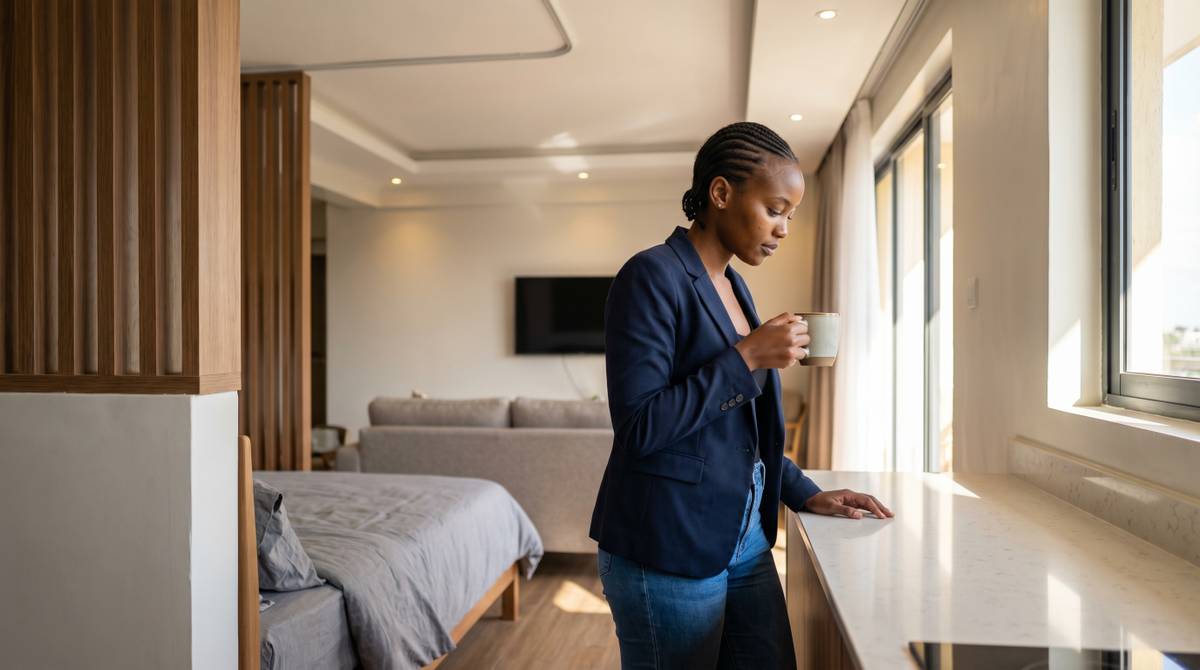
A bedsitter is a single open-plan room (typically 20–35 sqm) that combines your sleeping area, living space, and a small kitchen zone into one continuous space. It comes with a private ensuite bathroom — toilet, shower, and basin. There is no wall or partition separating the bed from the rest of the room. The kitchen is usually a built-in counter along one wall: a countertop, sink, a couple of cabinets, and a power socket for a cooker or kettle.
Bedsitters are the most common rental unit type in Nairobi's mid-to-budget market. They're the entry point for students, young professionals, and single earners. For a deeper breakdown, see our complete bedsitter guide.
Studio Apartment
A studio apartment in Kenya is an upgraded, more spacious version of the bedsitter — typically 25–45 sqm. It's still open-plan (no separate bedroom), but studios are distinguished by better finishes, a properly fitted kitchenette with wall cabinets and counter space, and sometimes a half-wall or partition that creates a visual separation between the sleeping and living zones.
Here's the problem: there is no legal or industry-standard definition that separates a "studio" from a "bedsitter" in Kenya. The Estate Agents Registration Board (EARB) doesn't regulate property naming conventions. This means any landlord can call a bedsitter a "studio" and charge premium rent for the label alone. In practice, many listings use "studio" to market a bedsitter with modern finishes — gypsum ceilings, tiled floors, premium paint, and better lighting.
One-Bedroom Apartment
A one-bedroom apartment has what neither the bedsitter nor the studio has: a separate, enclosed bedroom with its own door. The bedroom is physically walled off from the living room and kitchen. The kitchen is typically its own enclosed or semi-enclosed space as well. Total area ranges from 35–55 sqm in Nairobi.
This is the first unit type in Kenya's rental market where you get genuine privacy within your own home — you can close a door between your sleeping space and your living area. For couples, remote workers, and anyone who hosts visitors, this distinction matters daily.
Side-by-Side Comparison: Bedsitter vs Studio vs One-Bedroom
Feature | Bedsitter | Studio | One-Bedroom |
|---|---|---|---|
Typical Size | 20–35 sqm | 25–45 sqm | 35–55 sqm |
Bedroom | Same room as living area — no partition | Same room — may have half-wall divider | Separate enclosed room with door |
Kitchen | Built-in counter along wall (basic) | Fitted kitchenette with cabinets | Separate or semi-enclosed kitchen |
Bathroom | Private ensuite | Private ensuite | Private ensuite |
Living Room | Combined with bedroom | Combined with bedroom (more space) | Separate living/dining area |
Finishes | Basic — painted walls, simple tiles | Modern — gypsum, quality tiles, fixtures | Varies widely |
Privacy | Low — everything in one open space | Low-Medium — half-wall at best | High — closed bedroom door |
Rent Range (Nairobi 2026) | KES 5,000–30,000 | KES 15,000–65,000 | KES 15,000–200,000 |
Best For | Students, single earners on budget | Young professionals, singles wanting comfort | Couples, remote workers, families |
Key insight: The bedsitter-to-studio boundary is blurry and often exploited by landlords. The studio-to-one-bedroom boundary is clear and physical — if there's a door you can close between your bed and your living room, it's a one-bedroom. If there isn't, it's not.
Rent by Neighbourhood: What Each Unit Type Actually Costs in 2026
Nairobi rents vary dramatically by area. Here's what you can expect to pay for each unit type across the city's main rental zones, based on current listing data from early 2026.
Neighbourhood Zone | Bedsitter (KES/month) | Studio (KES/month) | One-Bedroom (KES/month) |
|---|---|---|---|
Budget (Eastleigh, Zimmerman, Githurai, Kahawa West) | 5,000–10,000 | 8,000–15,000 | 12,000–20,000 |
Mid-Range (South B/C, Ngong Road, Kasarani, Roysambu) | 8,000–18,000 | 15,000–25,000 | 18,000–35,000 |
15,000–30,000 | 22,000–45,000 | 30,000–80,000 | |
Premium (Kileleshwa, Lavington, Riverside) | 18,000–35,000 | 30,000–65,000 | 55,000–120,000 |
Satellite Towns (Ruiru, Ruaka, Syokimau, Rongai, Kitengela) | 5,000–12,000 | 10,000–18,000 | 15,000–30,000 |
Sources: BuyRentKenya, Kenya Property Centre, Jiji Kenya listings data, and Realtors.co.ke market report — all accessed April 2026.
Notice how the premium "studio" category overlaps heavily with the budget "one-bedroom" range. In areas like Kilimani, a furnished studio at KES 45,000 might sit next to a basic one-bedroom at KES 35,000. The studio has nicer finishes, but the one-bedroom gives you a separate room. The question is which you value more — aesthetics or structure.
How Landlords Use "Studio" to Charge More for Bedsitters
This is the section most Kenyan rental guides won't give you honestly. Here's how the studio-bedsitter label game works in practice:
The upgrade formula: A landlord builds or renovates a block of bedsitters. They add gypsum board ceilings, modern light fixtures, slightly better kitchen cabinets, and quality tiles. Then they list the units as "studios" — and charge 30–60% more than the bedsitter rate in the same area. The floor plan hasn't changed. The room size is the same. You're paying for finishes and a marketing label.
The half-wall trick: Some developers add a half-wall (waist-height or shoulder-height partition) to separate the sleeping zone from the living area. This is the closest thing Kenya has to a real bedsitter-to-studio distinction. But it's cosmetic — it doesn't create a separate room, and it doesn't add meaningful privacy or sound isolation.
How to protect yourself:
Ask for dimensions. If the unit is under 30 sqm with no partition, it's a bedsitter regardless of what the listing says. Don't pay studio prices for bedsitter space.
Visit in person. Photos can make a 22 sqm unit look spacious. Stand in the room. Can you fit a bed, a sofa, a dining table, and a wardrobe without them touching? If not, it's a bedsitter.
Compare within the building. Many buildings have both bedsitters and studios. Ask the caretaker to show you both so you can see the actual difference.
Check the kitchen. A real studio upgrade has a properly fitted kitchenette — full counter, wall cabinets, dedicated cooking zone. A bedsitter has a counter along the wall with a socket.
Working with a verified agent on Afriqahome can help you cut through misleading listings. Agents registered with EARB have a professional obligation to describe properties accurately.
Which One Should You Choose? A Decision Framework
The right unit type depends on three things: your budget, your lifestyle, and how long you plan to stay.
Choose a Bedsitter If:
You're a student or early-career professional earning under KES 50,000/month
You spend most of your day out — at work, university, or socialising — and mainly need a place to sleep
You're saving aggressively and want to keep housing costs under 20% of your income
You're in a satellite town (Ruiru, Rongai, Kitengela) where bedsitters represent the best value
You don't work from home and don't regularly host overnight guests
Choose a Studio If:
You're a working professional earning KES 60,000–120,000/month and want comfortable solo living
You value quality finishes — good lighting, clean lines, modern kitchen — and are willing to pay a premium for them
You want something between budget and proper apartment living
You're in an area like Kilimani or Westlands where well-finished studios offer genuine lifestyle value
You don't need a separate bedroom but want more space than a basic bedsitter
Choose a One-Bedroom If:
You're a couple, or you regularly have someone staying over
You work from home and need to separate your workspace from your sleeping area
You value privacy — you want to close a door and be in a different room
You're planning to stay for 12+ months and want a proper home setup, not a temporary space
You're a diaspora investor buying a rental unit — one-bedrooms have stronger rental yields and lower vacancy rates than bedsitters in most Nairobi neighbourhoods
Investment Angle: Which Unit Type Gives Better Returns?
For diaspora investors or Kenyans building rental portfolios, unit type selection directly affects yield, vacancy, and tenant quality.
Metric | Bedsitter | Studio | One-Bedroom |
|---|---|---|---|
Purchase Price (Nairobi avg.) | KES 2.5M–5M | KES 4M–8M | KES 5M–12M |
Monthly Rent (mid-range area) | KES 8,000–18,000 | KES 15,000–25,000 | KES 18,000–35,000 |
Gross Yield (estimate) | 2.5–4.5% | 3.0–5.0% | 4.0–6.5% |
Tenant Turnover | High — avg. 8–14 months | Medium — avg. 12–18 months | Low — avg. 18–36 months |
Vacancy Risk | Medium-High (oversupply in some areas) | Medium | Low (consistent demand) |
Airbnb Potential | Limited | Good in Kilimani/Westlands | Best (highest nightly rates) |
Yield estimates based on HassConsult, Cytonn, and KNBS 2023/2024 data, cross-referenced with 2026 listing prices.
The investor takeaway: Bedsitters are the cheapest entry point, but their yields are modest and tenant turnover is high. One-bedrooms offer stronger returns, longer tenancies, and better Airbnb potential — especially in upper-mid neighbourhoods. Studios occupy a middle ground that works best in areas with strong young-professional demand (Kilimani, Westlands, Kileleshwa). For a full breakdown of buying costs, see our stamp duty and closing costs guide.
What to Check Before Signing — Regardless of Unit Type
Whether you're renting a bedsitter, studio, or one-bedroom, these verification steps apply to every unit in Kenya:
Water supply: Ask whether the building has a borehole, water tank, or relies solely on county water. In many Nairobi estates, county water is unreliable. A building without a backup tank or borehole is a building where you'll regularly have no water.
Deposit terms: The standard in Kenya is two months' rent (one month rent + one month security deposit). Some landlords add a lease agreement fee of 2–20% of monthly rent. Get deposit terms in writing before paying anything.
Wi-Fi availability: If working from home matters to you, ask whether the building has fibre infrastructure. Installations like Safaricom Home Fibre or Zuku require fibre termination in the building — not all older buildings have it.
Security setup: Perimeter wall? CCTV? Security guard? Controlled gate access? These vary massively between buildings in the same neighbourhood.
Agent verification: If you're dealing with an agent, check they're registered with EARB. Unregistered operators are more likely to misrepresent unit types, charge illegal viewing fees, or disappear with deposits.
Use our property due diligence checklist to make sure you're not missing anything before you commit.
Frequently Asked Questions
What is the main difference between a bedsitter and a studio in Kenya?
Both are open-plan single-room units with a private bathroom. The practical difference is size and finishes: a studio is typically larger (25–45 sqm vs 20–35 sqm for a bedsitter), has a better-equipped kitchenette, and may include a half-wall partition. However, there's no official regulatory definition in Kenya — many landlords label bedsitters as studios to charge higher rent. Always ask for room dimensions and visit in person before committing.
How much does a studio apartment cost in Nairobi in 2026?
Studio rents in Nairobi range from KES 8,000 in budget areas (Zimmerman, Eastleigh) to KES 65,000 in premium neighbourhoods (Kilimani, Kileleshwa, Riverside). Mid-range areas like South B, Ngong Road, and Kasarani sit at KES 15,000–25,000. Furnished and serviced studios in Westlands can go even higher. Check current listings on Afriqahome for up-to-date pricing.
Is a one-bedroom apartment worth the extra cost over a studio?
If you work from home, live with a partner, or regularly host visitors, yes — the separate bedroom transforms daily life in ways a half-wall cannot. The rent premium over a studio is typically 30–50% more, but you gain genuine privacy, better resale/rental value, and lower tenant turnover if you're an investor. For solo professionals who spend most of their time outside, a studio may be sufficient.
Can a bedsitter be called a studio legally in Kenya?
Yes — there is no legal or regulatory framework in Kenya that defines or enforces the distinction between "bedsitter" and "studio." The Estate Agents Registration Board (EARB) does not regulate property naming. This means landlords and agents can label units however they choose, and many use "studio" as a marketing upgrade for bedsitters with modern finishes. Your best protection is to physically visit, measure the space, and compare prices within the same building.
Which unit type has the best rental yield for investors?
One-bedroom apartments typically deliver the strongest rental yields in Nairobi — estimated at 4.0–6.5% gross in mid-range areas. Bedsitters are the cheapest to buy but average just 2.5–4.5% yield with higher tenant turnover. Studios sit in between. For diaspora investors, one-bedrooms in upper-mid areas like Kilimani or Kileleshwa offer the best combination of yield, tenant stability, and Airbnb potential.
What should I check before renting any unit in Nairobi?
Water supply (borehole or tank backup), deposit terms in writing (standard is two months' rent), Wi-Fi/fibre infrastructure, security setup (CCTV, guard, gated access), and whether the agent is EARB-registered. Also confirm the actual room dimensions — don't rely on labels like "spacious studio" without seeing the unit. Use our due diligence checklist for the full verification process.
Explore Further
Now that you understand the difference between these unit types, here's where to go next:
What Is a Bedsitter? Kenya Rental Guide — Deep dive into bedsitter definitions, prices, and what to verify before renting.
First-Time Home Buyer Guide: Kenya — If you're ready to move from renting to owning.
Best Areas to Live in Nairobi — Compare neighbourhoods by price, lifestyle, and investment potential.
Browse Nairobi Apartments on Afriqahome — Verified listings from registered agents.
Find a Verified Agent — Connect with EARB-registered professionals who describe properties accurately.
Other Guides

Living in Juja, Kiambu: The University Town That Became a Satellite City — Prices, Estates & Honest Guide (2026)
Juja houses from KSh 1.2M, rent from KSh 2.5K. JKUAT area, Kenyatta Road estates, Kalimoni, Witeithie. Student yields 9-15%.

Westlands Property Guide: Prices, Lifestyle & Investment (2026)
Complete guide to Westlands real estate. Apartments from KES 8M, rental yields 6-8%, plus lifestyle amenities. Browse verified Westlands listings today.
Houses for Sale in Karen: Price Guide 2026
Karen house prices from KES 35M–250M+. 4-bedroom, 5-bedroom, villas. Karen Hardy, Ndege Road, budget breakdown. Updated March 2026.