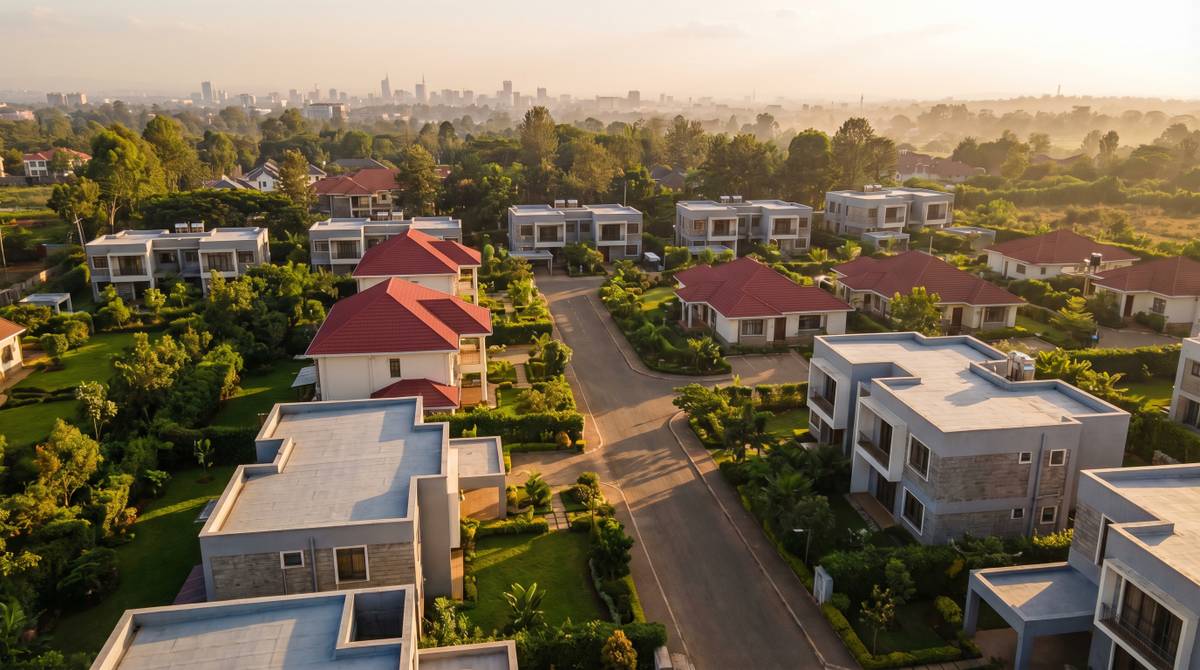
Every Type of House You'll Find in Kenya — and What Each One Actually Means
Bedsitter, studio, apartment, bungalow, maisonette, townhouse, villa — every Kenyan house type defined with 2026 prices, sizes, and who each suits best.
Every Type of House You'll Find in Kenya — and What Each One Actually Means
Search for property in Kenya and you'll see listings labelled "bungalow," "maisonette," "villa," "townhouse," "apartment," "penthouse," and half a dozen other terms — sometimes used interchangeably, sometimes meaning completely different things depending on who's selling. For diaspora investors who grew up with different housing vocabulary, or first-time buyers navigating Kenyan listings for the first time, this confusion isn't just annoying — it leads to mismatched expectations and bad purchasing decisions.
This guide defines every major type of house in Kenya as the terms are actually used in the local property market. Not the textbook version — the Nairobi version. For each type, you'll get the physical description, typical size, current 2026 price range, who it's designed for, and the honest pros and cons. By the end, you'll know exactly what you're looking at on any listing site.
The Master Comparison: All Kenyan House Types at a Glance
Before diving into each type, here's the full picture in one table. Prices reflect 2026 Nairobi and satellite town data.
House Type | Floors | Typical Size | Price Range (Buy) | Best For |
|---|---|---|---|---|
Bedsitter | 1 (unit) | 20–35 sqm | KES 2.5M–5M | Students, single earners |
Studio | 1 (unit) | 25–45 sqm | KES 4M–8M | Young professionals |
Apartment (1–3 BR) | 1 (unit in block) | 40–150 sqm | KES 5M–35M | Professionals, small families |
Penthouse | 1–2 (top floor) | 200–1,000+ sqm | KES 40M–150M+ | Ultra-high-net-worth, executives |
Bungalow | 1 | 80–250 sqm | KES 5M–30M | Families, retirees, first-time builders |
Maisonette | 2+ | 120–400 sqm | KES 8M–45M | Growing families, urban plots |
Townhouse | 2–3 | 150–350 sqm | KES 10M–95M | Families wanting community + security |
Villa | 1–2 | 200–600+ sqm | KES 30M–200M+ | Wealthy families, executives, diplomats |
Mansion | 2+ | 600–1,000+ sqm | KES 80M–500M+ | Ultra-wealthy, legacy properties |
Duplex | 2 (two units) | 70–150 sqm per unit | KES 8M–25M per unit | Investors, owner-occupier + rental |
Now let's go through each one in detail.
Bedsitter
A bedsitter is a single open-plan room that combines sleeping, living, and a basic kitchen area, with a private ensuite bathroom. No separate bedroom, no separate kitchen — everything is in one space. Typical size is 20–35 sqm. It's the entry-level rental unit in Kenya's housing market and the most common unit type in mid-to-budget apartment blocks across Nairobi.
Bedsitters are not standalone houses — they exist as units within larger apartment buildings. They're the most affordable self-contained option for renters, with monthly rent ranging from KES 5,000 in areas like Zimmerman and Githurai to KES 30,000 in Kilimani or Westlands.
For a full breakdown of bedsitters including investment yields and what to verify, see our complete bedsitter guide and our studio vs bedsitter comparison.
Studio Apartment
A studio is an upgraded bedsitter — typically 25–45 sqm, with better finishes, a fitted kitchenette, and sometimes a half-wall partition separating the sleeping zone. Still open-plan, still no separate bedroom. The key difference from a bedsitter is quality, not structure.
Important warning: there is no regulatory definition in Kenya that separates "studio" from "bedsitter." Many landlords relabel bedsitters with modern finishes as studios and charge 30–60% more. Always visit in person and ask for room dimensions before committing.
Rent ranges from KES 8,000 in budget areas to KES 65,000 in premium Nairobi neighbourhoods. Purchase price: KES 4M–8M.
Apartment (Flat)
An apartment (or "flat" — the terms are used interchangeably in Kenya) is a self-contained unit within a multi-storey residential building. Unlike bedsitters and studios, apartments have separate rooms: a dedicated bedroom (or multiple bedrooms), a living/dining area, a kitchen, and one or more bathrooms.
Apartments are Kenya's most common urban property type. They range from compact one-bedroom units (40–55 sqm) to spacious three-bedroom family apartments (120–150 sqm) and beyond. Most apartment buildings in Nairobi include shared amenities — parking, security, sometimes a gym or pool in premium developments.
Price Ranges (Nairobi 2026)
Bedrooms | Typical Size | Rent (KES/month) | Purchase (KES) |
|---|---|---|---|
1 BR | 40–70 sqm | 15,000–200,000 | 5M–15M |
2 BR | 70–110 sqm | 25,000–250,000 | 7M–25M |
3 BR | 100–150 sqm | 40,000–350,000 | 10M–35M |
Ranges reflect the full spectrum from budget areas like Embakasi and Pipeline to premium neighbourhoods like Kilimani and Westlands.
For diaspora investors, apartments — especially one and two-bedroom units in upper-mid areas — typically offer the strongest rental yields (4–7% gross) and most consistent tenant demand. Browse current options on Afriqahome's Nairobi listings.
Penthouse
A penthouse is the top-floor unit (or units) in a high-rise apartment building — typically occupying the entire floor or a significant portion of it. Penthouses are defined by their position (highest floor), their size (200–1,000+ sqm), and their premium features: expansive terraces, panoramic views, higher ceilings, private rooftop gardens, and sometimes a private elevator.
In Nairobi, penthouses are found in luxury developments in Westlands, Kilimani, Kileleshwa, and the emerging Upperhill corridor. Prices start around KES 40M for a three-bedroom penthouse and can exceed KES 150M for duplex penthouses in prime locations. Some developments in Westlands list penthouses at KES 69M and above for three-bedroom plus DSQ configurations.
This is a niche market — fewer than 20 penthouse listings appeared for sale across all Kenyan platforms in early 2026. Buyers are ultra-high-net-worth individuals, expatriates, and C-suite executives.
Bungalow
A bungalow is a single-storey standalone house where all rooms — bedrooms, living room, kitchen, bathrooms — are on one level. No stairs, no upper floor. Bungalows are the most traditional and widely understood house type in Kenya, popular in suburban areas, satellite towns, and rural settings.
Typical bungalows range from compact two-bedroom units (80 sqm) to spacious four-bedroom homes (200+ sqm). They sit on their own plot of land, which means you get a compound — space for parking, a garden, possibly a DSQ at the back.
Pros
Full accessibility — no stairs, making them ideal for elderly family members and young children
Lower construction cost per square metre compared to multi-storey homes (no reinforced slab needed)
Simpler to build, maintain, and expand horizontally
Preferred by first-time builders and families in satellite towns where land is more affordable
Cons
Requires more land than a maisonette with the same number of rooms — expensive in prime Nairobi areas
Less privacy separation between living areas and bedrooms (everything on one floor)
More vulnerable to security breaches — windows and roof are accessible from ground level
Price range (2026): KES 5M–15M in satellite towns (Kitengela, Ngong, Ruiru, Juja), KES 15M–30M+ in established Nairobi suburbs. Construction cost runs KES 30,000–55,000 per square metre depending on finishes. Popular areas for bungalows include Kitengela, Ngong, Rongai, Juja, Thika, and parts of Karen.
Maisonette
A maisonette is a multi-storey standalone house — typically two floors, sometimes three. The ground floor usually holds the living room, dining area, kitchen, and possibly a guest bedroom or study. The upper floor(s) contain the main bedrooms and family bathroom. An internal staircase connects the levels.
Maisonettes are one of Kenya's most popular house types for middle-class and upper-middle-class families. They're especially practical on smaller urban plots because they build upwards rather than outwards — you can fit a four-bedroom home on a 50×100 plot (an eighth of an acre) that would require a much larger plot as a bungalow.
Why Maisonettes Dominate the Kenyan Market
As urban land prices rise — especially in Nairobi, Kiambu County, and Kajiado — the maisonette has become the default choice for families who want a standalone home but can only afford an eighth-acre plot. The vertical design means more house on less land, with better privacy (bedrooms upstairs, entertaining downstairs) and often better security (upper floors are harder to breach).
Price range (2026): KES 8M–15M in fast-growing corridors like Ruiru, Juja, and Ngong. KES 15M–45M in established areas like Langata, Syokimau, and parts of Kileleshwa. Construction cost: KES 40,000–70,000 per square metre. For a full guide, see our maisonette explained article.
Townhouse
A townhouse (sometimes called a terrace house) is a multi-storey home that shares one or both side walls with neighbouring units — built in a row within a gated estate. Think of it as a maisonette, but in a community setting with shared amenities: security guards, perimeter walls, playgrounds, sometimes a clubhouse, gym, or pool.
Townhouses are designed for families who value community living, security, and shared infrastructure. They're especially popular among families with young children who want a safe, enclosed environment.
Price range (2026): KES 10M–25M in satellite towns (Ruiru, Athi River, Syokimau), KES 25M–95M in prime Nairobi estates (Lavington, Karen, Kileleshwa, Langata, Rosslyn). Monthly rent: KES 60,000–320,000 depending on area and size.
Villa
A villa in the Kenyan context is a large, high-end standalone home on a generous plot — typically a quarter-acre or more. Villas are distinguished from bungalows and maisonettes by their size (200–600+ sqm), their finishes (premium throughout), and their location (leafy, low-density suburbs).
Villas usually include features like spacious master suites, multiple living rooms, a fitted kitchen with pantry, staff quarters (DSQ), landscaped gardens, and parking for multiple vehicles. Many villas are in gated compounds with shared amenities.
In Nairobi, villas are concentrated in Karen, Lavington, Runda, Muthaiga, Kitisuru, and Nyari. Prices range from KES 30M in the outer suburbs to over KES 200M for prime addresses. Rental rates for four and five-bedroom villas in Karen and Runda typically fall between KES 200,000–500,000 per month.
Mansion
A mansion is Kenya's highest tier of residential property — think six or more bedrooms, expansive reception rooms, a gourmet kitchen, library, staff apartments, and grounds that may include a pool, tennis court, and manicured gardens. Floor area exceeds 600 sqm, and many mansions sit on half-acre to multi-acre plots.
Mansions are found in Nairobi's most exclusive enclaves: Runda, Muthaiga, Gigiri (the "diplomatic zone"), Karen, and Nyari. Prices start at KES 80M and can exceed KES 500M for trophy properties. These are legacy assets — bought for generational wealth, family legacy, or diplomatic use rather than rental yield.
Duplex, Triplex, and Fourplex
A duplex is a building that contains two separate residential units, typically side by side or stacked vertically, sharing a single wall or floor. Each unit has its own entrance, kitchen, bathrooms, and bedrooms. A triplex has three units; a fourplex has four.
In Kenya, duplexes serve two primary purposes. First, as an owner-occupier plus rental investment — you live in one unit and rent out the other. Second, as a pure rental investment on a single plot, generating multiple income streams from one piece of land.
Duplexes are increasingly popular in satellite towns like Ruiru, Juja, and Kitengela, where plot prices allow for multi-unit construction on a 50×100 plot. Expect to pay KES 8M–25M per unit depending on location, size, and finishes.
How to Choose: A Decision Framework by Buyer Type
If You Are… | Consider | Why |
|---|---|---|
First-time renter on a budget | Bedsitter or studio | Affordable, self-contained, no commitment |
Young professional upgrading | 1-BR apartment or studio | Separate rooms, better investment value |
Couple or small family renting | 2-BR apartment or townhouse | Space, community, amenities |
Family building first home | Bungalow (satellite town) | Lower cost, no stairs, expandable |
Family on urban plot | Maisonette | Maximises space on small plot |
Family wanting gated community | Townhouse | Security, amenities, community |
Diaspora investor (rental income) | 1–2 BR apartment in upper-mid area | Best yield + liquidity + tenant demand |
Diaspora investor (family home) | Maisonette or villa in satellite town | Space, land ownership, appreciation |
High-net-worth buyer | Villa or penthouse | Premium lifestyle, long-term value |
Whatever type you choose, work with an EARB-registered agent to ensure the property is described accurately, the title is clean, and all due diligence is done before you commit. Use our due diligence checklist to verify everything.
Frequently Asked Questions
What is the most common type of house in Kenya?
Apartments are the most common property type in Kenya's urban areas, particularly Nairobi. For standalone homes, bungalows and maisonettes dominate — bungalows are more common in satellite towns and rural areas where land is affordable, while maisonettes are the preferred choice on smaller urban plots where vertical building is more practical.
What is the difference between a maisonette and a townhouse in Kenya?
A maisonette is a standalone multi-storey house on its own plot. A townhouse is also multi-storey, but it shares side walls with neighbouring units and exists within a gated estate with shared amenities (security, landscaping, sometimes a pool or clubhouse). Townhouses offer a community environment; maisonettes offer more independence and typically a larger private compound.
Which type of house is cheapest to build in Kenya?
Bungalows are the cheapest to build per square metre because they don't require the reinforced concrete slab, columns, and formwork needed for upper floors. Construction cost for a basic bungalow runs KES 30,000–45,000 per sqm, compared to KES 40,000–70,000 per sqm for a maisonette. However, bungalows require more land, which can offset the construction savings in expensive areas.
What is a villa in Kenya compared to a bungalow?
Both can be single-storey standalone homes, but a villa is significantly larger (200–600+ sqm vs 80–250 sqm for a bungalow), sits on a bigger plot (quarter-acre minimum vs eighth-acre for bungalows), has premium finishes throughout, and is located in upmarket suburbs like Karen, Runda, or Lavington. A bungalow is the practical family home; a villa is the luxury version.
Which house type gives the best return on investment in Kenya?
For rental yield, apartments in upper-mid Nairobi areas (Kilimani, Westlands, Kileleshwa) typically deliver 4–7% gross annual returns. Bedsitter blocks in satellite towns can reach 10–12% ROI for self-built projects, but with higher management burden and tenant turnover. Maisonettes and villas offer lower yields (3–5%) but stronger long-term capital appreciation. Your best choice depends on whether you prioritise cash flow or asset growth.
Can a diaspora Kenyan buy any type of house in Kenya?
Yes — Kenyan citizens (including dual citizens) can buy any property type on freehold or leasehold terms. Non-citizens can hold leasehold titles for up to 99 years but cannot own freehold land. For the complete process, see our USA diaspora buying guide, UK guide, or UAE guide. Always work with a verified agent and an independent lawyer.
Explore Further
Studio vs Bedsitter vs One-Bedroom: What's the Real Difference? — Detailed comparison of rental unit types.
What Is a Maisonette in Kenya? — Deep dive into Kenya's most popular standalone house type.
Best Areas to Live in Nairobi — Compare neighbourhoods by property type, price, and lifestyle.
First-Time Home Buyer Guide: Kenya — The complete process from saving to key handover.
Stamp Duty & Closing Costs 2026 — Every fee you'll pay when purchasing property.
Browse Nairobi Apartments — Verified listings from registered agents on Afriqahome.
Browse Nairobi Houses — Bungalows, maisonettes, townhouses, and villas.
Find a Verified Agent — Connect with EARB-registered professionals.
Other Guides

Living in Juja, Kiambu: The University Town That Became a Satellite City — Prices, Estates & Honest Guide (2026)
Juja houses from KSh 1.2M, rent from KSh 2.5K. JKUAT area, Kenyatta Road estates, Kalimoni, Witeithie. Student yields 9-15%.

Westlands Property Guide: Prices, Lifestyle & Investment (2026)
Complete guide to Westlands real estate. Apartments from KES 8M, rental yields 6-8%, plus lifestyle amenities. Browse verified Westlands listings today.
Houses for Sale in Karen: Price Guide 2026
Karen house prices from KES 35M–250M+. 4-bedroom, 5-bedroom, villas. Karen Hardy, Ndege Road, budget breakdown. Updated March 2026.