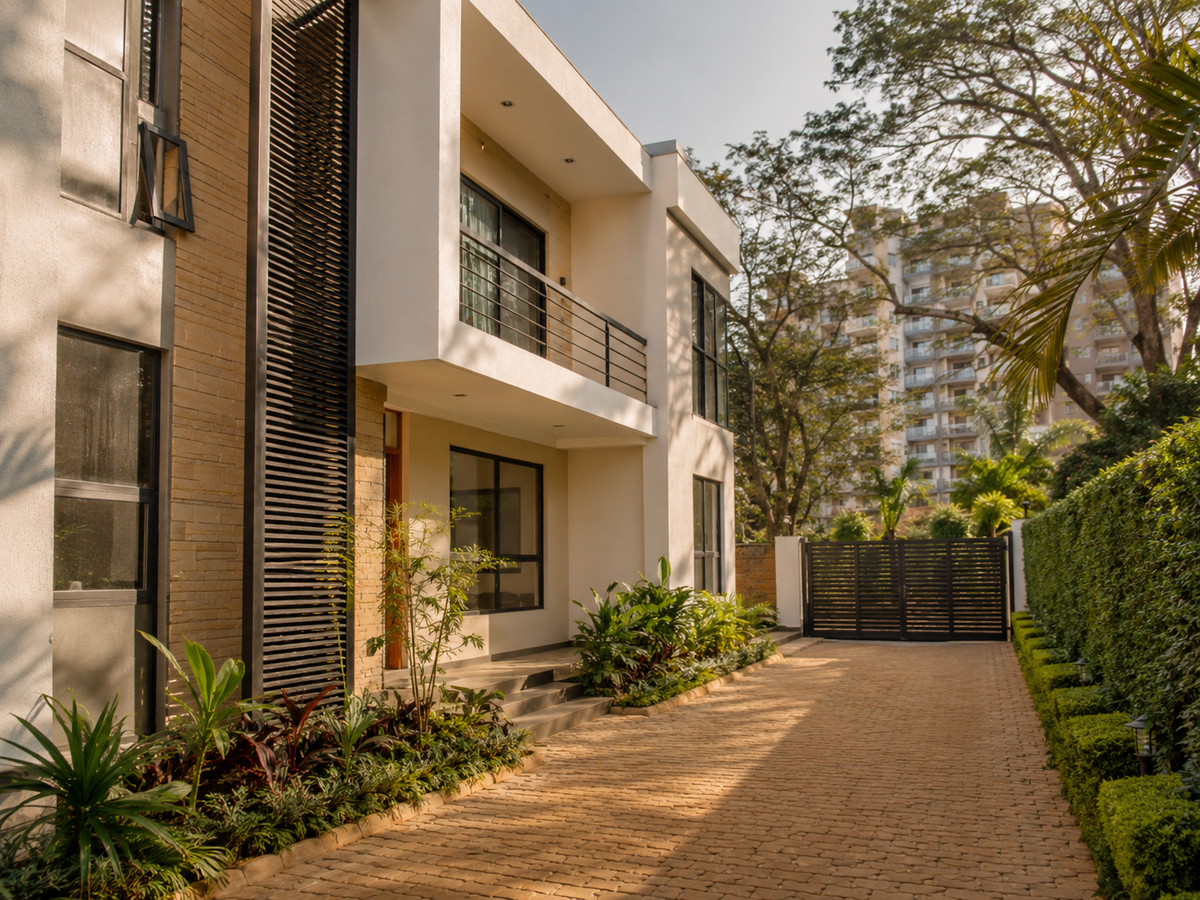
Houses for Sale in Kilimani: Prices, Types & 2026 Buyer Guide
Houses for sale in Kilimani: why most listings are apartments, true house prices from KES 18M, best streets, and an honest Kileleshwa comparison.
Searching for houses for sale in Kilimani reveals something most listing portals won't tell you upfront: Kilimani is overwhelmingly an apartment market, and genuine standalone houses are scarce. Of the hundreds of results tagged "house" on the major portals, the large majority are apartments, duplexes, or townhouses rather than detached family homes. Understanding that distinction is the single most useful thing a buyer can do before spending money here. This guide breaks down what actually trades, current price ranges in KES, the streets to focus on, and how Kilimani compares to neighbours like Kileleshwa and Lavington for house buyers.
The context matters. According to HassConsult's Q1 2026 Property Index, Kilimani houses posted quarterly price growth of 3.9% — the third-strongest in Nairobi after Lavington (4.2%) and Spring Valley (4.0%) — while apartment prices in several oversupplied suburbs corrected downward. The house segment is being supported by genuine undersupply, which is exactly why house prices here behave very differently from the apartment headlines.
What Houses for Sale in Kilimani Cost in 2026
Pricing depends heavily on what you actually mean by "house." A 5-bedroom duplex apartment marketed as a house sells in a very different bracket from a true detached home on its own plot. The table below separates the realistic ranges based on current listing data from BuyRentKenya, Kenya Property Centre, and PropertyPro (April 2026).
Property type | Typical size | Price range (KES) | Notes |
|---|---|---|---|
2-bed townhouse / maisonette | 120–150 m² | 13M–20M | Limited stock |
3-bed townhouse / duplex | 150–220 m² | 18M–35M | Most common "house" listing |
4-bed townhouse / maisonette | 220–300 m² | 35M–55M | Often in small gated courts |
5–6 bed duplex / standalone | 300 m²+ | 50M–99.5M | Rare; older homes or penthouses |
True detached standalone | Plot-dependent | 45M upward | Very scarce; mostly older builds |
For perspective, Kenya Property Centre lists the average house price in Kilimani at around KES 35M, with detached and semi-detached homes spanning KES 34M to KES 99.5M. BuyRentKenya quotes a wider range of KES 6.9M to KES 55M with an average size near 155 m² — the lower end of that range almost always refers to apartment-style units rather than standalone houses. The gap between those two datasets is the "house vs apartment" labelling problem in numbers.
The Honest Reality: Houses Are Rare in Kilimani
This deserves its own section because it catches buyers out repeatedly. HassConsult's structural data shows detached houses now make up just 8.5% of Nairobi's overall property market, with semi-detached units at 20.4% and apartments at 71.1%. A decade ago detached homes were 32.7% of the market. In Kilimani specifically, developers spent years buying older bungalows and replacing them with apartment towers, so the supply of genuine standalone houses has shrunk dramatically.
What this means in practice: if you want a detached home with a private garden in Nairobi, Kilimani is one of the harder places to find it, and the few available are usually older properties on compact plots priced from KES 45M upward. Many buyers who start their search in Kilimani end up in Kileleshwa or Lavington, where lower-density housing stock is more plentiful at comparable budgets.
Verify what you're actually buying. A "house" listed in Kilimani may be a leasehold apartment, a unit in a sectional-title development, or a duplex sharing walls. The legal tenure (freehold vs leasehold), the title type, and whether you own the land or a share of it materially affect value and resale. Always confirm the title before committing.
House Types You'll Actually Find
Knowing the categories helps you filter listings faster and read prices correctly.
Type | What it is | Best for |
|---|---|---|
Townhouse / maisonette | Multi-storey unit in a gated court, own entrance, small yard | Families wanting house-feel with security |
Duplex apartment | Two-floor unit inside an apartment block, often top floors | Buyers wanting space without standalone upkeep |
Older standalone | Detached 1990s–2000s home on its own plot | Buyers prioritising land and privacy |
Penthouse | Premium top-floor apartment, sometimes marketed as a "house" | Lifestyle and views over land |
If you're open to apartments — which dominate the area — our companion guide on Kilimani apartments covers that segment in detail, and the broader living in Kilimani guide sets out neighbourhood character, schools, and amenities.
Best Streets and Micro-Areas for Houses
House-style stock clusters in the quieter, lower-density pockets of Kilimani rather than the dense apartment corridors. Focus your search here:
Street / area | Character |
|---|---|
Kindaruma Road | Mix of newer developments and gated townhouse courts |
Dennis Pritt Road | Established, leafy; some older standalone homes remain |
Suna Road / Menelik Road | Quieter residential feel, townhouse pockets |
Ole Dume Road | Central, walkable to Yaya; mostly converted to apartments |
Galana Road | Premium addresses, newer high-end developments |
Proximity to Ngong Road and Argwings Kodhek Road is the main commercial axis that drives value differences. Two similar homes can be priced several million KES apart based on the road they sit on, backup power and water, parking allocation, and the quality of the gated court's management.
Kilimani House Prices 2026: What's Driving the Market
The headline of 2026 is a genuinely two-speed market. HassConsult's Q1 2026 data shows overall suburban sale prices rose 1.1% in the quarter, driven almost entirely by demand for standalone and semi-detached houses, while apartment prices fell in 10 of 18 surveyed suburbs. Westlands and Upper Hill apartment prices dropped 7.9% and 6.8% respectively over the year; Lavington apartments fell 6.4%.
Houses moved the opposite way. Kilimani house sales grew 9.3% annually (Sarabi Realty / HassConsult data), and on a quarterly basis Kilimani houses appreciated 3.9% in Q1 2026. The driver is structural undersupply: very few new houses are being built in established suburbs because developers make more money building apartments on the same land. That scarcity supports house prices even when the wider market is cautious.
The trade-off: Kilimani's strong house-price growth comes precisely because houses are rare here. That scarcity supports resale value, but it also means you'll pay a premium and have fewer options. Buyers chasing maximum appreciation should weigh this against lower-density suburbs where house stock — and competition among sellers — is greater.
Pros and Cons of Buying a House in Kilimani
Pros | Cons |
|---|---|
Central location — 10–15 min to the CBD and Upper Hill | Genuine standalone houses are scarce and expensive |
Walkable amenities: Yaya Centre, Prestige Plaza, restaurants | High traffic and noise on main roads like Ngong Road |
Strong house-price growth (+3.9% Q1 2026, +9.3% YoY) | Apartment oversupply nearby can pressure resale perceptions |
Established infrastructure, schools, and hospitals | Most "house" listings are actually apartments or duplexes |
Good security and gated-court options | Smaller plots than Karen, Runda, or parts of Lavington |
High rental demand from professionals and expatriates | Construction activity and density continue to rise |
Kilimani vs Kileleshwa vs Lavington for House Buyers
If a house specifically is your goal, it's worth comparing the three closest alternatives. All three sit on the same western corridor, but their housing stock differs.
Factor | Kilimani | Kileleshwa | Lavington |
|---|---|---|---|
House availability | Scarce | Moderate | Good |
Typical house price | KES 18M–99M | KES 20M–80M | KES 20M–250M+ |
Plot sizes | Compact | Compact–medium | Medium–large |
Q1 2026 house growth | +3.9% | Stable | +4.2% (strongest) |
Density | High | Medium–high | Medium |
Best for | Central, walkable lifestyle | Mid-budget house seekers | Family homes, larger plots |
For wider context on which Nairobi suburbs suit which buyer, see our pillar guide on the best areas to live in Nairobi and the neighbourhood rental yield breakdown.
Investment Outlook and Rental Yields
Kilimani consistently delivers some of Nairobi's stronger rental yields, supported by sustained demand from professionals, expatriates, and young families. HassConsult recorded overall suburban rental yields at 7.4% — the highest level since 2007 — and Kilimani sits comfortably within that band. House-style properties typically yield slightly lower gross returns than apartments because of their higher capital cost, but they tend to hold capital value better in a soft market.
The honest investment read for 2026: houses in Kilimani offer scarcity-driven capital protection and steady rental demand, but the entry price is high and the standalone-house options are limited. If yield is your priority, apartments or satellite-town houses may serve better; if you want a central, appreciating, hard-to-replace asset and can afford the premium, a Kilimani townhouse or duplex is defensible. For the full national picture, read our Kenya real estate 2026 market report.
For Diaspora Investors
Kilimani is popular with diaspora buyers because the central location and rental demand make it relatively easy to let when you're abroad. At a reference rate of roughly KES 129 to the US dollar (CBK, 2026), a typical 3-bed townhouse at KES 25M is about USD 194,000, and a 4-bed at KES 45M is around USD 349,000 — figures that compare favourably with major-city housing in the US, UK, or UAE.
The risks are the same ones every remote buyer faces: paying for the wrong tenure, dealing with an unverified agent, or buying a unit mislabelled as a house. Engaging a verified agent and an independent advocate to confirm the title and contract is the most important safeguard. Our diaspora buying guide and the diaspora hub walk through power of attorney, safe transfers, and remote due diligence step by step.
How to Buy Safely in Kilimani
Because so many Kilimani listings are mislabelled and the market is busy, due diligence matters more than usual. Three steps reduce — though never fully eliminate — your risk:
Step | What to do | Why |
|---|---|---|
1. Verify the title | Run an official search on Ardhisasa / at the registry | Confirms ownership and flags charges or disputes |
2. Check tenure and type | Confirm freehold vs leasehold, standalone vs sectional title | Determines what you actually own and its resale value |
3. Use a verified agent + advocate | Work with vetted professionals, not cold-contact sellers | Reduces fraud and contract risk |
Walk through the full process with our property due diligence checklist and learn the official process in the title deed verification guide. Budget for closing costs too — use the stamp duty calculator and read the closing costs breakdown, since stamp duty alone is 4% of value in urban areas like Kilimani.
Verification reduces risk but does not eliminate it entirely. No badge, search, or checklist removes all uncertainty from a property purchase — the goal is to make fraud far harder and surprises far rarer by doing each step properly.
Frequently Asked Questions
Are there standalone houses for sale in Kilimani?
Yes, but they are scarce. Detached houses make up only about 8.5% of Nairobi's overall property market (HassConsult), and Kilimani in particular has been heavily redeveloped into apartments. The genuine standalone homes that remain are usually older properties on compact plots priced from around KES 45M upward. Buyers seeking detached homes often find more options in Kileleshwa, Lavington, or Karen.
What is the average price of a house in Kilimani?
Kenya Property Centre lists the average house price in Kilimani at around KES 35M, with detached and semi-detached homes ranging from about KES 34M to KES 99.5M (April 2026). BuyRentKenya quotes a wider KES 6.9M–55M range, but the lower figures typically refer to apartment-style units rather than true houses. Expect KES 18M–35M for most 3-bed townhouses and duplexes.
Why are many "houses" in Kilimani actually apartments?
Listing portals often tag duplexes, maisonettes, townhouses, and penthouses as "houses" because they offer house-like space. True detached homes are rare in Kilimani, so most house-tagged results are sectional-title units inside or attached to apartment developments. Always confirm the property type and land tenure before assuming you're buying a standalone house.
Are Kilimani house prices rising or falling in 2026?
Rising. HassConsult's Q1 2026 index recorded Kilimani house prices up 3.9% for the quarter — the third-strongest in Nairobi — and house sales grew 9.3% over the year. This contrasts with apartment prices, which fell in several oversupplied suburbs. House prices are supported by structural undersupply, since few new houses are being built in established suburbs.
Is Kilimani a good place to buy a house as an investment?
It can be. Kilimani offers scarcity-driven capital protection, a central location, and strong rental demand, with suburban yields around 7.4% (HassConsult, the highest since 2007). The trade-offs are a high entry price and limited standalone-house options. If pure yield is the goal, apartments or satellite-town houses may perform better; if you want a central, hard-to-replace, appreciating asset, a Kilimani townhouse or duplex is a defensible choice.
How do I avoid being scammed when buying a house in Kilimani?
Run an official title search on Ardhisasa or at the land registry, confirm the tenure and property type in writing, and work with a verified agent plus an independent advocate rather than responding to cold-contact sellers. These steps reduce fraud and contract risk substantially, though no process eliminates risk completely. Afriqahome lists properties from verified agents to make this safer.
Explore Further
Ready to browse? See current houses for sale in Nairobi and apartments for sale, or connect with a verified agent who knows the Kilimani market. For more area context, read the complete Kilimani living guide, compare with Lavington and Westlands, and review the 2026 market report before you decide.
Data sources: HassConsult Q1 2026 Property Index; Kenya Property Centre, BuyRentKenya, and PropertyPro listing data (April 2026); Sarabi Realty 2025. Prices are indicative ranges and change with the market — verify current figures before committing.
Other Guides

Living in Juja, Kiambu: The University Town That Became a Satellite City — Prices, Estates & Honest Guide (2026)
Juja houses from KSh 1.2M, rent from KSh 2.5K. JKUAT area, Kenyatta Road estates, Kalimoni, Witeithie. Student yields 9-15%.

Westlands Property Guide: Prices, Lifestyle & Investment (2026)
Complete guide to Westlands real estate. Apartments from KES 8M, rental yields 6-8%, plus lifestyle amenities. Browse verified Westlands listings today.
Houses for Sale in Karen: Price Guide 2026
Karen house prices from KES 35M–250M+. 4-bedroom, 5-bedroom, villas. Karen Hardy, Ndege Road, budget breakdown. Updated March 2026.